
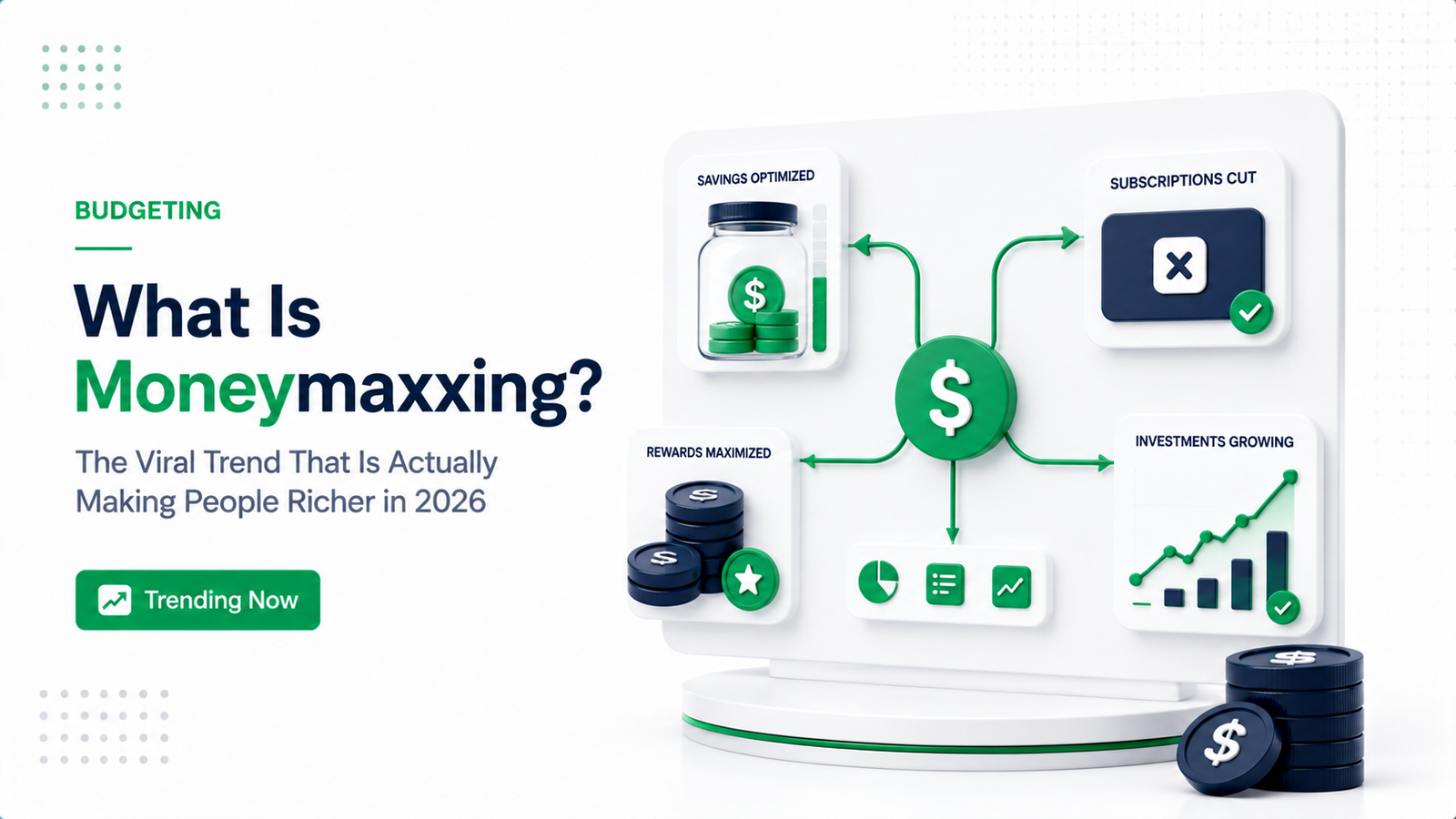
- Moneymaxxing means optimizing every dollar you earn, spend, save, and invest — with zero waste
- The term went viral in 2026 but the strategy is not new — it is a gamified version of smart financial habits
- Over 72% of Gen Z and 50% of millennials still rely on parents financially — moneymaxxing directly addresses why
- Unlike extreme frugality or hustle culture, moneymaxxing is about efficiency, not suffering
- 7 practical moneymaxxing moves you can start today — most take under 30 minutes to set up
If you have spent any time on social media lately, you have probably seen the word “maxxing” attached to everything. Looksmaxxing. Sleepmaxxing. Even breadmaxxing.
The internet has turned optimization into a lifestyle — and in 2026, that obsession has finally arrived in personal finance.
Moneymaxxing is the fastest-growing financial trend right now. CNBC called it a “cultural shift” just this week. Northwestern Mutual, the CFP Board, and financial advisors across the country are all weighing in on it.
But here is what nobody is saying clearly: moneymaxxing is not a new idea. It is a new name for something people who build wealth have always done — making sure every dollar works as hard as possible.
In this guide, you will learn exactly what moneymaxxing is, why it is resonating so strongly in 2026, where it goes wrong, and 7 specific moves to start doing it today.
What Is Moneymaxxing Exactly?
Moneymaxxing is the practice of systematically optimizing every part of your financial life — spending less on what does not matter, earning more on what you already have, and removing every dollar of waste from your budget.
The term comes from the broader “maxxing” trend on social media, where the suffix gets attached to anything people want to optimize. Looksmaxxing is about maximizing your appearance. Sleepmaxxing is about maximizing your rest. Moneymaxxing is about maximizing the return on every dollar you touch.
In practice, moneymaxxing looks like this:
- Canceling subscriptions you forgot about and redirecting that money to savings
- Switching to a budgeting system that actually tracks where your money goes
- Redeeming credit card rewards and cashback you have been ignoring
- Automating savings so money moves before you can spend it
- Investing consistently in low-cost index funds instead of letting cash sit idle
- Negotiating bills, subscriptions, and services for better rates
None of these ideas are revolutionary. But packaged together as a mindset — where every financial decision is viewed through the lens of “is this dollar working as hard as it could?” — the cumulative effect is significant.
The CFP Board describes it as a modern, gamified approach to financial habits. The game framing is deliberate: moneymaxxing turns money management from a chore into a challenge with visible scores and wins.
Why Moneymaxxing Is Exploding Right Now
Moneymaxxing is not going viral by accident. It is a direct response to a specific economic reality that millions of young people are living through in 2026.
The numbers are striking. According to Northwestern Mutual’s 2026 Planning and Progress Study, over half of millennials and 72% of Gen Z still rely on their parents for financial support. On average, young adults in 2026 do not expect to achieve full financial independence until age 37.
At the same time, inflation has pushed prices 25 to 30% higher than pre-pandemic levels. Rent is consuming larger portions of take-home pay than at any point in recent history. And the traditional path — get a job, save a little, retire eventually — feels increasingly disconnected from reality for people entering or early in their careers.
Moneymaxxing resonates because it offers something concrete: instead of waiting for circumstances to improve, it focuses entirely on what you can control right now. You cannot control rent prices. You cannot control your employer’s raise cycle. But you can control whether your cash is sitting in a zero-interest account, whether you are paying for three streaming services you barely use, and whether the money you do save is actually invested.
The “maxxing” framing also matters psychologically. Turning financial optimization into a game with clear moves and measurable progress makes it engaging in a way that traditional personal finance advice rarely is. People are sharing their moneymaxxing wins on TikTok, Reddit, and Instagram the same way they share workout progress — and that social reinforcement is powerful.
External resource: Moneymaxxing is a cultural shift, not just a trend — CNBC
How Moneymaxxing Is Different from FIRE and Hustle Culture
Two comparisons come up constantly in conversations about moneymaxxing — and both miss the point in important ways.
Moneymaxxing vs FIRE
The FIRE movement (Financial Independence, Retire Early) requires extreme savings rates of 50 to 70% of income and often involves drastic lifestyle cuts. It is effective for a specific type of highly disciplined, high-earning person willing to sacrifice significantly in the short term.
Moneymaxxing is different. It does not ask you to retire early, save 60% of your income, or eat rice and beans for a decade. It asks a simpler question: given what you are already spending, are you getting maximum value from it? The goal is efficiency, not deprivation.
Moneymaxxing vs Hustle Culture
Hustle culture tells you to work more — more side jobs, more hours, more income at any cost. Moneymaxxing explicitly rejects this. A behavioral finance expert from Ally Bank put it clearly: moneymaxxing is about creating everyday habits for long-term success, not jumping from one money trend to the next in search of a quick fix.
The contrarian point most articles miss: moneymaxxing at its best is actually anti-hustle. It is about making your existing money work harder so you need to hustle less — not grinding yourself into the ground to earn more while spending just as wastefully.
Where it goes wrong is when the optimization mindset becomes an obsession — working excessive hours, treating every social situation as a financial optimization problem, or sacrificing relationships for marginal financial gains. That version is hustle culture with a new label. The healthy version is purely about eliminating waste and improving efficiency with what you already have.
Understand the foundation first: How to Save Your First $10,000 — Step-by-Step Plan
7 Moneymaxxing Moves to Start Today
These are the highest-impact moves — ranked by how much financial difference they make relative to the time they take to set up.
Move 1 — Audit every subscription you pay for (30 minutes, one time)
Go through your last two bank statements line by line. Write down every recurring charge. The average person finds 3 to 5 subscriptions they forgot about or no longer use. Canceling just $40 per month in unused subscriptions adds $480 per year back to your budget — money that was producing zero value.
Move 2 — Automate your savings on payday (15 minutes, one time)
Set up an automatic transfer from your checking account to a savings account on the same day you receive your paycheck. Even $100 per paycheck is $2,600 per year saved with zero ongoing effort. Automation removes willpower from the equation entirely — the most effective moneymaxxing move there is.
Build the habit properly: How to Build an Emergency Fund Fast
Move 3 — Track your actual spending for one month
Most people have no accurate idea what they spend per month. The actual number is almost always higher than the estimate — and the gap lives in small daily purchases that feel insignificant individually. Tracking for one month reveals exactly where the waste is, so you can cut with precision rather than guessing.
Move 4 — Redeem every reward point and cashback you have earned
The average American has unredeemed credit card rewards worth $175 or more sitting in accounts they never check. Log into every card, loyalty program, and cashback app you use and redeem what you have earned. This is money you already earned — collecting dust.
Move 5 — Negotiate at least one bill this month
Call your phone provider, internet service, or insurance company and ask for a better rate. The script is simple: “I have been a customer for X years and I would like to discuss whether there is a better rate available.” Most providers have unadvertised loyalty discounts. The average successful negotiation saves $15 to $40 per month per service — $180 to $480 per year for a single 20-minute call.
Move 6 — Stop letting uninvested cash lose value
Cash sitting in a standard checking account earns essentially nothing while inflation erodes its purchasing power by 3.5% per year. Money you do not need for 3 or more years should be invested in low-cost index funds. Money you need within 1 to 2 years should be in a high-yield savings account earning 4 to 5% annually. Every dollar in the wrong place is leaving money on the table.
Start here: Best Investment Apps for Beginners with $100
Move 7 — Do a monthly money review (15 minutes per month)
Once a month, spend 15 minutes reviewing three numbers: what came in, what went out, and what you saved. That is it. Moneymaxxers who track these numbers consistently make better decisions because they can see exactly what is working and what is not. Progress compounds when you measure it.
Where Moneymaxxing Goes Wrong
Like any trend, moneymaxxing has a version that helps and a version that hurts.
The helpful version is what this article describes: identifying financial waste, automating good habits, and making sure every dollar is deployed effectively. It is sustainable, low-stress, and builds genuine long-term wealth.
The harmful version looks like this:
- Optimization obsession — spending hours researching whether to spend $2 more or less on a product, to the point where the time cost exceeds the financial benefit
- Social damage — refusing to split a dinner bill fairly, treating every social interaction as a financial transaction, or alienating friends and family in the name of efficiency
- Risky shortcuts — social media versions of moneymaxxing often include early-stage IPO investments, short-term rental arbitrage schemes, and crypto speculation dressed up as optimization. These are not moneymaxxing — they are speculation with extra steps.
- Burnout — when every dollar becomes a source of anxiety rather than a tool, the psychological cost erases the financial benefit
The test for healthy moneymaxxing is simple: does this optimization take less than an hour to set up and then run automatically? If yes, it is probably worth doing. If it requires constant active management, daily stress, or sacrificing things that genuinely matter to you — it has crossed from moneymaxxing into something else.
External resource: What is moneymaxxing — Northwestern Mutual
Frequently Asked Questions
Is moneymaxxing just another name for budgeting?
Budgeting is one component of moneymaxxing, but moneymaxxing is broader. Budgeting tracks and controls spending. Moneymaxxing goes further — it asks whether every dollar you spend, save, and invest is being deployed at its maximum potential. A moneymaxxer does not just budget. They also negotiate bills, automate savings, redeem rewards, invest idle cash, and continuously look for financial inefficiencies to eliminate.
Can you moneymaxx on a low income?
Yes — and in some ways it matters more on a lower income because there is less margin for waste. The core moves (canceling unused subscriptions, automating small savings, redeeming rewards, tracking spending) cost nothing and apply regardless of income level. The compounding effect of eliminating $100 per month in waste is proportionally larger when $100 represents a bigger share of your budget.
How is moneymaxxing different from being cheap?
Being cheap means avoiding spending to the point of negative impact — on relationships, experiences, or quality of life. Moneymaxxing is about eliminating waste, not eliminating enjoyment. A moneymaxxer will cancel a streaming service they never watch but will happily pay for the one they use daily. The goal is maximum value from every dollar spent, not minimum spending at any cost.
Final Thoughts
Moneymaxxing went viral because it gave a catchy name to something that has always been true: people who build wealth do not do it by earning dramatically more than everyone else. They do it by wasting dramatically less.
The moves are not complicated. Cancel what you do not use. Automate what you want to save. Invest what you do not need short-term. Negotiate what you are overpaying for. Review your numbers once a month.
None of that requires a finance degree, a high income, or extreme sacrifice. It requires a decision — to stop letting your money sit idle, get wasted on forgotten subscriptions, or lose value in accounts that earn nothing.
That decision is available to anyone. That is exactly why moneymaxxing is more than a trend.