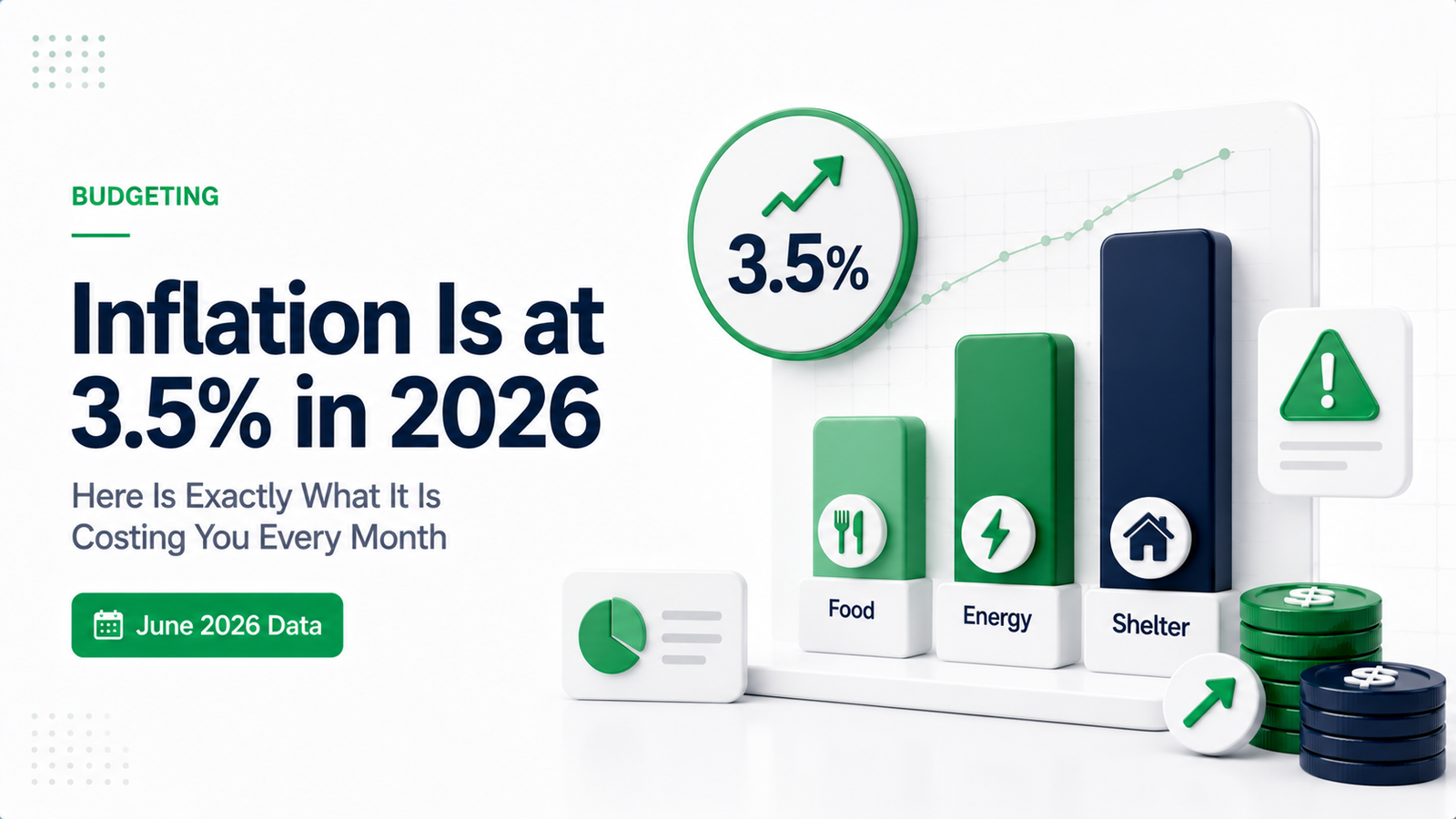
- The June 2026 CPI report shows inflation at 3.5% over the past 12 months — published July 14, 2026
- On a $4,000/month budget, 3.5% inflation costs you an extra $140 every single month — $1,680 per year
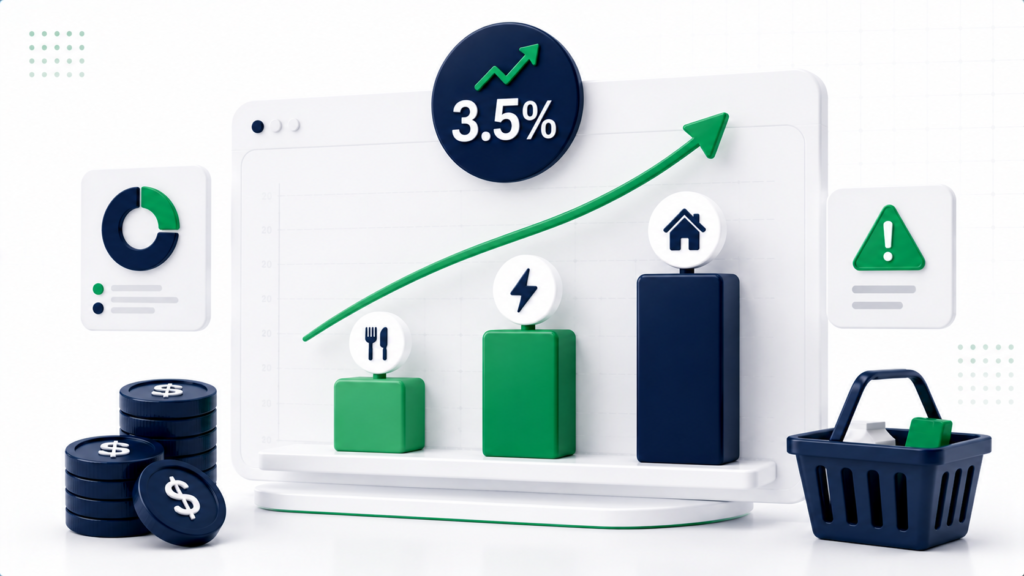
- Food, shelter, and energy are the three categories hitting household budgets hardest right now
- Gasoline peaked at 40.5% higher year-over-year in May before easing — energy remains the biggest wildcard
- 6 specific moves can offset inflation’s impact without cutting your lifestyle to zero
The U.S. Bureau of Labor Statistics published the June 2026 inflation report on July 14, 2026 — yesterday. The headline number: prices are up 3.5% over the past 12 months.
That number sounds small. It is not.
3.5% inflation means that everything you bought last year for $100 now costs $103.50. Multiply that across your entire budget — groceries, rent, gas, insurance, utilities — and the real cost becomes something very different from what headlines suggest.
In this article, you will find the exact math on what inflation is actually costing your household each month in 2026, which categories are hitting hardest, and six specific moves you can make right now to protect your money.
What the June 2026 CPI Numbers Actually Mean
The Consumer Price Index dropped on July 14, 2026 — and the numbers tell a story that headline writers are already moving past too quickly.
Here is what the BLS reported:
- Overall inflation (CPI-U): up 3.5% over the past 12 months
- Monthly change in June: down 0.4% — the largest single-month drop since April 2020
- Core inflation (excluding food and energy): up 2.59% annually
- Energy prices in June: fell 5.7% for the month after surging in prior months
The monthly drop is genuinely good news — and it was driven almost entirely by falling energy prices after a spike caused by the Iran conflict earlier this year. But one month of lower energy prices does not erase what happened over the past 12 months, and it does not mean inflation is solved.
Core inflation at 2.59% is still above the Federal Reserve’s 2% target. Shelter costs, food away from home, and services are all still rising. And anyone who paid $4.20+ per gallon of gas this spring felt the real-world version of that data in their wallet.
The Exact Monthly Cost of 3.5% Inflation on Your Budget
Here is the calculation nobody runs for you — what 3.5% annual inflation actually costs a real household per month.
Most people read “3.5% inflation” and think: that is less than a coffee. Here is what it actually means at different budget levels:
| Monthly Budget | Extra Cost Per Month | Extra Cost Per Year | Lost in 5 Years |
|---|---|---|---|
| $2,000/month | $70/month | $840/year | $4,200+ |
| $3,000/month | $105/month | $1,260/year | $6,300+ |
| $4,000/month | $140/month | $1,680/year | $8,400+ |
| $5,000/month | $175/month | $2,100/year | $10,500+ |
| $7,000/month | $245/month | $2,940/year | $14,700+ |
The “5 years lost” column compounds at 3.5% annually — it assumes inflation stays at this level, which historically it never does for long. But it illustrates the real cost of doing nothing.
The critical insight: if your salary did not increase by at least 3.5% this year, you received a pay cut in real terms. Your paycheck bought more last July than it does today.
Read more: How to Negotiate Your Salary and Actually Get a Raise
The 3 Categories Draining Your Wallet the Most
Inflation is not hitting everything equally. Three categories are responsible for most of the real pain households are feeling in 2026.
1. Energy — the most volatile and most visible
Energy prices surged dramatically earlier this year, with gasoline up over 40% year-over-year in May 2026 before the June pullback. The Iran conflict disrupted oil supply chains and sent pump prices spiking — the national average for regular gas peaked above $4.20 per gallon this spring.
June brought relief: energy fell 5.7% for the month. But energy prices are notoriously volatile. One geopolitical event, one hurricane season, one OPEC decision — and June’s progress disappears within weeks.
What this costs a typical driver: At 40% higher gas prices for several months, a driver filling a 15-gallon tank weekly paid roughly $25–$35 extra per fill-up. That is $100–$140 extra per month just in gas.
2. Shelter — the slow and persistent drain
Housing costs rose 3.4% over the past year and are not going away fast. Rent rose 0.4% in May alone. Owners’ equivalent rent — the largest single component of the entire CPI at over 25% of the index — is still running above 3% annually.
The painful math: a renter paying $1,500/month last year is now facing $1,551 at 3.4% inflation — an extra $612 per year just to stay in the same apartment. And in high-demand cities, actual rent increases are running much higher than the national average.
3. Food — the daily reminder
Food prices rose 3.1–3.2% annually. Groceries (food at home) and restaurants (food away from home) both increased. This is the category people feel most viscerally because they encounter it multiple times per week.
A household spending $600/month on groceries is now spending roughly $619 for the same cart — an extra $228 per year. Multiply that by the restaurant meals, coffee runs, and takeout orders and the real food inflation number for most families is considerably higher.
Why 2026 Inflation Feels Different from 2022
This is not 2022 — and understanding the difference changes how you should respond to it.
In 2022, inflation hit 9.1% at its peak. It was broad, sudden, and driven by supply chain collapse, pandemic stimulus, and a global demand shock all hitting at once. Everything got more expensive simultaneously — used cars, furniture, appliances, food, energy, and rent all surged together.
2026 is structurally different in three ways:
- Supply chains are repaired. Used cars fell 2% year-over-year. New vehicles dropped 0.3% in May. The goods that spiked in 2022 have largely corrected.
- The pressure is concentrated. Energy, housing, and services are driving 2026 inflation — not a broad-based price surge across everything. This means targeted responses work better than blanket spending cuts.
- Prices are rising from a higher base. Even at 3.5%, prices are compounding on top of the 20%+ cumulative inflation from 2021–2023. Your groceries are not 3.5% more expensive than pre-pandemic — they are closer to 25–30% more expensive. The 3.5% is the rate of additional increase on top of that already elevated level.
The practical implication: the smartest moves in 2026 target the specific categories that are actually inflating — not a general lifestyle overhaul.
6 Moves to Protect Your Money From Inflation Right Now
Generic advice like “spend less” does not beat inflation. These 6 moves target exactly where 2026 inflation is hitting hardest.
Move 1 — Put idle cash in a high-yield savings account immediately
Cash sitting in a regular savings account earning 0.01% is losing 3.5% of its purchasing power every year. High-yield savings accounts currently offer 4–5% APY — meaning your savings are actually outpacing inflation instead of being eroded by it. This is the single easiest move with the highest guaranteed return for zero risk.
Read more: Best High-Yield Savings Accounts Compared
Move 2 — Lock in fixed costs wherever possible
Inflation punishes variable costs and rewards fixed ones. If your rent is month-to-month, negotiate a 12 or 24-month lease now before your landlord raises it. If you have a variable-rate loan, explore refinancing to a fixed rate while rates are stable. Lock in subscriptions and annual plans that are cheaper than monthly equivalents.
Move 3 — Audit your grocery bill with a category-by-category approach
Rather than buying less food, buy smarter. The categories driving grocery inflation in 2026 include fresh vegetables, specialty items, and brand-name packaged goods. Store-brand staples, frozen vegetables, and bulk proteins (eggs, canned beans, chicken) have inflated far less. Switching 30% of your grocery cart to store brands typically saves $50–$80 per month with zero change in nutrition.
Move 4 — Invest rather than save for money you do not need for 3+ years
Inflation at 3.5% destroys the real value of money sitting still. Index funds tracking the S&P 500 have historically returned 7–10% annually — well above inflation. If you have an emergency fund fully funded and additional savings sitting idle, investing in low-cost index funds is how you make your money grow faster than inflation erodes it.
Read more: How to Invest in Index Funds — Complete Beginner Guide
Move 5 — Negotiate your salary using inflation as your argument
Most employers expect salary negotiation once a year. Most employees never use inflation data in that conversation. Going into your next review and saying “inflation has run at 3.5% over the past year — I would like to discuss a cost-of-living adjustment to maintain my real compensation” is a factual, professional, and highly effective argument. A raise that does not match inflation is, mathematically, a pay cut.
Move 6 — Build a second income stream to offset rising costs
This is the move most personal finance articles skip because it requires effort. But a side income of $300–$500 per month completely neutralizes 3.5% inflation on a $4,000–$5,000 monthly budget. Freelancing, selling digital products, or monetizing a skill online are all realistic paths to that number within 3 to 6 months.
Frequently Asked Questions
Is 3.5% inflation bad?
Compared to 2022’s 9.1% peak, 3.5% looks manageable. But it is still above the Federal Reserve’s 2% target, and it compounds on top of the 25–30% cumulative price increases since 2021. For households that did not receive a salary increase of at least 3.5% this year, 3.5% inflation means their real purchasing power declined. It is not catastrophic — but it is not harmless either, especially when it is concentrated in unavoidable categories like food, rent, and energy.
Will inflation go back down in 2026?
The June 2026 data showed a meaningful monthly drop of 0.4% — the largest since April 2020 — driven by falling energy prices after the Iran conflict eased. If energy prices remain stable and shelter costs continue their slow deceleration, headline inflation could trend toward 3% or below by year-end. However, energy prices are highly volatile, and any new geopolitical disruption or weather event could reverse that progress quickly. The Federal Reserve is holding its target rate at 3.50%–3.75%, signaling it does not expect to cut rates until inflation is sustainably below 2.5%.
What is the best thing to do with money during inflation?
The worst thing is to leave cash idle in a low-interest account. The best immediate moves are: move savings to a high-yield account earning 4–5% APY, invest money you do not need for 3+ years in diversified index funds, lock in fixed costs where possible, and if you have debt, prioritize paying off high-interest variable rate debt before rates rise further. Inflation rewards action and punishes inaction.
Final Thoughts
The June 2026 CPI report is one piece of data published on one Tuesday morning. What matters more than the headline number is what you do with it.
3.5% inflation costs a typical household $1,260 to $2,100 per year in lost purchasing power. That is money that disappears silently — no invoice, no notification, just a budget that stretches a little less each month.
The six moves above are not theory. They are specific, targeted responses to exactly where 2026 inflation is hitting. High-yield savings, fixed costs, smarter grocery spending, index fund investing, salary negotiation, and side income — any two or three of these implemented together are enough to neutralize inflation’s impact on most household budgets.
Inflation does not wait. Neither should your response to it.