
Key Takeaways
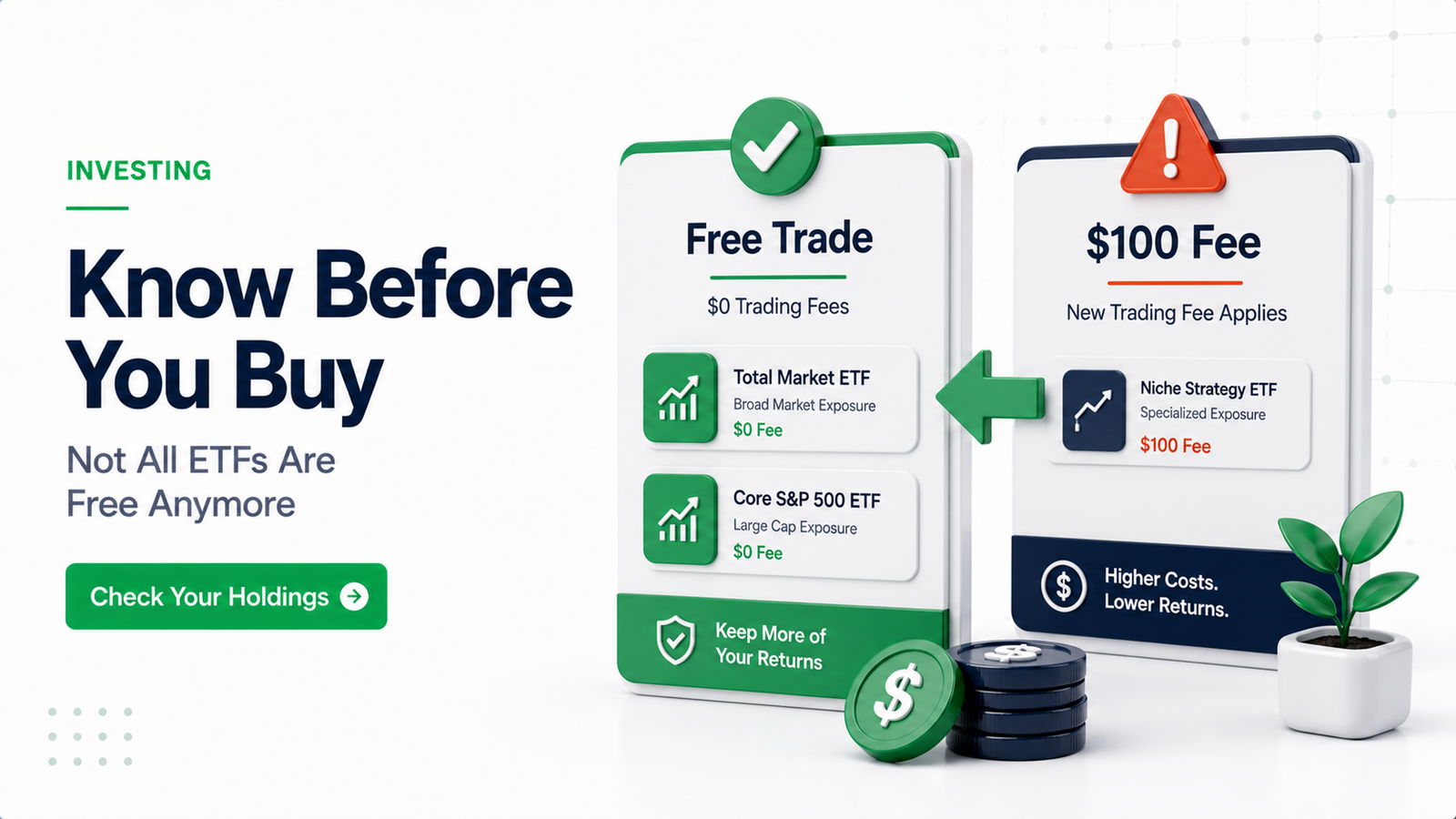
- Fidelity started charging up to $100 per purchase on certain ETFs beginning June 1, 2026
- The fee applies when an ETF issuer does not pay Fidelity a back-end platform fee
- Over 120 ETFs are currently affected, including popular retail funds from Roundhill and Kurv
- Charles Schwab has confirmed it is in negotiations with ETF issuers and may introduce similar fees by end of 2026
- Most mainstream ETFs — Vanguard, iShares, SPDR, Fidelity’s own funds — are not affected
- You can avoid the fee entirely by checking the order preview screen before confirming any purchase
For years, the story in retail investing has been simple: commissions are going to zero. In 2019, every major brokerage eliminated trading commissions on stocks and ETFs. Investors cheered. The race to the bottom looked complete.
In 2026, that story got a lot more complicated.
Fidelity — one of the largest and most respected brokerages in the world — quietly began charging investors up to $100 per purchase on a growing list of ETFs. The fee is not labelled a commission. Fidelity calls it a “service fee.” But it lands at the exact same moment: when you hit confirm on a buy order.
Now Charles Schwab is reportedly preparing to follow suit. And Morgan Stanley’s E*TRADE already charges ETF issuers a back-end licensing fee, with the power to block non-paying issuers from the platform entirely.
Here is everything you need to know — what this fee is, which ETFs it affects, what brokers are doing, and exactly what to do before your next ETF purchase.
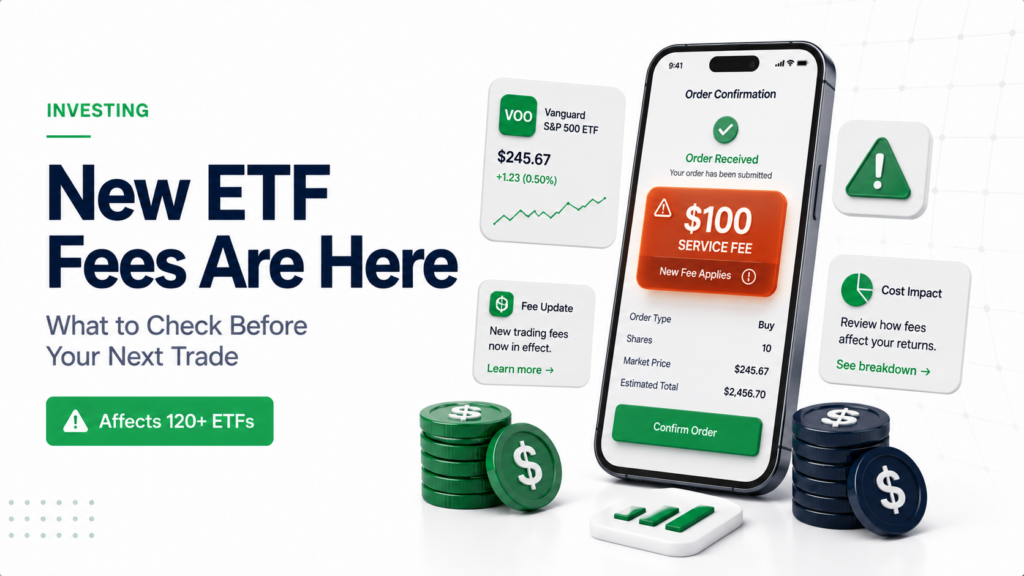
Table of Contents
What Is This New ETF Service Fee?
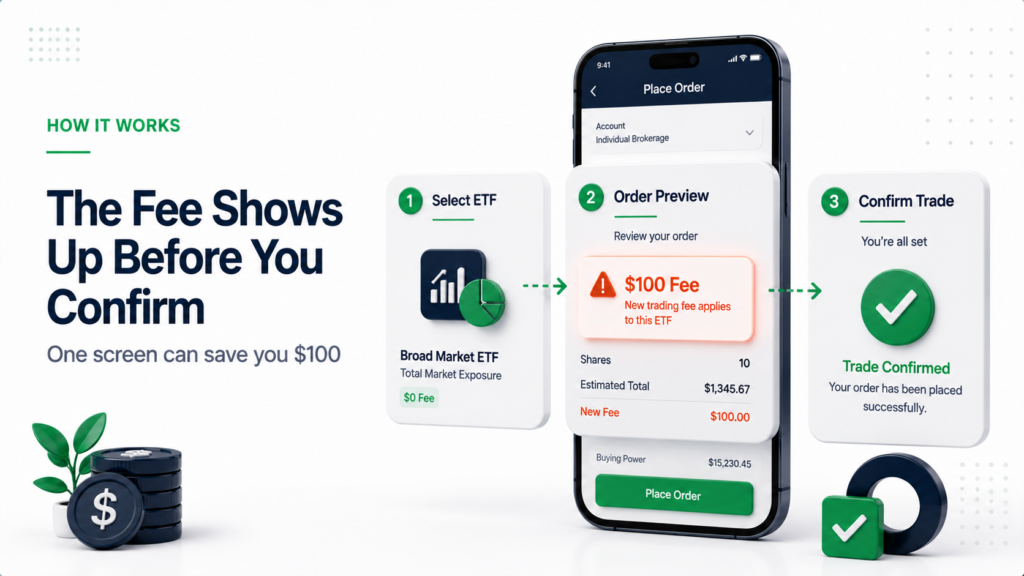
Starting June 1, 2026, Fidelity began charging a service fee of 5% of the purchase value, capped at $100, on purchases of certain ETFs. The fee applies at the time of purchase — not the sale — and is disclosed on the order preview screen before you confirm the trade.
Fidelity’s own description of why the fee exists is revealing. According to the company’s official service fee PDF, the charge applies to ETFs from providers that do not pay Fidelity a “direct, asset-based fee to support their ETFs’ availability on our brokerage platform, including support for shareholder support services, the provision of calculation and analytical tools, and general investment research and education materials.”
In plain language: if an ETF issuer does not pay Fidelity a platform fee, Fidelity passes that cost to investors instead. The arrangement has been widely described in the industry as a “pay to play” model — either the fund company pays to be on the shelf for free, or investors pay every time they shop from that shelf.
This is not Fidelity’s first use of a service fee. A small list of around 27 niche ETFs had been subject to similar fees since November 2025. However, on May 22, 2026, Fidelity expanded that list dramatically — from 27 funds to more than 120 — including ETFs that millions of retail investors actively buy and discuss. That expansion is what triggered the backlash.
Which ETFs Are Affected?
The most impacted ETF issuer is Roundhill Investments, which has more than 40 funds on Fidelity’s service fee list. These include several of the most discussed retail ETFs of 2025 and 2026:
| ETF Ticker | ETF Name | Issuer |
|---|---|---|
| MAGS | Roundhill Magnificent Seven ETF | Roundhill |
| QDTE | Roundhill 0DTE Covered Call Strategy ETF | Roundhill |
| YBTC | Roundhill Bitcoin Covered Call Strategy ETF | Roundhill |
| IPO | Renaissance IPO ETF | Renaissance Capital |
| Kurv series | Yield Premium Strategy ETFs (Apple, Tesla, Google, others) | Kurv |
The important flip side: the vast majority of ETFs at Fidelity are not affected. If you invest in mainstream funds from Vanguard, iShares, SPDR, Schwab, Invesco, or Fidelity’s own lineup — including index funds tracking the S&P 500 or total market — you will not see this fee. Those issuers have platform agreements in place.
Fidelity has also confirmed it is in ongoing dialogue with affected issuers. Some may reach agreements and be removed from the list. The full list of currently affected ETFs is available as a PDF directly on Fidelity’s website, and it is updated without advance notice.
Why Is Fidelity Doing This?
The honest answer is economics. When Fidelity and other brokers eliminated trading commissions in 2019, they did not eliminate their operating costs. Brokerages still spend real money on platform infrastructure, research tools, customer support, and the settlement mechanics that make ETF trading possible.
The model that replaced commissions was revenue sharing. Large ETF issuers pay brokerages an asset-based fee — a small percentage of the assets held by their fund on that platform. This arrangement is common practice across the mutual fund industry, and it has been extended to ETFs by the biggest players.
Smaller and newer ETF issuers often decline to pay these fees, either because they cannot afford to or because they object to the model on principle. Historically, that meant they were still listed — brokerages built their reputations on wide selection and absorbed the cost.
What changed in 2026 is that Fidelity decided to stop absorbing that cost. Instead of subsidizing smaller issuers, it is now passing the bill to investors. Critics, including prominent fund manager Meb Faber, called the move “gross” and described it publicly as a “pay to play” structure. Fidelity’s official position is more measured: the company says it is engaging in “constructive dialogue” with issuers and expects many will reach agreements to come off the list.
What About Charles Schwab and Other Brokers?
Charles Schwab is the broker most closely watching this space — and most likely to follow.
Schwab CEO Richard Wurster confirmed during the company’s most recent earnings call that Schwab is actively negotiating with ETF issuers over platform fees, and indicated a target of rolling out a similar structure by the end of 2026. Schwab manages approximately $2.4 trillion in ETF assets, making it the second largest ETF custodian after Fidelity. The economic incentive to capture some of that revenue through platform fees is significant.
Schwab has stated it is in discussions with the 400-plus asset managers on its platform, and that those talks are “going well.” However, the exact implementation — whether Schwab will charge investors a fee directly, charge issuers only, or both — has not been confirmed publicly.
Morgan Stanley, the parent company of E*TRADE, already operates a different version of this model. It charges ETF issuers a back-end “data licensing fee” of $10,000 per fund per year, with a minimum of $150,000. Critically, Morgan Stanley’s published policy states that it may choose not to offer ETFs from issuers that decline to pay — meaning investor access could be cut off entirely, not just made more expensive.
Robinhood and Vanguard have not announced similar fee structures. Robinhood may use this as a marketing advantage: the platform’s appeal to retail investors depends heavily on a simple, zero-fee experience, and publicly opposing brokerage platform fees could differentiate it sharply from incumbents.
What This Means for Everyday Investors
For most people who invest in broad market index funds — S&P 500 ETFs, total stock market ETFs, dividend ETFs from major issuers — nothing changes. These funds are held by large issuers that have long-standing platform agreements. Your Vanguard VOO, iShares IVV, or SPDR SPY purchase at Fidelity costs exactly $0 in commissions today and will continue to do so.
The impact is concentrated among investors who buy from smaller, newer, or niche ETF issuers — particularly the specialty and thematic funds that have grown popular on social media and retail investing forums over the past two years.
The real risk is less about the fee itself and more about what it signals. If Schwab follows Fidelity, and if the model continues spreading, the ETF industry’s cost structure is changing in a meaningful way. The era in which any issuer could list an ETF and reach all investors at no friction is ending. Platform access is becoming a paid privilege — and the cost of that privilege will ultimately be passed somewhere, whether to fund companies, to investors, or both.
For investors who hold affected ETFs and plan to add more, the $100 cap limits the damage on larger purchases. Buying $2,000 of an affected ETF triggers the 5% fee, but it is capped at $100 — meaning the effective fee rate drops as your purchase size grows. Buying $5,000 of an affected ETF costs $100 in fees, which is 2%. Buying $10,000 costs the same $100, which is 1%. The fee structure is more painful for smaller, incremental investors than for large lump-sum buyers.
For a broader look at how ETF fees work and what to watch for, the NerdWallet breakdown of ETF service fees and NerdWallet’s ETF investing guide are both useful references.
What to Do Right Now
There are three practical steps worth taking today if you use Fidelity or are considering it:
Action Checklist
1. Check your current holdings
If you hold any ETFs from Roundhill, Kurv, or other smaller specialty issuers in a Fidelity account, look them up against Fidelity’s current service fee PDF. The fee only applies to purchases — selling is unaffected — but if you plan to add to these positions, know the cost in advance.
2. Always check the order preview screen
Before confirming any ETF purchase on Fidelity, the platform is required to display the service fee if one applies. Do not skip this screen. A $100 surprise on a $500 purchase is a 20% cost that wipes out months of potential gains.
3. Consider routing affected purchases elsewhere
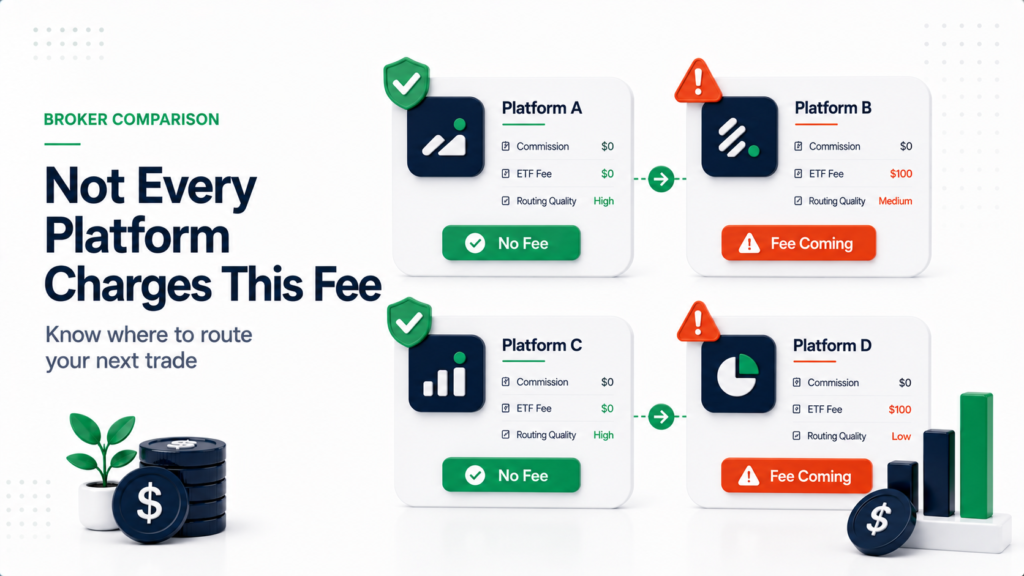
If you want to buy a specific ETF that is on Fidelity’s service fee list, check whether that ETF is available at another broker without a fee. Charles Schwab currently does not apply this type of fee. Robinhood does not either. For a single purchase, moving the trade to a different platform is a straightforward workaround that costs nothing.
If you are not currently using Fidelity but are evaluating brokerages, this development is worth factoring in — especially if your investment strategy involves thematic, sector-specific, or newer ETFs. The overall quality of Fidelity’s platform remains strong. However, the service fee list is growing, not shrinking, and the situation at Schwab and E*TRADE is still developing.
For investors focused on broad-market index fund investing — which covers the vast majority of what beginners are advised to buy — none of this changes the calculus meaningfully. Mainstream ETFs remain completely free to trade at every major brokerage.
For more on how to think about ETFs as part of a long-term investment plan, see our guide on how to invest in index funds as a beginner and our overview of ETFs vs mutual funds.
Frequently Asked Questions
Final Thoughts
The free trading revolution of 2019 did not eliminate the economics of running a brokerage. It just moved the revenue model underground. For years, that revenue came from payment for order flow, cash sweep programs, and back-end agreements with large fund companies — none of which the average investor ever saw.
What Fidelity has done in 2026 is make part of that model visible. Smaller ETF issuers who do not participate in revenue sharing now have their investors charged directly. Whether you view that as transparency or a penalty on choice depends on your perspective.
What matters practically is this: for the majority of investors buying mainstream index funds, nothing has changed. For investors in specialty or thematic ETFs from smaller issuers, a new cost has entered the picture — and it is worth knowing about before you place your next trade.
The list can change at any time. Check it before you buy.
Keep Reading
Build your investing knowledge