
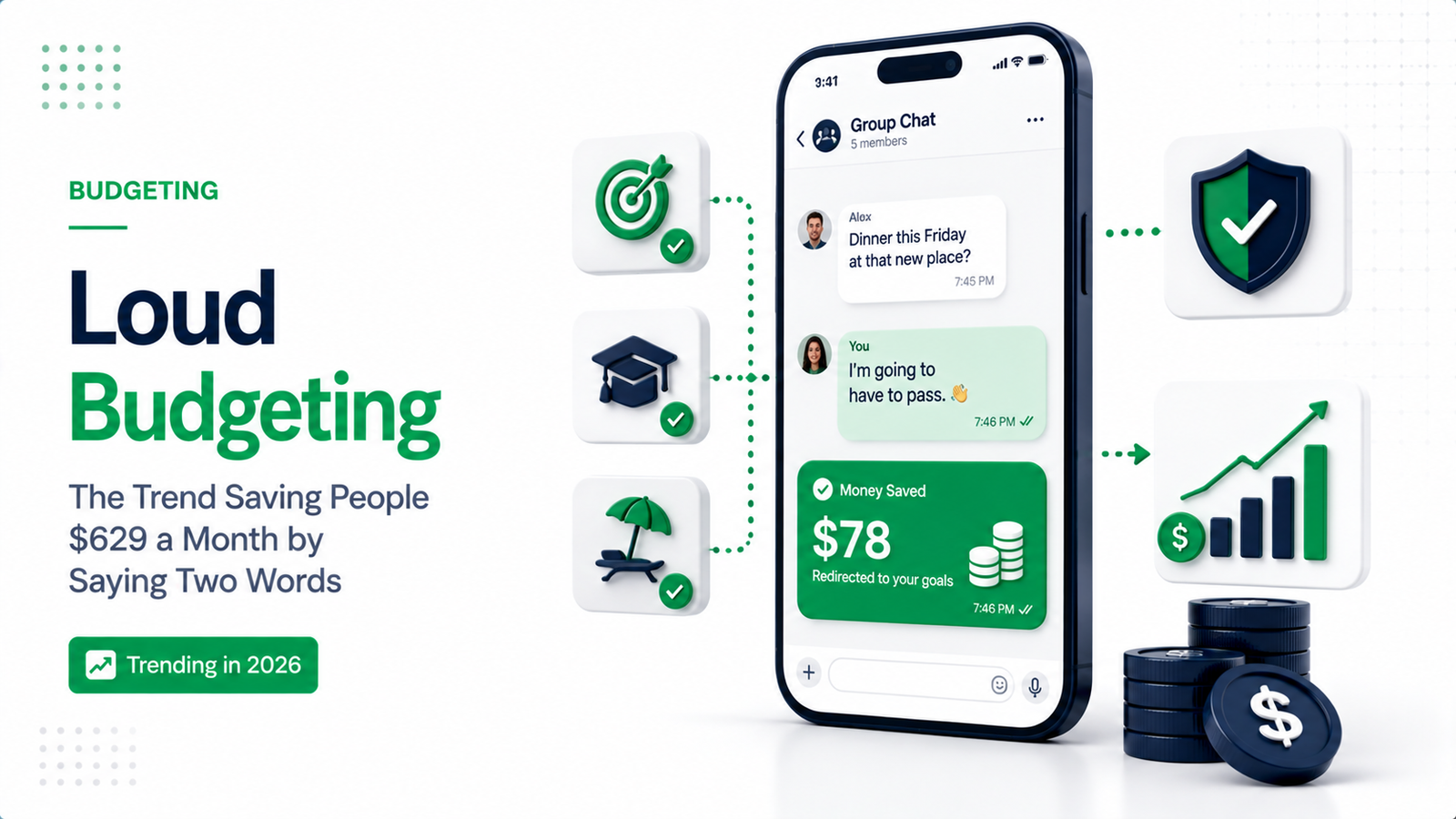
- Loud budgeting means saying your real reason out loud when you choose not to spend — “that is not in my budget”
- 42% of Gen Z now openly tell friends which plans they can and cannot afford, up from 38% two years ago
- People who practice loud budgeting report saving an average of $629 per month — not by cutting more, but by spending in line with what they already decided mattered
- Around 1 in 5 Americans exceed their monthly budget — loud budgeting directly addresses why
- It costs nothing, requires no app, and works better the more you actually say it out loud
It is Thursday afternoon. You have kept your spending in check all week. You are feeling good about your budget.
Then the group chat lights up: dinner, drinks, and a concert on Saturday for an artist you do not even like, at a restaurant that costs three times what you usually spend.
The old response: invent an excuse, go anyway and stress about it, or quietly put it on a credit card.
The new response — the one that 42% of Gen Z has already adopted — is just saying the actual reason out loud: “That is not in my budget right now.”
Two words. Zero excuses. And according to the data, those two words are saving people an average of $629 per month.
That is loud budgeting. And in 2026, it has become one of the most talked-about financial shifts of the decade.
What Is Loud Budgeting Exactly?
Loud budgeting is the practice of openly and unapologetically communicating your financial boundaries — especially when it comes to saying no to spending you cannot or choose not to do.
The term was coined in late 2023 by comedian and content creator Lukas Battle, who described it in a viral TikTok video as “the opposite of quiet luxury.” Where quiet luxury was about performing wealth you may or may not have — unbranded cashmere, logoless bags, the implication of money — loud budgeting flips the premise entirely: instead of pretending you can afford things you cannot, you say plainly that you are choosing not to spend.
The key distinction Battle made from the beginning is important: loud budgeting is not about saying you do not have the money. It is about saying you are choosing not to spend it on this. That reframe matters enormously. It shifts the conversation from embarrassment to intention — from “I cannot afford it” to “I have decided what my money is for.”
In practice, loud budgeting sounds like:
- “That is not in my budget this month — I am saving for something else right now.”
- “I am going to skip the dinner but I would love to meet up for coffee instead.”
- “I am trying to hit a savings goal this quarter so I am keeping social spending low.”
- “That sounds fun but it does not fit what I am working toward financially — count me out this time.”
None of these require an explanation, an apology, or a detailed breakdown of your finances. They require only honesty and the willingness to say the real reason instead of a polite fiction.
External resource: What is loud budgeting and how it works — WalletHub
The Numbers Behind the Trend
What makes loud budgeting different from most viral money trends is that the data actually supports it.
Here are the numbers that matter:
| Statistic | Source |
|---|---|
| 42% of Gen Z openly tell friends which plans they can and cannot afford | Bank of America Better Money Habits 2026 |
| Loud budgeters report saving an average of $629 per month | Clarify Capital survey data |
| 1 in 5 Americans exceed their monthly budget regularly | WalletHub 2026 survey |
| 54% of Americans are currently living paycheck to paycheck | 2026 budgeting trend report |
| 75% of Gen Z take active steps to save money when making social plans | 2026 Gen Z financial behavior study |
The $629 monthly savings number is the most striking — and also the most revealing. People who practice loud budgeting are not saving that money by cutting necessities or living more frugally in some meaningful way. They are saving it by finally spending in line with what they already said their priorities were.
The implication is significant: most budget failures are not math problems. They are social pressure problems. Loud budgeting fixes the actual root cause.
Why Most Budgets Die at Dinner Invitations
Here is the part that financial planning advice almost never addresses: most budgets do not fall apart in a spreadsheet. They fall apart in a group chat.
You can set a perfect monthly budget on a Sunday evening. By Friday, one social invitation has already pushed you $80 over. By the end of the month, a string of “just this once” decisions has turned a disciplined plan into a theory you wrote down and never followed.
This is not a discipline failure. It is a social architecture failure. Human beings are wired for social belonging — and in most social contexts, spending money is the mechanism of participation. Saying no to the dinner, the trip, the group gift, or the round of drinks feels like saying no to the relationship itself.
Loud budgeting solves this by separating the two. When you say “that is not in my budget right now,” you are not rejecting the relationship. You are being honest about a practical constraint while remaining present in the conversation. It gives the other person accurate information instead of a vague excuse — and it turns out most people respond to honesty far better than they respond to invented headaches.
The research backs this up. Among people who practice loud budgeting, the social consequences they feared almost never materialize. Friends adjust. Plans get modified. And the people who push back are usually the ones who were using group spending as social validation for their own choices — which is a different problem entirely.
Read this next: How to Stop Living Paycheck to Paycheck
How to Practice Loud Budgeting Without Feeling Awkward
The first time is always the hardest. After that, it gets significantly easier — and the results compound fast.
Step 1 — Know your actual numbers before you need them
Loud budgeting only works if you know what your budget actually is. Before you can say “that is not in my budget,” you need to know what is in your budget. Spend one hour this week reviewing last month’s bank statements and identifying exactly how much you are currently spending on social and discretionary categories. That number becomes your reference point.
Start here: Budgeting Methods Compared — 50/30/20 vs Zero-Based
Step 2 — Prepare your phrase in advance
The awkwardness of loud budgeting usually comes from being caught off guard and not knowing what to say. Decide your phrase before you need it. Options that work well:
- “That does not fit my budget this month.”
- “I am working toward a savings goal right now so I am keeping extras low.”
- “I am going to pass on this one — let me know what else is coming up.”
Pick the one that feels most natural to you and practice saying it once or twice in a mirror. It sounds ridiculous but it works — the first time you say it out loud to yourself, the second time you say it to a friend is far less charged.
Step 3 — Offer an alternative, not an apology
The most effective loud budgeting does not leave a social vacuum. Instead of just saying no, offer a different way to connect that fits your budget. “I cannot make the restaurant but I would love to grab coffee Sunday” keeps the relationship intact without the financial pressure. You are not withdrawing — you are redirecting.
Step 4 — Be consistent, not occasional
The awkwardness fades completely once the people in your life understand that this is how you operate — not a one-time excuse but a consistent approach to your finances. After the first two or three times, most people stop questioning it. Some start adopting it themselves.
Step 5 — Direct the money you saved immediately
This is the step most loud budgeting content skips. Saying no to a $120 dinner is only valuable if the $120 goes somewhere intentional. The moment you decline spending, transfer that amount (or a portion of it) to your savings goal. The act of redirecting the money immediately turns a passive abstention into an active financial win.
Build your savings foundation: How to Save Your First $10,000 — Step-by-Step Plan
Loud Budgeting Beyond Social Situations
Most people think of loud budgeting as a social strategy. But the same principle applies far beyond group chats and dinner invitations.
The core of loud budgeting is this: say your real financial priority out loud, to yourself or others, instead of letting unspoken social pressure override your stated goals. That principle works in several other contexts:
With yourself — internal loud budgeting
Many impulsive purchases happen in silence — a quick online checkout, a spontaneous item added to a cart, a subscription upgrade clicked without thinking. Saying your reason out loud before buying creates a pause. “I am buying this because I want it right now, not because it fits my goals” is more honest than the silence that usually precedes a regretted purchase. That pause is often enough to make a different decision.
With family members
Financial misalignment between partners and family members is one of the leading causes of relationship stress. Openly stating financial priorities — “this month I want to focus on the emergency fund before any extras” — makes the plan visible and discussable rather than a private source of tension.
In the workplace
Loud budgeting also applies to salary conversations. Openly discussing compensation, knowing your number, and saying it clearly is a form of loud budgeting at work. Professionals who state their salary expectations directly and unapologetically consistently negotiate better outcomes than those who wait to see what they are offered.
External resource: How loud budgeting helps you save more money — Yahoo Finance
Where Loud Budgeting Goes Wrong
Like any trend, loud budgeting has a healthy version and a version that creates different problems.
The healthy version is everything described above: honest, calm, consistent communication about your financial priorities without shame or apology.
Where it goes wrong:
- Oversharing financial details. Loud budgeting does not mean announcing your account balance or itemizing your debt in social situations. The goal is to communicate a boundary, not deliver a financial statement. One sentence is enough.
- Using it as a permanent avoidance strategy. If loud budgeting becomes a way to never participate in anything social, ever, it has become isolation dressed as financial discipline. The goal is alignment between spending and priorities — not elimination of all discretionary spending.
- Making others feel judged. Stating your own financial boundary is healthy. Commenting on others’ spending choices as a comparison is a different behavior entirely. Loud budgeting is about you, not a commentary on what everyone else should do.
- No budget behind the words. Saying “that is not in my budget” without actually having a budget is just an excuse with better branding. The strategy only produces the $629/month savings result when there is a real financial plan it is protecting.
Frequently Asked Questions
Is loud budgeting the same as being cheap?
No — and the distinction matters. Being cheap means avoiding spending regardless of the impact on relationships or quality of life, often without a clear financial purpose. Loud budgeting is intentional: you are choosing where your money goes and communicating that choice honestly. A loud budgeter will happily spend on things that genuinely matter to them. They just stop spending on things that do not — and they say so, instead of pretending otherwise.
What if my friends react badly when I practice loud budgeting?
Most people find that the feared reaction almost never happens. Friends generally respond better to honesty than to vague excuses. If someone consistently pushes back on your financial boundaries, that is useful information about the relationship dynamic — and it is worth examining whether that person respects your choices in general. True friendships do not require you to overspend to maintain them.
How do I start loud budgeting if I do not have a budget yet?
Start by building a basic budget first — even a rough one. Track what you spent last month, identify your biggest discretionary categories, and decide what you want to protect. Once you have a number in mind for social spending, loud budgeting gives you a way to stay inside it. Without the budget underneath it, loud budgeting is just a phrase without a purpose. Check out our guide on budgeting methods compared to find the approach that fits your life.
Final Thoughts
Loud budgeting went viral because it solved a problem that every budgeting spreadsheet in history has failed to address: the gap between what you plan to spend and what you actually spend when other people are involved.
The strategy is deceptively simple. Say your real reason. Offer an alternative. Redirect the money you saved. Repeat until it is no longer awkward — which happens faster than you think.
The $629 monthly savings average is not the product of extreme frugality or lifestyle sacrifice. It is the product of one habit: spending in line with what you already decided mattered, instead of what the group chat decided for you.
That is loud budgeting. And it costs exactly nothing to start.