

- Saving $10,000 is achievable on almost any income with the right system
- The biggest obstacle is not income — it is the lack of a clear plan
- Automating your savings removes willpower from the equation completely
- Cutting just 3 to 4 spending habits can free up hundreds of dollars per month
- Reaching $10,000 takes between 12 and 36 months for most beginners — and it compounds from there
Saving your first $10,000 is one of the biggest financial milestones you can hit. It is the point where money starts working for you instead of slipping through your fingers every month.
But for most people, $10,000 feels impossible. Bills pile up, unexpected costs appear, and the month ends before the paycheck does.
The good news: saving $10,000 is not about earning more money. It is about building a system that works automatically — even if you are starting from zero.
In this guide, you will learn exactly how to save your first $10,000, step by step, no matter your income level.
Step 1 — Set a Clear $10,000 Savings Goal
A goal without a deadline is just a wish. Saving $10,000 only becomes real when you attach a number and a date to it.
Start by asking yourself one question: how much can I realistically save every month?
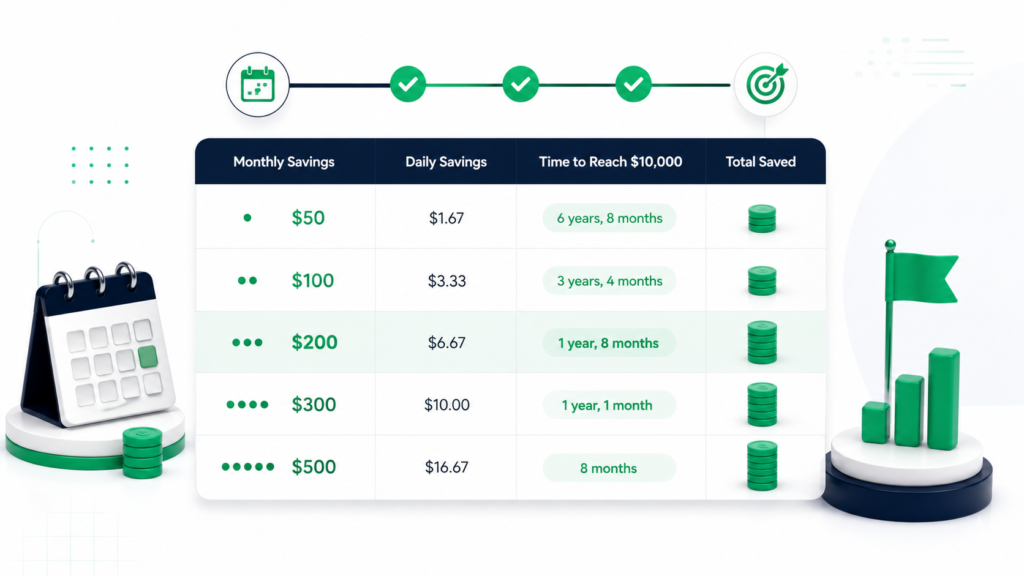
Here is what the math looks like depending on your monthly savings amount:
| Monthly Savings | Time to $10,000 | Daily Amount |
|---|---|---|
| $200/month | 50 months | $6.67/day |
| $300/month | 34 months | $10/day |
| $500/month | 20 months | $16.67/day |
| $700/month | 15 months | $23.33/day |
| $1,000/month | 10 months | $33.33/day |
Pick your number. Write it down. This is your target — $10,000 by a specific month and year.
Pro tip: open a dedicated savings account just for this goal. Keeping it separate from your main account makes it much harder to spend accidentally.
Step 2 — Know Exactly Where Your Money Goes
You cannot fix what you cannot see. Before cutting anything, you need a clear picture of where every dollar is going right now.
Most people are surprised when they do this exercise. Small daily expenses — coffee, food delivery, streaming services — add up to hundreds of dollars every month without feeling like it.
How to track your spending in 10 minutes:
- Go through your last 3 bank statements
- Write down every spending category: rent, food, transport, subscriptions, entertainment
- Add up the totals per category
- Highlight anything that shocks you
You will likely find at least $100 to $300 per month that you can redirect to savings without feeling any real pain.
External resource: How to track your spending — Investopedia
Step 3 — Build a Simple Monthly Budget
A budget is not a punishment. It is a plan that tells your money where to go before the month starts.
The simplest budget for beginners is the 50/30/20 rule:
- 50% of income — needs (rent, food, utilities, transport)
- 30% of income — wants (dining out, entertainment, subscriptions)
- 20% of income — savings and debt repayment
If 20% savings feels too aggressive right now, start with 10% and increase by 1% every month. The habit matters more than the amount at the beginning.
Want to go deeper? Read our guide: Budgeting Methods Compared — 50/30/20 vs Zero-Based
Step 4 — Cut the Spending That Is Draining You
Every dollar you stop wasting is a dollar closer to $10,000. You do not need to cut everything — just target the highest-impact areas first.
The fastest wins:
- Cancel unused subscriptions. Go through every recurring charge on your bank statement and cancel anything you forgot about.
- Cut food delivery apps. Cook at home 3 more times per week and save $80 to $150 per month easily.
- Apply the 48-hour rule. Wait 48 hours before buying anything over $30. Most impulse urges disappear.
- Switch to store brands. For groceries and toiletries, store brands are often identical in quality at half the price.
- Negotiate your phone and internet plan. Call your provider and ask for a better rate — most will offer a discount to keep you.
Even cutting just 3 of these habits can free up $200 to $400 per month — which gets you to $10,000 significantly faster.
Step 5 — Automate Your Savings
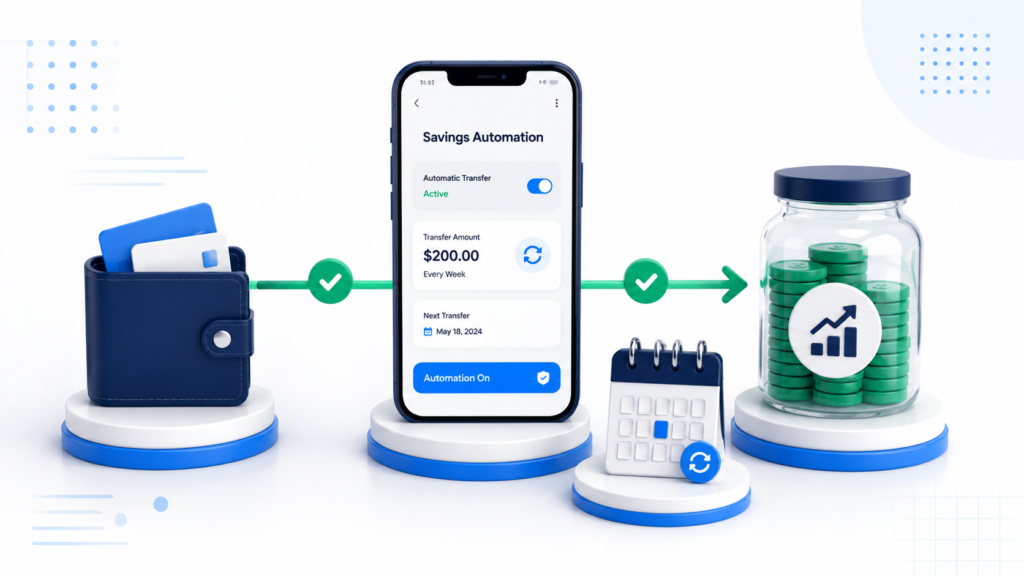
Automation is the single most powerful savings habit you can build. When savings happen automatically, you never have to rely on willpower.
Set up an automatic transfer from your checking account to your savings account on the same day you get paid. Even $50 per paycheck counts.
The principle is simple: pay yourself first. Treat your savings transfer like a bill that you cannot skip — because it is the most important one you will ever pay.
External resource: How to automate your savings — NerdWallet
Step 6 — Boost Your Income on the Side
Cutting expenses has a limit. Earning more does not. If you want to reach $10,000 faster, adding even $200 to $300 per month in side income can cut your timeline in half.
Beginner-friendly ways to earn extra income:
- Freelancing (writing, design, translation, data entry) on Fiverr or Upwork
- Selling unused items around your home on Facebook Marketplace or eBay
- Offering local services (cleaning, delivery, tutoring)
- Completing paid surveys and micro-tasks online
- Renting out a room, parking space, or storage space
Step 7 — Track Your Progress Every Month
What gets measured gets done. Checking your savings balance monthly keeps you motivated and shows you whether your system is working.
Create a simple tracker — even a notebook works. Write down your savings balance on the first of every month. Watch the number grow.
Every time you hit a small milestone ($1,000, $2,500, $5,000) celebrate it in a small way. Progress compounds emotionally just as much as it does financially.
External resource: How to track your savings goals — The Balance
Also read: How to Build an Emergency Fund Fast
Frequently Asked Questions
How long does it take to save $10,000?
It depends on how much you can save each month. Saving $300 per month gets you there in about 34 months. Saving $500 per month takes around 20 months. The fastest path combines moderate expense cuts with a small side income — many people reach $10,000 in 12 to 18 months using this approach.
Is it possible to save $10,000 on a low income?
Yes — but it requires more time and discipline. The key is to start with whatever amount is possible, even $50 per month, and increase it gradually. Automating the transfer on payday ensures you save consistently even when money feels tight.
Where should I keep my savings while working toward $10,000?
A high-yield savings account is the best option for most beginners. It keeps your money separate from your spending account, easy to access if needed, and earns a small return while you save. Avoid keeping this money in a regular checking account where it is too easy to spend.
Final Thoughts
Saving your first $10,000 is not about being perfect with money. It is about building a simple system and sticking to it long enough for the results to show.
Set your goal. Track your spending. Build a budget. Automate your savings. And check your progress every month without fail.
The first $10,000 is always the hardest. After that, the habits are built, the system is working, and the next $10,000 comes faster than you think.