
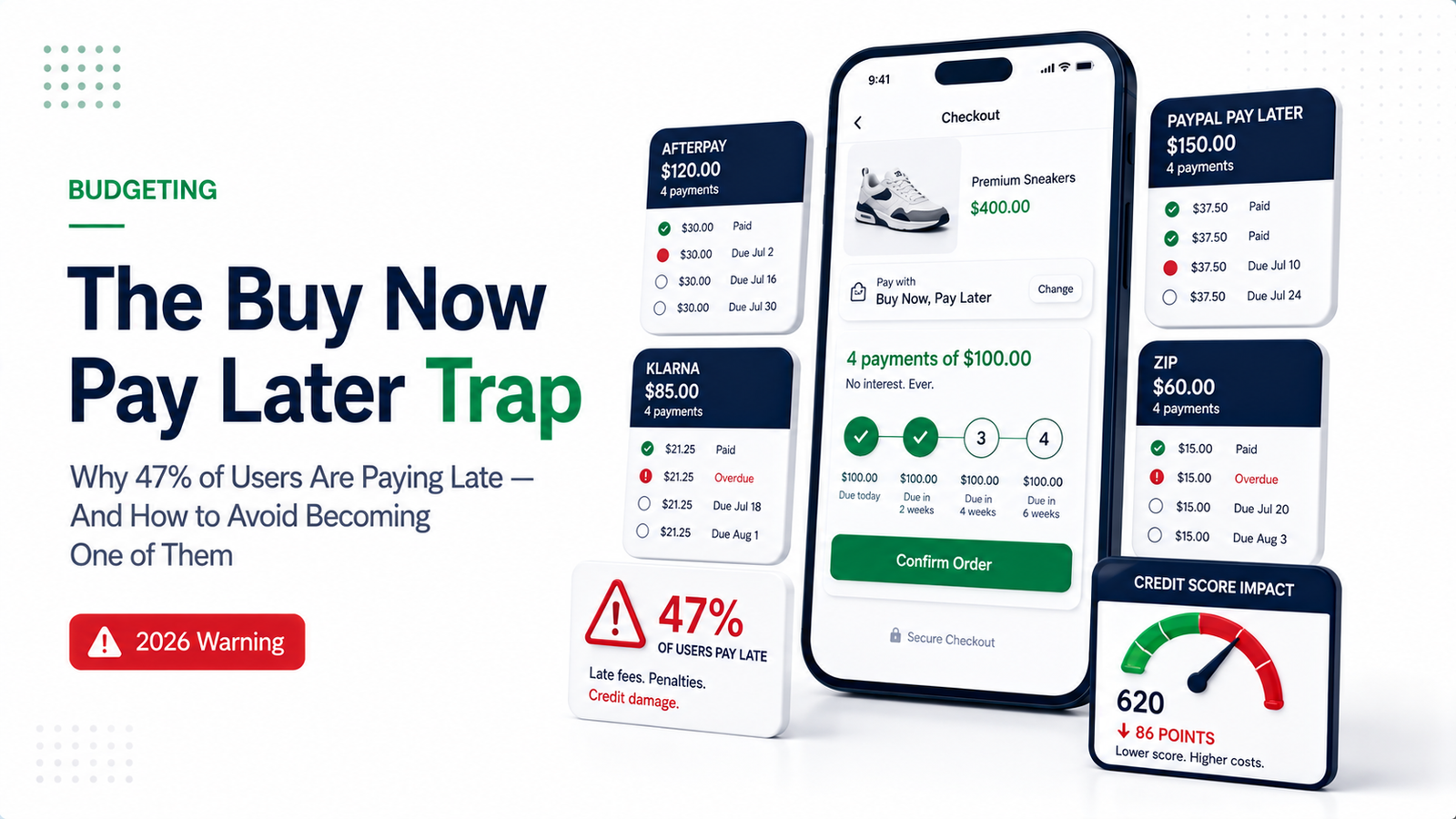
- 50% of US adults have used Buy Now Pay Later — 37% made a purchase with one in the past 90 days alone
- 47% of BNPL users paid late on at least one loan in the past year — up from 41% the year before and 34% two years ago
- 60% of BNPL users are carrying multiple loans simultaneously — a pattern called “loan stacking” that quietly destroys budgets
- More than half of BNPL users say they would not be able to make ends meet without BNPL — a sign of dangerous financial dependency
- Starting in fall 2025, Affirm began reporting BNPL loans to credit bureaus — a missed payment can now damage your credit score just like a missed credit card payment
It starts with a pair of sneakers.
The price is $120. That feels like a lot. But the checkout page offers something different: four payments of $30, spread over six weeks, zero interest. Suddenly $120 feels like $30 — and you click confirm.
Two weeks later, you buy a jacket. Four payments of $22.50. Then a laptop accessory. Then groceries — yes, groceries — on BNPL. Then a holiday gift. Then a phone case.
By the time the payments start overlapping, you are managing six different payment schedules across three apps, and $280 is leaving your account every two weeks in installments you can barely track.
This is not an edge case. This is the average BNPL user in 2026. And the data shows exactly how it ends.
What BNPL Actually Is — And What It Is Not
Buy Now Pay Later is a short-term financing product that splits a purchase into equal installments — typically four payments over six weeks — with no interest charged if you pay on time.
The major BNPL providers in 2026 are Affirm, Klarna, Afterpay, and PayPal Pay Later. They are integrated directly into the checkout pages of thousands of retailers — from Amazon and Target to small Etsy shops and grocery delivery apps. The process takes seconds: select BNPL at checkout, enter basic personal information, and your purchase is approved instantly.
What BNPL is not: it is not free money, it is not a credit card, and it is not consequence-free. It is a loan. A short-term, usually interest-free loan — but a loan with due dates, late fees, and as of 2025, credit reporting implications that millions of users never anticipated.
The “interest-free” framing is the core of the marketing — and the core of the problem. Zero interest sounds like zero risk. But interest is not the only way a financial product can hurt you. Overspending, missed payments, and loan stacking can damage your financial position just as severely as a high-interest debt — without the warning signs that a rising interest bill provides.
External resource: How to avoid the debt traps of Buy Now Pay Later — U.S. PIRG
The 2026 Data That Should Worry You
The BNPL industry loves to share adoption numbers. Here are the numbers they do not put in their press releases.
| Statistic | 2024 | 2026 | Trend |
|---|---|---|---|
| Users who paid late in past year | 34% | 47% | 📈 +13 points in 2 years |
| Users carrying 3+ loans at once | ~30% | 60% | 📈 Doubled in 2 years |
| Users buying groceries with BNPL | Low | Growing fast | 📈 Major warning sign |
| Users who say they could not make ends meet without BNPL | — | More than 50% | 🚨 Financial dependency |
| Users who regretted a BNPL purchase | — | 15%+ | 📈 Impulse buying enabled |
The grocery number is the most alarming data point in the entire BNPL story. When a payment tool designed for discretionary purchases starts being used for food — a basic necessity — it signals that a significant portion of users are not using BNPL as a convenience. They are using it because they cannot cover essential expenses from their income alone.
The contrarian point: the Federal Reserve’s February 2026 economic brief concludes that BNPL does not currently pose a systemic risk to financial stability at the macroeconomic level. That is probably true. But financial stability at the macro level is cold comfort if you personally are one of the 47% who paid late last year, or one of the 60% managing three or more overlapping payment schedules simultaneously.
External resource: LendingTree 2026 Buy Now Pay Later Report — full data
How the BNPL Trap Works — Step by Step
The BNPL trap does not happen all at once. It builds gradually through a specific sequence of decisions that feel reasonable individually and catastrophic collectively.
Step 1 — The price illusion
BNPL fundamentally changes how purchases feel. A Federal Reserve researcher described it precisely: “I would normally pay $20 for one shirt at J.Crew, but with BNPL, I can spend $20 over several weeks for three shirts — BNPL leads to larger purchases and lower cart abandonment.” The math has not changed. Three shirts still cost three shirts worth of money. But the psychological experience of paying $20 instead of $60 makes the larger purchase feel affordable — and that illusion is the entry point to the trap.
Step 2 — Loan stacking
Because each BNPL loan feels small at checkout, and because multiple BNPL apps are available across different retailers, users accumulate multiple active loans simultaneously. The average BNPL user in 2026 is managing 3 or more active loans. Each one felt manageable in isolation. Together, they create a payment schedule that can consume a significant portion of biweekly take-home pay before any other bill is paid.
Step 3 — The invisible debt problem
Until late 2025, most BNPL loans were not reported to credit bureaus. This created what analysts call “phantom debt” — real financial obligations that did not appear anywhere on a credit report. A lender evaluating your creditworthiness for a car, apartment, or mortgage could not see your BNPL obligations. You might appear financially healthy on paper while actually managing $800 in active BNPL payments per month.
Step 4 — A missed payment triggers the cascade
When one payment is missed — perhaps because overlapping due dates were not tracked, or because an unexpected expense depleted the account — late fees apply immediately. On some platforms, a missed payment also accelerates remaining installments, making the full balance due at once. One missed $30 payment can become a $120 demand within 24 hours, triggering an overdraft, a declined payment on a second loan, and a cascading series of fees across multiple accounts simultaneously.
Step 5 — The CFPB withdrew consumer protections
In 2025, the CFPB withdrew rules that would have required BNPL providers to send billing statements, give consumers the right to dispute charges, and mandate refunds for returned merchandise. Without those protections, BNPL users have significantly fewer rights than credit card holders in disputes, returns, or unauthorized charge situations. The consumer protection gap is real and largely unknown.
Related: Loud Budgeting: The Money Trend Saving People $629 a Month
The Credit Score Risk Nobody Warned You About
For years, one of BNPL’s selling points was that it did not affect your credit score. That is no longer true.
Starting in fall 2025, Affirm began reporting BNPL loans to major credit bureaus. FICO incorporated BNPL data into its scoring model, creating FICO Score 10, which explicitly accounts for BNPL payment history. Klarna and Afterpay have been more cautious about full reporting, but the direction of the industry is clear — BNPL is being brought into the mainstream credit reporting system.
What this means practically:
- A missed BNPL payment can now damage your credit score just like a missed credit card payment — potentially dropping your score by 50 to 100 points for a single late payment
- Multiple BNPL loans increase your utilization and debt load visible to lenders — even if you never missed a payment, high BNPL balances can make you appear over-leveraged
- The phantom debt problem is closing — lenders evaluating mortgages, car loans, or apartment applications will increasingly be able to see your BNPL obligations
- On-time payments may help build credit — this is the genuine positive of reporting, particularly for thin-file borrowers who lack traditional credit history
The net effect: BNPL is transitioning from a low-stakes convenience tool to a credit product with real credit consequences. Users who treated it as consequence-free because it did not show up on their report need to update that assumption immediately.
Build your financial foundation: What Is No Buy 2026 — The Movement Saving People Thousands
When BNPL Is Actually Fine to Use
BNPL is not universally dangerous. Used correctly and narrowly, it can be a genuinely useful tool. The problem is that most people do not use it correctly or narrowly.
BNPL is appropriate when all of the following conditions are true:
- You are buying something you genuinely need — not something the price illusion made feel affordable. A broken appliance you must replace. A necessary work tool. A medical expense.
- You have verified the total fits your budget — not just the installment amount. The full purchase price needs to be something you could afford to pay in cash if required. If you could not pay cash for it, BNPL is not making it affordable — it is making it seem affordable.
- You have only one active BNPL loan at a time — loan stacking is where the math breaks down. One small loan is manageable. Three overlapping loans consuming a combined $300 per month in biweekly payments is a budget crisis in slow motion.
- You have set a payment reminder — the most common cause of late BNPL payments is not inability to pay, it is forgetting a due date. Set a calendar reminder for every installment due date before you click confirm at checkout.
- You are not using it for groceries, utilities, or recurring expenses — when BNPL becomes the mechanism for covering basic living costs, it is a signal that spending and income are misaligned in a way that installment payments cannot solve.
If any of those conditions are not met, the right answer is not to use BNPL for that purchase — it is to either wait until you can afford it, or to not buy it.
How to Get Out of BNPL Debt Right Now
If you are currently managing multiple BNPL loans and feeling the pressure, here is the exact sequence to get back in control.
Step 1 — List every active BNPL loan in one place
Open every BNPL app you use and write down: the total remaining balance, the next payment due date, and the payment amount. Most people carrying multiple BNPL loans do not have a clear picture of their total BNPL exposure. The act of listing them is often enough to shock you into changing behavior. Add up the total. That number is your starting point.
Step 2 — Stop taking new BNPL loans immediately
Every new BNPL loan while you are paying off existing ones extends the problem. Delete the apps from your phone or turn off the BNPL option in your checkout settings. The goal is to run down existing balances to zero before adding any new ones. This is non-negotiable.
Step 3 — Pay off the smallest balance first
With BNPL, unlike credit cards, there is usually no interest differential between loans. Pay the smallest remaining balance to zero first — this eliminates one payment schedule, reduces cognitive load, and frees up cash flow for the next one. Repeat until all loans are closed.
Step 4 — Build a budget that covers your actual needs
If you were using BNPL for groceries or essential expenses, the underlying problem is a gap between income and spending that BNPL was temporarily filling. Closing that gap requires either reducing expenses, increasing income, or both. A simple budget that accounts for all monthly obligations — including the BNPL payments you are still running down — is the foundation.
Start here: How to Make a Monthly Budget You Will Actually Stick To
Step 5 — Replace the BNPL habit with the 30-day rule
For any non-essential purchase over $30, wait 30 days before buying it. Add it to a list. Come back in a month and decide if you still want it. The majority of impulse purchases that would have gone on BNPL disappear from the list within two weeks. This single habit eliminates most of the spending that BNPL enables — and saves the money that would have gone to installments.
Read more: What Is Moneymaxxing? The Viral Trend Making People Richer in 2026
Frequently Asked Questions
Does BNPL affect your credit score in 2026?
Yes — as of fall 2025, Affirm began reporting BNPL loans to credit bureaus, and FICO incorporated BNPL data into its FICO Score 10 model. A missed payment on an Affirm loan can now damage your credit score the same way a missed credit card payment does. Klarna and Afterpay have been slower to report, but the industry trend is toward full credit reporting for all major providers. Treat every BNPL loan as a credit product with real credit consequences — because in 2026, it is.
Is BNPL the same as a credit card?
No — and the differences matter. Credit cards charge interest on unpaid balances, provide strong consumer protections (dispute rights, fraud liability limits, refund rights), and have a single monthly billing statement. BNPL typically charges no interest if paid on time, but provides far fewer consumer protections — the CFPB withdrew rules in 2025 that would have aligned BNPL protections with credit card standards. BNPL also fragments debt across multiple payment schedules, making it harder to track total obligations. For most financial situations, a credit card used responsibly and paid in full monthly provides better consumer protections than BNPL.
Can BNPL help build credit for people with no credit history?
Potentially — now that BNPL payments are being reported to credit bureaus, consistent on-time payments can contribute positively to a credit file. For thin-file borrowers who cannot access traditional credit products, this is a genuine benefit of the new reporting regime. The risk is the reverse: a missed payment on a BNPL loan can now damage a thin-file borrower’s score significantly, potentially making their credit situation worse rather than better. The credit-building benefit only works if every payment is made on time — which the data shows 47% of users are currently failing to do.
Final Thoughts
Buy Now Pay Later is not inherently evil. Used narrowly — one loan at a time, for something you genuinely need, with a payment reminder set — it is a neutral financial tool.
The problem is how the average person actually uses it in 2026. Multiple simultaneous loans. Grocery purchases. Impulse buys that turn into regretted purchases. Payment schedules that overlap until a single unexpected expense triggers a cascade of late fees and missed payments.
The data is unambiguous: 47% of BNPL users paid late last year. That number has risen every year for three consecutive years. And now, for the first time, those late payments are showing up on credit reports.
The tool has not changed. The stakes just got higher.