
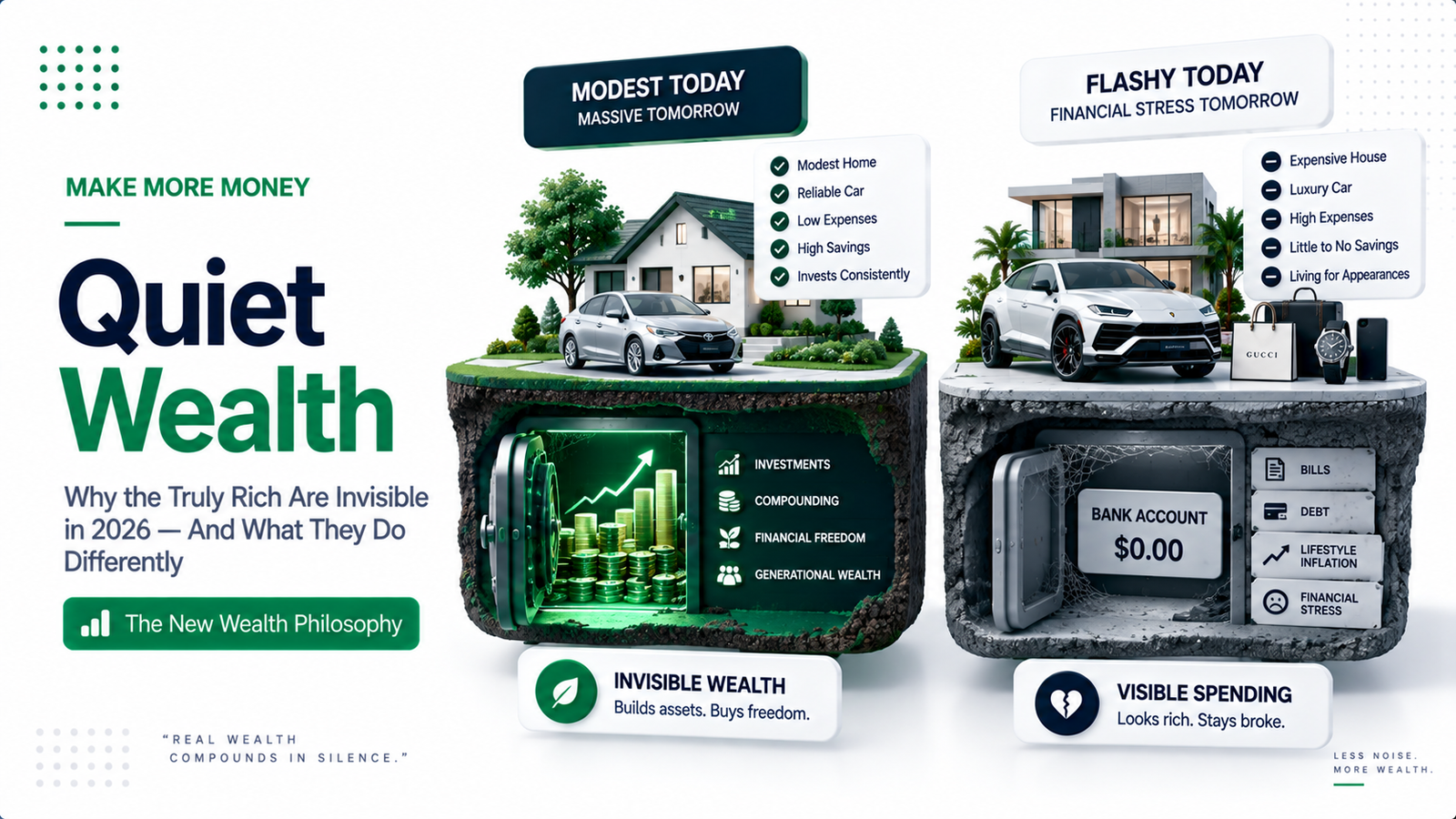
- The richest person in your neighborhood likely drives a modest car, lives in an ordinary house, and nobody knows it — this is quiet wealth, and it is becoming the dominant wealth-building philosophy of 2026
- The loudest signals of financial success — luxury cars, designer brands, lavish spending — are disproportionately associated with people who have high incomes but almost no actual wealth
- The top 1% increased their wealth by $33.9 trillion since 2015 — almost none of it visible to the outside world because it exists in stock portfolios, private equity, and compounding investments
- Quiet wealth is not about secrecy — it is about a fundamentally different definition of financial success: net worth over appearance, compounding over consumption
- The five behaviors that separate quiet wealth builders from high-income spenders — and how to apply them at any income level
Someone could be the richest person at a dinner table, and nobody would know.
That observation — from a financial writer reflecting on the nature of modern wealth — captures something profound about how money actually works in 2026. Where wealth once announced itself through unmistakable landmarks — the biggest house in town, the local business employing half the community, the car that turned every head — today’s substantial wealth is largely invisible.
It lives in stock portfolios that nobody can see. In index funds that quietly compound while the owner sleeps. In paid-off properties that carry no visible mortgage. In financial independence that requires no performance and no audience.
This is quiet wealth — and it is replacing loud money as the dominant financial philosophy of 2026.
Not because people are hiding their money. But because a growing number of people have figured out something the display economy never wants you to understand: the behaviors that make you look wealthy and the behaviors that make you actually wealthy are almost perfectly opposite.
What Quiet Wealth Actually Is
Quiet wealth is not a financial product, an investment strategy, or a savings rate. It is a philosophy — a fundamentally different way of measuring financial success.
The conventional definition of financial success in consumer culture is visible: the house, the car, the wardrobe, the vacation, the restaurant. Success is performed. It is shown. It requires an audience to validate it.
Quiet wealth inverts that entirely. Its defining characteristic is that it is invisible to outsiders — because it exists entirely in assets that do not display themselves. A diversified stock portfolio is not visible. A maxed-out Roth IRA does not show up at dinner. A fully funded emergency fund and zero consumer debt have no aesthetic. Financial independence produces no Instagram content.
Today’s substantial wealth more often takes the form of diversified stock portfolios — invisible to everyone, sometimes even to close family members. The richest person in your neighborhood might drive a modest car, live in an unremarkable house, and catch the bus to work.
The key insight behind quiet wealth is this: having and investing money is invisible — it is the spending that becomes visible. Wealth can quietly compound, completely out of sight. Only when someone chooses to convert that wealth into consumption does it announce itself to the world.
Which means: the loudest displays of wealth are, paradoxically, evidence of wealth being converted away — not accumulated.
External resource: The Invisible Millions — The Quiet Wealth Phenomenon
The Paradox — Why Looking Rich Keeps You Poor
The most counterintuitive fact in personal finance: the people who look the wealthiest are frequently the least wealthy — and the people who look the most ordinary are often the most financially secure.
This is not a new observation. The Millionaire Next Door — one of the most important personal finance books ever written — documented it with actual research data in 1996. The typical American millionaire, the book found, drives a used vehicle, lives in a house well below what their income would allow, and wears unremarkable clothes. They became wealthy precisely because they spent below their means consistently for decades.
In 2026, that pattern has become even more pronounced — and more culturally visible. The loudest signals of success often mask the most precarious financial positions. Credit cards and equity lines can fund impressive displays of prosperity, while genuine, substantial wealth can pass completely unnoticed.
Morgan Housel captured this perfectly in The Psychology of Money — the most recommended personal finance book of 2026. When you see someone driving a luxury car, you rarely think “that person is impressive.” You think “if I had that car, people would think I was impressive.” The cruel irony: the person driving the car bought it for the same reason. They wanted others to think they were impressive. And nobody actually thought that — they were too busy imagining themselves in the car.
The math that makes this concrete: a person earning $150,000 per year who spends $140,000 has a net worth that grows by $10,000 annually. A person earning $80,000 who spends $50,000 grows their net worth by $30,000 per year. After ten years, the high earner has $100,000. The moderate earner has $300,000. The visible lifestyle signals would suggest the opposite.
Read more: 10 Best Personal Finance Books in 2026 — That Actually Change How You Think About Money
Why Real Wealth Is Invisible in 2026
The nature of wealth itself has changed in ways that make invisibility increasingly the default — not just the preference of the cautious rich, but the structural reality of how modern wealth is stored.
Financial assets replaced physical ones
Previous generations stored wealth in things you could see: land, businesses, livestock, physical property. These assets had to exist somewhere visible. They employed people. They stood in the landscape. Wealth was, by necessity, somewhat visible.
Today’s wealth is stored in financial instruments — stock portfolios, index funds, private equity positions, cryptocurrency wallets. These are numbers in databases. They do not occupy physical space. They cannot be observed by neighbors. The wealthiest people in the world hold assets that are, in a very literal sense, invisible to everyone around them.
The richest 1% grew $33.9 trillion richer — invisibly
The top 1% increased their wealth by $33.9 trillion since 2015. Capital income now accounts for 47% of global income, up from 39% in 1980. The wealthiest 1% of the global adult population captured 38% of all additional wealth accumulated since the mid-1990s.
Almost none of this accumulation is visible. It happened in brokerage accounts, private equity distributions, and compound returns on assets held for decades. The wealth gap widened dramatically — while looking, from the outside, like nothing happened at all.
The next generation of billionaires will be unrecognizable
The next generation of the ultra-wealthy will not be recognizable by their real estate portfolios or their garage full of hypercars. Their fortunes will live inside server farms, licensing agreements, and swarms of autonomous software that never sleep, never age, and never show up on the society page. The invisible billionaire — whose entire net worth exists in code, intellectual property, and automated systems — is already emerging in 2026.
The 5 Behaviors of Quiet Wealth Builders
Quiet wealth is not a personality type or a level of income. It is a set of behaviors that can be practiced at any income level — and that compound dramatically over time.
Behavior 1 — They measure success by net worth, not lifestyle
Quiet wealth builders track one number obsessively: net worth. Not income, not square footage, not the brand of their car. Net worth — assets minus liabilities — is the only number that tells you whether you are actually building wealth or just spending more as you earn more.
Most people have a vague sense of their income and a detailed knowledge of their monthly spending. Very few people know their actual net worth to the dollar. The ones who do — who update it monthly and optimize for its growth — are the ones whose wealth compounds invisibly for decades.
Behavior 2 — They automate savings before lifestyle inflation can catch up
Every time income increases — a raise, a bonus, a new job — the quiet wealth builder immediately increases their automated savings and investment contributions before the new income integrates into their lifestyle. The raise goes to the index fund before it goes to the upgraded apartment.
This behavior is the direct antidote to lifestyle creep — the silent wealth killer where spending rises to match every income increase, leaving net worth perpetually flat despite decades of career advancement.
Behavior 3 — They are radically unbothered by what others think of their spending
Quiet wealth requires a specific kind of social confidence: the willingness to drive an ordinary car, wear unremarkable clothes, and skip the restaurant that everyone is talking about — without feeling a need to explain, justify, or perform poverty.
This is harder than it sounds. Consumer culture is designed to make you feel inadequate for not participating in it. The quiet wealth builder has internalized a different scorecard: their net worth statement, not their social image, is the measure of financial progress.
Behavior 4 — They invest consistently regardless of market conditions
Quiet wealth is built by people who invest automatically every month — in good markets and bad — without attempting to time the cycle. The compounding of consistent contributions over decades is responsible for the overwhelming majority of their eventual wealth. The specific investments matter far less than the consistency.
This behavior is invisible by design. There are no social media posts about automatic index fund contributions. There is no status associated with dollar-cost averaging. The performance is entirely internal — a number in a brokerage account that grows without an audience.
Behavior 5 — They spend extravagantly on what genuinely matters to them — and nothing else
Quiet wealth is not frugality. It is intentionality. The quiet wealth builder does not deprive themselves — they simply ruthlessly cut everything that does not produce genuine value in their life and spend freely on the things that do.
This is Ramit Sethi’s “conscious spending” concept made concrete: identify the 2 or 3 things in your life that genuinely make you happier — and spend lavishly on those without guilt. Cut everything else without mercy. The goal is not to spend as little as possible. It is to spend only on what is actually worth spending on.
Apply the philosophy: What Is Moneymaxxing? The Viral Trend Making People Richer in 2026
Why Quiet Wealth Is Replacing Loud Money Culturally
The shift toward quiet wealth in 2026 is not just individual — it is a broad cultural movement with specific economic and generational drivers.
Three years of inflation changed the calculus
When prices rise 25 to 30% cumulatively — as they did between 2021 and 2026 — the performance of consumption becomes harder to sustain. The $20 burrito, the $500 weekend trip, the $80,000 car that once felt like a reasonable reward for a good year now require genuine financial sacrifice. As the cost of performing wealth has increased, the appeal of quietly building it has grown.
Gen Z is rejecting the performance economy
Quiet wealth is not a monetary plan or a money-making equation. It is more of a cultural change in the way individuals consider spending their money, saving, and displaying success. They do not flex their purchases but silently accumulate savings and invest in the background. Gen Z — the generation that grew up watching influencers perform wealth that turned out to be debt — is disproportionately skeptical of financial performance. Loud budgeting, moneymaxxing, and quiet wealth are all expressions of the same underlying shift: money as a tool for genuine security, not a prop for social validation.
Succession, White Lotus, and culture made it aspirational
The aesthetic of understated wealth became mainstream through cultural products that celebrated old money restraint over new money flash. The Roy family’s unbranded cashmere in Succession. The contrast between restrained linen and loud resort wear in White Lotus. These narratives mainstreamed the idea that the truly wealthy do not need to signal — and that the loudest signals often belong to the most financially precarious.
Social media created fatigue with financial performance
A decade of watching influencers perform lifestyles funded by brand deals, debt, and selective photography has produced genuine skepticism about visible wealth signals. When the “rich lifestyle” is so clearly performable by anyone with a credit card and a ring light, its signal value collapses. The reaction — a growing preference for authenticity over performance — is what quiet wealth fills.
Read more: Loud Budgeting: The Money Trend Saving People $629 a Month
How to Start Building Quiet Wealth Today
Quiet wealth is not a destination you reach after decades — it is a set of habits you adopt today that produce compounding results over time. Here is exactly where to start.
Step 1 — Calculate your actual net worth right now
Add up everything you own (savings, investments, property value, car value) and subtract everything you owe (debt, mortgage balance, car loan, student loans). That number is your net worth. It is the only financial number that actually matters for wealth building — and most people have never calculated it. Write it down. Update it monthly. Make it grow.
Step 2 — Identify your personal lifestyle creep
Look at your spending over the past three years alongside your income over the same period. Did spending rise in proportion to income? If so, you experienced lifestyle creep — and your net worth grew far less than your income growth would suggest it should have. Identifying where lifestyle creep entered your budget is the first step to reversing it.
Step 3 — Automate an investment before your next paycheck
Set up an automatic investment transfer — even $100 per paycheck — to a brokerage account buying a low-cost index fund. Set it up before you do anything else this week. The specific amount matters less than the automation. Every month that transfer happens without decision, and every month it compounds without audience, is a month of quiet wealth building.
Start here: 12 Passive Income Ideas That Actually Work in 2026
Step 4 — Choose your three genuine spending priorities
Identify three categories in your life where spending genuinely produces happiness or value: travel with your family, great food at home, your fitness, your children’s education — whatever is actually true for you. Spend generously on those three. Cut aggressively on everything else. This is not deprivation — it is the most sophisticated form of financial intentionality.
Step 5 — Stop measuring your financial success by what others can see
This is the hardest step and the most important one. Quiet wealth requires internalizing a different scorecard. Your net worth statement is your report card. Not your car, not your apartment, not your wardrobe. Every time you feel the pull to spend for an audience rather than for yourself, pause and ask: does this purchase move my net worth forward or backward? The answer will be enough.
Frequently Asked Questions
Is quiet wealth the same as being cheap?
No — and the distinction is important. Being cheap means avoiding spending regardless of value, often at the expense of experiences, relationships, or quality of life. Quiet wealth is intentional spending: generous on what matters, ruthless on what does not. A quiet wealth builder happily spends $5,000 on a family vacation they genuinely value. They would not spend $500 on a designer handbag purchased primarily to signal status to others. The difference is not the amount — it is whether the spending serves your actual values or your audience’s perception of your values.
Can you build quiet wealth on a modest income?
Yes — and in fact, quiet wealth is more accessible on a modest income than loud wealth is. Loud wealth requires significant income to sustain its performance. Quiet wealth requires only consistent habits: spending below your means, automating savings, and investing the difference in low-cost index funds over time. A person earning $50,000 who saves and invests 20% of their income for 30 years builds more genuine wealth than a person earning $150,000 who spends 95% of it performing affluence. The income matters less than the gap between income and spending.
Is quiet wealth just stealth wealth for rich people?
Stealth wealth — deliberately hiding wealth to avoid social friction, crime risk, or tax scrutiny — is one expression of quiet wealth but not its defining feature. The broader quiet wealth philosophy is not primarily about hiding money from others. It is about genuinely not measuring your financial success by what others can observe. The motivations are internal: net worth growth, financial security, compound returns, and the freedom that comes from assets rather than appearances. Whether others know about it is secondary — the primary difference is what you optimize for.
Final Thoughts
The richest person at your dinner table probably drives a car you have forgotten by the time you reach your own. They live in a house that does not signal anything. They wear clothes that communicate nothing. And their net worth is compounding invisibly in a brokerage account that has never been the subject of a social media post.
That is not an accident. It is a philosophy — one that is replacing loud money in 2026 because a growing number of people have figured out the fundamental truth: wealth is what you do not spend. And the freedom it produces is not visible to anyone else. It does not need to be.
Start measuring your net worth instead of your appearance. Automate your investments before lifestyle inflation can absorb your raises. Spend generously on what genuinely matters and cut everything else without apology. And stop performing financial success for an audience that is not watching as closely as you think.
Quiet wealth does not announce itself. That is exactly the point.