
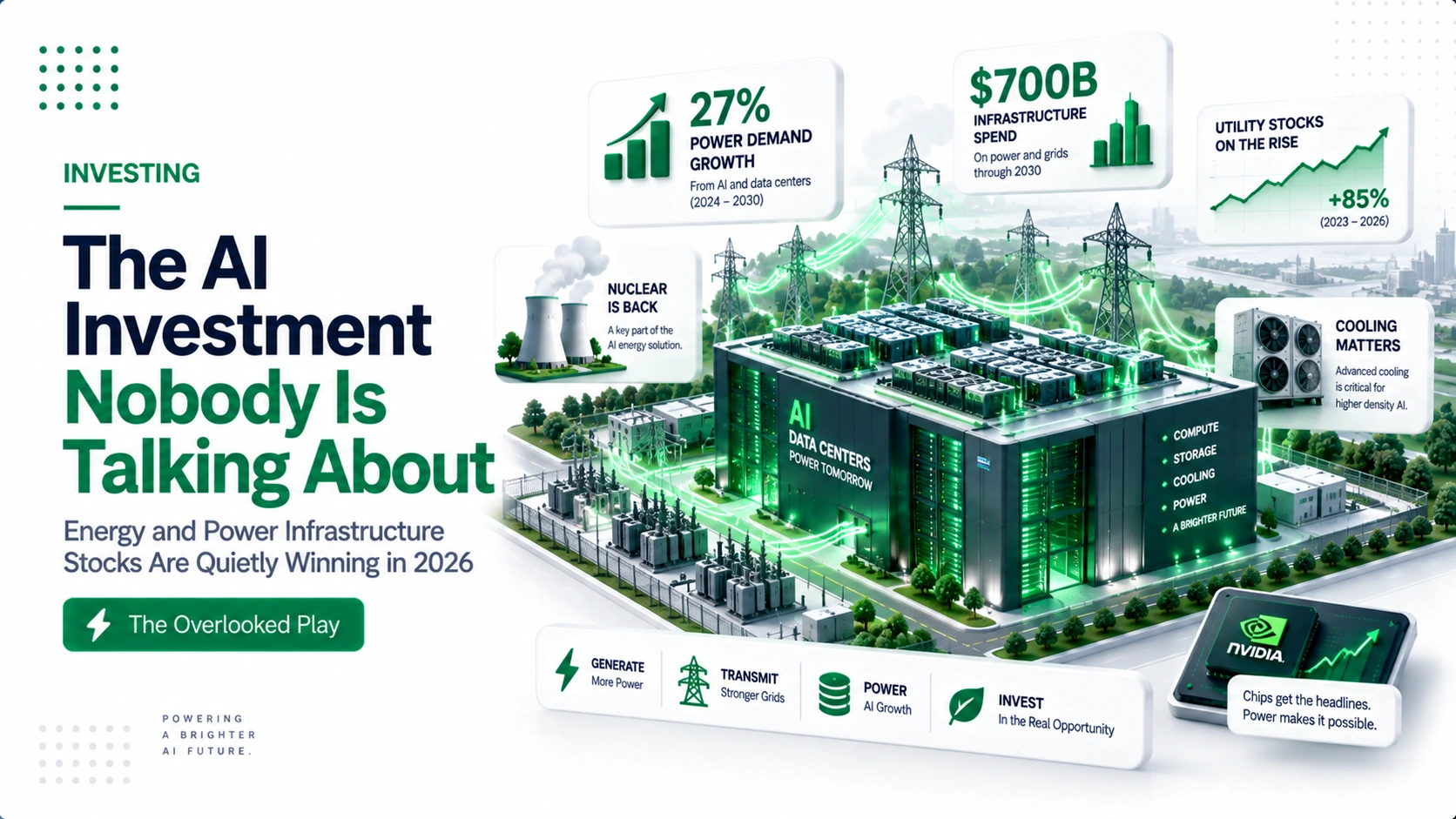
- A single AI task consumes up to 1,000 times more electricity than a traditional web search — making energy the invisible bottleneck of the entire AI industry
- Tech giants are projected to spend $700 billion on AI infrastructure in 2026 alone — and every dollar of that spend requires power to run it
- Worldwide data center power demand is forecast to rise 27% in 2026, reaching 132 gigawatts — up from 104 gigawatts in 2025
- JPMorgan, Morgan Stanley, and Bloomberg all flagged AI energy and cooling infrastructure as the most overlooked investment opportunity of 2026
- While Nvidia has surged 880% in three years, utility and data center infrastructure stocks have quietly delivered strong returns with a fraction of the volatility
Everyone is talking about Nvidia. Everyone is buying AI software stocks. Billions of dollars are chasing the companies building artificial intelligence.
Almost nobody is asking where all that AI is going to get its power.
A single AI query consumes up to 1,000 times more electricity than a traditional Google search. Training a large AI model requires enough energy to power hundreds of homes for a year. And with Microsoft, Google, Amazon, and Meta projected to spend a combined $700 billion on AI infrastructure in 2026 alone — every single chip in every single data center needs power to run, power to cool, and power to keep running 24 hours a day.
The AI energy problem is not a future problem. It is a 2026 problem. Worldwide data center power demand is forecast to rise 27% this year. Virginia’s data centers already consume 26% of all electricity in the state. The US may need 50 gigawatts of new power capacity by 2028 just to maintain AI leadership globally.
That scale of demand creates an investment opportunity that most retail investors have completely missed — because they were too busy watching Nvidia’s stock price.
- The AI power problem — why energy is the real bottleneck
- The numbers that explain the opportunity
- Where smart money is actually going in AI energy
- The specific stocks and ETFs worth knowing about
- The risks that are real and the ones that are overstated
- How a beginner should approach this opportunity
- Frequently Asked Questions
The AI Power Problem — Why Energy Is the Real Bottleneck
The most important constraint on AI’s growth in 2026 is not chips. It is not software. It is not talent. It is electricity.
Every AI model — whether it is answering a question, generating an image, or running a business process autonomously — requires a data center to run on. And data centers require enormous, uninterrupted power. Not the kind of power you plug a laptop into. The kind that requires new substations, new transmission lines, and in some cases, new power plants.
The scale of the problem is staggering:
- A single AI task uses up to 1,000 times more electricity than a traditional web search
- Training GPT-4 required roughly 50 gigawatt-hours of electricity — enough to power 4,600 US homes for a year
- Data centers in Virginia already consume 26% of all electricity in the state
- By 2030, AI could account for up to 9% of all US energy consumption — up from 4% in 2023
- The US may need 50 gigawatts of new power capacity by 2028 — roughly double New York City’s entire consumption — just to remain globally competitive in AI
The response from tech companies has been extraordinary. In March 2026, seven major AI companies — Amazon, Google, Meta, Microsoft, OpenAI, Oracle, and xAI — signed the White House-facilitated Ratepayer Protection Pledge, committing to directly fund all necessary grid infrastructure improvements required by their AI operations. This is technology companies becoming infrastructure investors — a role they have never played before at this scale.
External resource: AI data center energy consumption trends and investment opportunities 2026 — TTMS
The Numbers That Explain the Opportunity
These are the numbers that professional investors are tracking — and that most retail investors have never seen in one place.
| Metric | 2025 | 2026 Forecast | By 2030 |
|---|---|---|---|
| Global data center power demand | 104 GW | 132 GW (+27%) | 240+ GW |
| Hyperscaler AI infrastructure spend | ~$400B | $700B | $3T+ total |
| US utility grid investment needed | Underway | $1.4T over 5 yrs | $7T globally |
| New US power capacity needed for AI | — | 50 GW by 2028 | 100+ GW |
| AI share of US electricity consumption | 4% | 5-6% | Up to 9% |
The data center sector alone is projected to expand at a 14% compound annual growth rate through 2030 — requiring up to $3 trillion in total investment. Roughly 100 gigawatts of new data centers are anticipated to come online between 2026 and 2030, equating to $1.2 trillion in real estate asset value creation plus an additional $1 to $2 trillion for IT equipment.
The key investment insight: Morgan Stanley estimates that nearly $3 trillion of AI-related infrastructure investment will flow through the global economy by 2028 — and more than 80% of that spending is still ahead. The AI infrastructure buildout is not a past event. It is happening now, and it is accelerating.
External resource: How data center and utility stocks are benefiting from AI energy demand — Kavout
Where Smart Money Is Actually Going in AI Energy
JPMorgan, Morgan Stanley, and Bloomberg have all identified AI energy infrastructure as the most overlooked investment opportunity in 2026. Here is specifically where professional investors are positioning.
1. Utility companies with data center contracts
Traditional electric utilities — the kind that have existed for a century powering homes and businesses — are experiencing a demand surge unlike anything in their history. Companies with significant data center customer bases in AI-heavy markets like Virginia, Texas, and the Pacific Northwest are seeing electricity demand grow at rates previously associated only with industrial revolutions. Utilities with long-term power purchase agreements with hyperscalers have locked in multi-decade revenue streams that are largely invisible in traditional utility analysis.
2. Data center REITs
Data center Real Estate Investment Trusts own and operate the physical buildings that house AI computing infrastructure. Companies like Equinix and Digital Realty own hundreds of data centers globally and lease capacity to hyperscalers including Microsoft, Google, and Amazon. As AI demand forces these companies to lease more space and sign longer contracts, data center REITs benefit from both higher occupancy rates and rising lease prices — with the added benefit of paying dividends as REITs are legally required to distribute 90% of taxable income to shareholders.
3. Power grid infrastructure companies
The existing US power grid was not designed for the load that AI is adding to it. Transformers, substations, transmission lines, and switching equipment — the physical hardware of electricity distribution — all need to be upgraded or expanded. Companies manufacturing grid infrastructure components are experiencing backlog growth of 3 to 5 years as utilities race to build capacity faster than AI demand arrives.
4. Nuclear energy — the surprise AI power solution
Tech companies need power that is available 24 hours a day, 7 days a week, with no intermittency. Solar and wind fail this test. Nuclear does not. Microsoft signed a 20-year power purchase agreement to restart Three Mile Island specifically to power its AI data centers. Google, Amazon, and Meta have all signed nuclear power agreements in 2025 and 2026. This has created renewed investment interest in nuclear energy companies and uranium producers that had been largely ignored for a decade.
5. Cooling technology companies
AI chips run extremely hot. Cooling a high-density AI data center requires sophisticated technology — liquid cooling systems, advanced heat exchangers, and thermal management hardware that does not exist in conventional data centers. Companies specializing in data center cooling are among the fastest-growing industrial technology businesses in 2026, with order books extending years into the future as new AI data centers require cooling infrastructure from day one.
The Specific Stocks and ETFs Worth Knowing About
This is not investment advice — it is a map of where professional investors are looking, explained in plain language.
| Category | Examples | Why It Benefits | Risk Level |
|---|---|---|---|
| Data Center REITs | Equinix (EQIX), Digital Realty (DLR) | Direct landlord to AI companies, rising rents, dividend income | ⭐⭐ Medium |
| Utilities with AI contracts | Constellation Energy (CEG), Vistra (VST) | Long-term power contracts with hyperscalers, nuclear exposure | ⭐⭐ Medium |
| Grid infrastructure | Eaton (ETN), Vertiv (VRT), GE Vernova (GEV) | Building the physical infrastructure AI power requires | ⭐⭐ Medium |
| Nuclear energy | Cameco (CCJ), NuScale Power (SMR) | 24/7 carbon-free power demand from AI companies rising sharply | ⭐⭐⭐ Higher |
| AI Infrastructure ETF | Global X Data Center & Digital Infrastructure ETF (VPN) | Diversified exposure across the entire AI infrastructure theme | ⭐⭐ Medium |
| Utility ETF | Utilities Select Sector SPDR (XLU) | Broad utility exposure with AI tailwind, pays dividends | ⭐ Lower |
The contrarian point that professional investors keep making: while Nvidia trades at 25x forward earnings and requires flawless execution to justify its valuation, many AI infrastructure and utility plays trade at 15 to 20x earnings — with multi-decade contracted revenue streams that are far more predictable than semiconductor cycle demand. The energy side of AI is less exciting than the chip side. That is precisely why it may be better priced.
Start investing: 7 Best Investment Apps for Beginners in 2026 — Start With Just $100
The Risks That Are Real and the Ones That Are Overstated
Every investment opportunity comes with risks. Here is an honest assessment of which ones matter and which ones are noise.
Real risk 1 — Efficiency gains could reduce power demand growth
AI chips are becoming more energy-efficient with every new generation. If the efficiency curve steepens faster than AI adoption grows, the projected demand for electricity could be overstated. DeepSeek demonstrated in January 2026 that competitive AI models could be built at dramatically lower computational cost — which potentially means dramatically lower power consumption per output. This is the most legitimate bear case for AI energy investment.
The counterargument: efficiency gains historically increase total consumption in technology (Jevons paradox). When something gets cheaper to run, people use more of it. Lower compute costs have historically led to more AI applications, more queries, and ultimately more total power demand even as efficiency per task improves.
Real risk 2 — Regulatory delays on grid expansion
New power plants and transmission lines require permits, environmental reviews, and regulatory approvals that can take years. The US grid is notoriously slow to expand — interconnection queues for new power projects stretch 5 to 7 years in many markets. If regulatory bottlenecks delay the power supply expansion, data center operators may face higher costs or slower buildouts than projected — reducing demand for the infrastructure companies supplying them.
Overstated risk — AI will fail and demand will collapse
Some analysts argue that the AI capex cycle is speculative and that if AI fails to monetize at scale, hyperscaler spending will collapse and take AI energy demand with it. This is theoretically possible but increasingly unlikely given the actual enterprise adoption data visible in 2026. Microsoft, Google, and Amazon are not spending $700 billion on infrastructure they do not believe will generate returns — and their CFOs have access to actual usage and revenue data that analysts do not.
Overstated risk — Renewable energy will immediately solve the AI power problem
Solar and wind are the cheapest forms of new power generation in 2026 — but they are intermittent. AI data centers require 24/7 uninterruptible power. This means nuclear, natural gas backup, and battery storage are essential alongside renewables — creating demand for a broader range of energy technologies than a simple “renewable energy wins” narrative suggests. The complexity of the power mix required is actually bullish for more types of energy investments, not fewer.
How a Beginner Should Approach This Opportunity
The AI energy investment theme is real and well-supported by data. Here is how to approach it responsibly as a beginner.
Start with your existing index fund position
A total market index fund already gives you exposure to AI energy infrastructure companies — utilities, data center REITs, and grid equipment manufacturers are all included in broad market indices. Before adding specific AI energy positions, recognize that you may already have meaningful exposure through your existing investments. Adding more concentrates your risk without necessarily improving your expected return.
If you want targeted exposure — use an ETF first
The Global X Data Center and Digital Infrastructure ETF provides diversified exposure across the AI infrastructure theme without requiring you to pick individual winners. This reduces the risk that any single company’s problems (a bad earnings report, a regulatory issue, an executive change) disproportionately affects your position. An ETF is the right starting point for most beginners exploring a new investment theme.
Keep AI energy to a maximum of 5 to 10% of your total portfolio
Even the most compelling investment thesis can be wrong. The AI energy buildout is real and well-evidenced — but it is also already partially priced into many of these stocks after strong performance in 2025 and early 2026. Limiting this theme to 5 to 10% of your portfolio lets you participate in the upside if the thesis plays out while limiting the damage if it does not.
Think in years, not months
The $3 trillion AI infrastructure buildout that Morgan Stanley projects is a multi-year story — not a trade. Data center construction takes 18 to 36 months. Grid expansion projects take 5 to 7 years. Nuclear plant restarts take even longer. If you invest in AI energy infrastructure expecting a quick return, you will be disappointed and likely sell at exactly the wrong moment. This is a 3 to 7 year thesis, not a 3 to 7 month one.
Learn the foundation: How to Invest in Index Funds — Complete Beginner Guide
Frequently Asked Questions
Why are AI energy stocks less talked about than AI chip stocks?
Because utility companies and data center infrastructure businesses are not culturally exciting. Nvidia has Jensen Huang presenting at sold-out conferences. Data center REITs have quarterly earnings calls about occupancy rates and lease expirations. The narrative around chips, models, and software is far more compelling than the narrative around transformers, substations, and cooling systems — even though the latter is equally essential to the AI buildout and potentially better valued. Financial media covers what generates audience engagement, not necessarily what generates investment returns.
Is AI energy investment the same as clean energy investment?
Partially — but not entirely. While hyperscalers are committed to powering their AI operations with renewable energy over time, the immediate power demand from AI is being met by whatever power is available, including natural gas and nuclear. The AI energy investment opportunity spans clean energy (solar, wind, nuclear), conventional energy backup (natural gas), grid infrastructure, data center real estate, and cooling technology. It is a broader opportunity than pure clean energy — and in some ways more compelling because it does not depend on policy support or subsidy structures to be economically viable.
Could energy costs make AI too expensive and slow the buildout?
Rising electricity costs are a real concern for AI companies and data center operators — and they are already showing up in earnings calls and cost discussions. However, the economic return from AI services is large enough that even significantly higher energy costs do not appear to be slowing investment decisions materially. Microsoft’s $700 billion commitment and the White House infrastructure pledge both suggest that energy cost is a known and accepted variable, not a showstopper. For investors, higher electricity prices for AI companies are a negative for AI companies and a positive for the energy companies supplying them — making the energy side of the trade somewhat inversely correlated to AI software performance.
Final Thoughts
The AI investment story of 2026 is being told almost entirely through chips and software. Nvidia, Microsoft, Google, Anthropic — the companies building and deploying AI models are getting all the attention and most of the capital.
The companies making sure those models can actually run — the utilities building new power plants, the data center REITs leasing the buildings, the grid equipment manufacturers producing the transformers and substations, and the cooling technology companies keeping the chips from melting — are getting almost none of it.
That asymmetry between attention and economic necessity is where investment opportunities tend to live.
The $700 billion in AI infrastructure spending projected for 2026 is not theoretical. It is contracted, in progress, and accelerating. Every dollar of that spending needs power. And right now, the power side of the AI trade is trading at a significant discount to the software side — with comparable growth drivers and considerably more predictable revenue streams.
That might be exactly where a patient, long-term investor wants to be.