
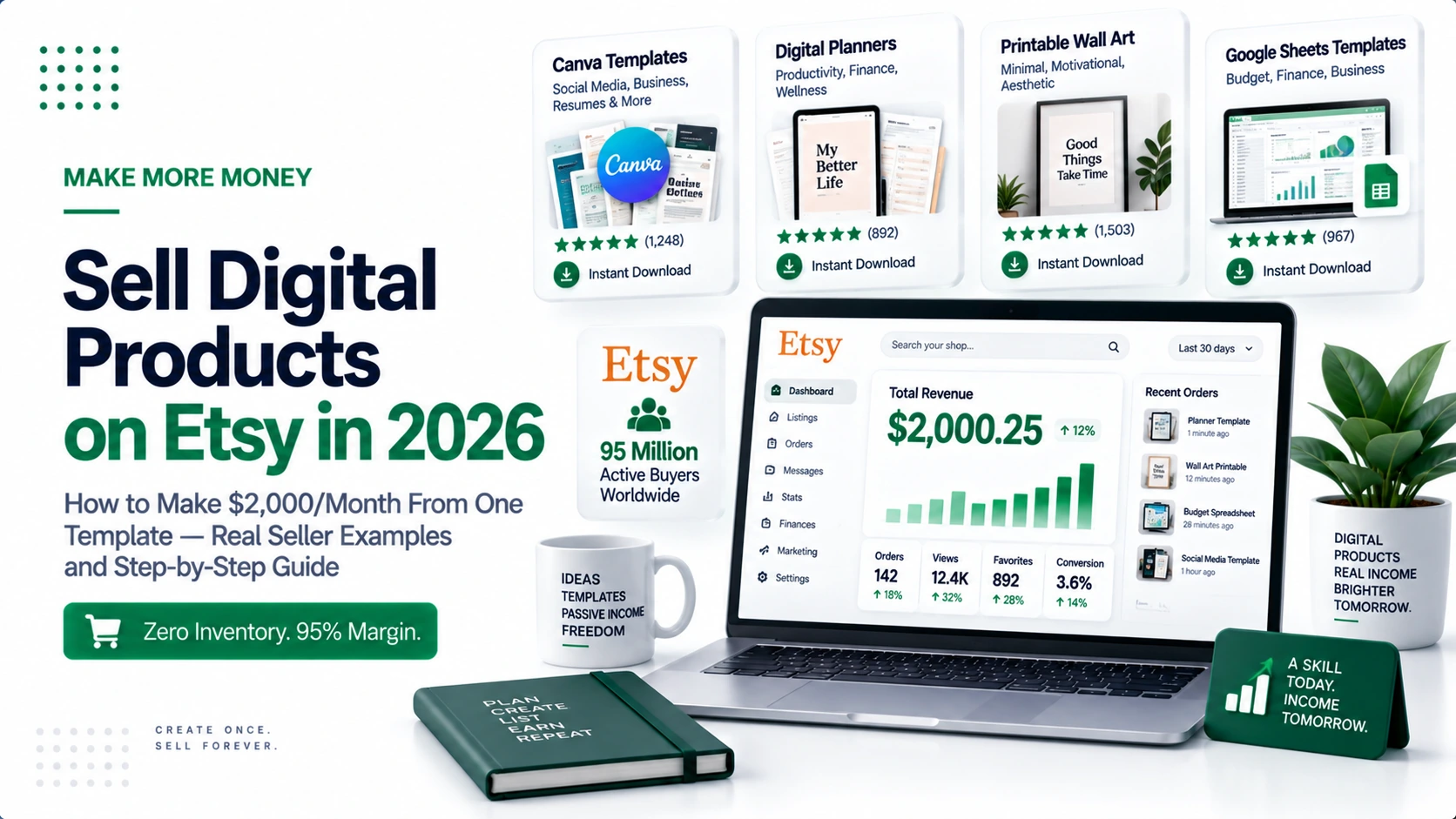
- Selling digital products on Etsy is one of the highest-margin businesses available in 2026 — create once, sell forever, 95%+ profit on every sale
- Sarah started selling Instagram Canva templates in January 2025. By month 3, her shop hit £6,000/month working 10 hours per week
- Etsy has 95 million active buyers in 2026 — a built-in audience actively searching for templates, planners, and printables every single day
- The top 5 best-selling digital product categories in 2026: business templates, wedding stationery, digital planners, printable wall art, and SVG cut files
- Shops with 50–100 well-optimized listings in the right niche can realistically generate $500–$2,000/month in passive income — and top sellers earn $10,000–$50,000+/month
Sell digital products on Etsy in 2026 and you can earn money from a file you created once — while you sleep, while you work, while you are on vacation.
That is not a marketing line. It is the verified business model of thousands of Etsy sellers generating $1,000 to $10,000 per month from templates, planners, and printables that cost nothing to deliver after the initial creation.
Sarah started selling Instagram Canva templates in January 2025. She designed 200 templates in Canva, bundled them together, and listed them for £18–£25. Her shop hit £6,000 in monthly revenue by month 3. She works 10 hours per week.
Another seller in a digital products community went from 12 listings to 400+ in a single month by batch-creating design sets. Products from 2021 still generate $100–$300 per month — years after the original creation.
This is the complete guide to how it works, what sells, how to start with zero experience, and what the realistic income timeline looks like.
- Why selling digital products on Etsy works in 2026
- The 8 best-selling digital products on Etsy right now
- What realistic income looks like — with real seller data
- How to start your Etsy digital shop this week
- Etsy SEO — how to get found by buyers
- The 4 mistakes that kill most new shops
- Frequently Asked Questions
Why Selling Digital Products on Etsy Works in 2026
The economics of digital products on Etsy are unlike almost any other business model available to a beginner.
Zero inventory. Zero shipping. Zero marginal cost.
When someone buys your digital product on Etsy, the platform delivers the file automatically. You do not pack anything, ship anything, or manage any inventory. The 50th sale of a template costs you exactly the same as the first: nothing. A physical product business requires you to source, store, and ship every unit. A digital product business requires you to create the file once. Every sale after that is pure margin.
95 million active buyers already on the platform
Etsy has 95 million active buyers in 2026 — people who came to the platform specifically to find and buy creative products. You do not need to build an audience, run ads, or drive traffic from scratch. The buyers are already there, already searching, already with payment details saved. Your job is to create a product they are already looking for and optimize your listing so they can find it.
Profit margins of 95%+
Etsy charges a $0.20 listing fee per item and a 6.5% transaction fee on each sale. On a $15 template, you pay approximately $1.20 in fees and keep $13.80. Your profit margin is 92%. Compare that to a physical product business where manufacturing, shipping, and storage typically consume 40–70% of revenue. Digital products on Etsy are one of the highest-margin businesses available to anyone starting from zero.
Products earn for years after creation
A well-optimized Etsy listing does not expire. Products created in 2021 still generate consistent monthly income for sellers who built their shops well. The income is not just passive in the short term — it compounds as listings accumulate reviews, gain search ranking, and continue selling without any additional effort.
External resource: How to make $2,000–$10,000/month selling digital downloads on Etsy — SideQuestHustle
The 8 Best-Selling Digital Products on Etsy Right Now
Not all digital products sell equally on Etsy. These are the 8 categories generating consistent income for sellers in 2026 — with real pricing and earning data.
1. Canva Social Media Templates — $500–$6,000/Month
Price range: $8–$25 per pack | Best niches: Instagram, Pinterest, LinkedIn, coaches, real estate agents, restaurants
Social media Canva templates are among the top-selling digital products on Etsy in 2026. Content creators, influencers, entrepreneurs, and small businesses rely on Canva to create professional-looking content without starting from scratch — and they will pay $15–$25 for a pack of 30–100 branded templates that saves them hours.
Real example: Sarah designed 200 Instagram Canva templates, listed them in bundles of 30–50 at £18–£25 each, and hit £6,000/month revenue by month 3 working 10 hours per week. Average monthly views for top social media template shops: 696,000+.
The key insight: niche-specific templates outsell generic ones every time. “Instagram templates for real estate agents” converts better than “Instagram templates.” The more specific your buyer, the higher your conversion rate and the less competition you face.
2. Digital Planners — $8–$25 Each, 95% Margin
Price range: $8–$25 | Best formats: GoodNotes, Notability, iPad-compatible PDF
Digital planners for iPad are one of the most consistent selling categories on Etsy. Buyers use them in GoodNotes and Notability apps for daily planning, goal setting, habit tracking, and journaling. A well-designed undated daily planner with hyperlinked navigation sells repeatedly year-round with no seasonal dropoff.
What sells best: undated planners (no year means no expiry), niche-specific versions (teacher planners, fitness planners, budget planners), and planner bundles that combine multiple layouts at a higher price point ($25–$45).
The compound advantage: planner buyers often return to the same shop for multiple purchases. A buyer who loves your 2026 planner layout will buy your habit tracker, your gratitude journal, and your meal planner — making each initial sale worth significantly more than its face value.
3. Business Templates — $12–$40, B2B Buyers with Bigger Budgets
Price range: $12–$40 | Best types: Invoice templates, contract templates, proposal templates, Google Sheets trackers
Business templates target small business owners, freelancers, and entrepreneurs — buyers who have professional budgets and understand the value of a tool that saves them hours. A clean, formula-ready Google Sheets invoice template sells for $12–$20 and requires almost no ongoing support once the instructions PDF is included.
The highest-value business templates in 2026: budget and bookkeeping spreadsheets ($15–$35), freelance contract templates ($20–$40), social media content calendars ($12–$25), and client onboarding kits ($25–$45). Business buyers also leave more detailed, credibility-building reviews than general consumer buyers.
4. Wedding Stationery Templates — $15–$50, High-Value Orders
Price range: $15–$50 per template | Best types: Invitations, save the dates, programs, menus, table numbers
Wedding stationery is one of the most lucrative digital product niches on Etsy because couples buy entire suites — an invitation, a save the date, a program, a menu, and table numbers all in the same style. One buyer can easily generate $80–$150 in sales from a single wedding event. The market is enormous, seasonal peaks are predictable (January–April for summer weddings), and premium design commands premium prices.
What converts: Corjl and Canva-editable templates that buyers can personalize themselves without hiring a designer. Clear mockup photos showing the stationery in real settings (dinner table, envelope, flat lay) dramatically increase click-through and conversion rates.
5. Printable Wall Art — $5–$15, Volume Plays
Price range: $5–$15 per print | Best niches: Minimalist quotes, botanical prints, nursery art, kitchen prints, motivational art
Printable wall art is the highest-volume category on Etsy — lower per-item price but enormous search demand and a buyer pool that purchases multiple prints at once for gallery walls. A set of 3 coordinated botanical prints priced at $8–$12 each generates $24–$36 per transaction.
The Etsy algorithm advantage: printable wall art listings accumulate reviews faster than higher-priced products because of purchase volume, which improves search ranking, which drives more traffic, which generates more reviews. Early momentum in this category compounds quickly once a shop establishes its first 20–30 reviews.
6. SVG Cut Files — Crafters Who Buy Repeatedly
Price range: $3–$12 per file | Best types: Cricut files, Silhouette files, themed SVG bundles
SVG cut files for Cricut and Silhouette cutting machines are one of the most loyal buyer categories on Etsy. Crafters who find a designer they like return again and again for new designs. One seller building a library of 400+ SVG files across multiple themes generates consistent $2,000–$4,000/month purely from this category.
Best performing themes in 2026: seasonal designs (holiday, Halloween, Valentine’s), hobby-specific files (dog mom, plant mom, teacher), and niche profession files (nurse, firefighter, military). Bundles of 20–50 related SVG files at $8–$15 outperform individual files dramatically.
7. Educational Printables for Teachers — Repeat Customers
Price range: $3–$20 | Best types: Classroom decor, worksheets, lesson plan templates, reading logs
Teachers are one of the most loyal and highest-volume buyer segments on Etsy. A teacher who finds a classroom decor set they love buys the alphabet version, the numbers version, the seasonal version, and the subject-specific version from the same shop. Educational printables generate repeat customers at a rate few other categories match.
The subject advantage: niche subject matter outperforms generic education printables. “3rd grade multiplication worksheets” converts better than “math worksheets.” Specificity drives search traffic from teachers who know exactly what they need.
8. Budget and Finance Spreadsheets — Personal Finance Buyers
Price range: $8–$35 | Best types: Monthly budget trackers, debt payoff planners, savings goal trackers, income/expense spreadsheets
Personal finance spreadsheets are a fast-growing category on Etsy in 2026 — driven by the same interest in budgeting and financial control that makes personal finance content so popular. A pre-built Google Sheets budget that is color-coded, formula-ready, and actually works is worth good money to buyers who cannot afford a financial app subscription or accountant.
The review advantage: buyers who successfully use a budget spreadsheet to pay off debt or save money leave glowing, detailed reviews that generate enormous organic credibility. One authentic five-star review describing real financial results is worth more to conversion than ten generic positive reviews.
What Realistic Income Looks Like — With Real Seller Data
Here is the honest income picture across different levels of commitment and catalog size.
| Stage | Listings | Timeline | Realistic Monthly Income |
|---|---|---|---|
| Starting out | 10–20 listings | Month 1–2 | $0–$100 |
| Building momentum | 30–50 listings | Month 2–4 | $100–$500 |
| Consistent income | 50–100 listings | Month 3–6 | $500–$2,000 |
| Serious income | 100–300 listings | Month 6–12 | $2,000–$6,000 |
| Top seller | 300–1,000+ listings | Month 12+ | $10,000–$50,000+ |
The listing count insight that changes everything: Etsy’s algorithm rewards active shops. A shop with 100 listings has 100 opportunities to appear in search results. A shop with 10 listings has 10. Volume is a multiplier — every new listing is a new entry point for buyers. Sellers who batch-create products and add listings consistently grow their monthly income faster than sellers who spend weeks perfecting a small number of products.
Real seller benchmarks from 2026 data: most successful Etsy digital sellers reach $1,000–$3,000 per month within 6–12 months. Top sellers in competitive niches like planners and SVG files earn $10,000+ monthly. The income is largely passive once listings are optimized — meaning it continues to grow even when you are not actively working.
How to Start Your Etsy Digital Shop This Week
Here is the exact launch sequence that works — in the order that matters.
Step 1 — Pick one niche and one product type
The most common mistake beginners make is trying to sell everything. Budget planners AND wedding invitations AND SVG files AND wall art in the same shop. Etsy’s algorithm favors shops with coherent themes — and buyers trust shops that specialize. Pick one niche (personal finance, weddings, fitness, teachers, real estate) and one product type (Canva templates, printables, spreadsheets) to start. You can expand later once you have traction.
Step 2 — Create your first 10 products using Canva (free)
Canva’s free tier is sufficient to create professional digital products. For templates, use Canva’s template editor to build layouts your buyers can customize. For printables, design in standard sizes (A4, US Letter, 5×7 for stickers and cards). Export as high-resolution PDF for printables, or share Canva template links for editable templates. AI tools like ChatGPT can help you generate content ideas, descriptions, and variations significantly faster than working from scratch.
Step 3 — Open your Etsy shop ($0 to start)
Creating an Etsy account and opening a shop is free. Your first listing costs $0.20. Choose a shop name that reflects your niche but is flexible enough to grow with — avoid names too specific to one product type. Complete your shop bio, add a professional-looking banner (Canva has free templates), and set your policies before your first listing goes live.
Step 4 — Write listings that rank in Etsy search
Your listing title, tags, and description determine whether Etsy shows your product to buyers. Use the exact words buyers type when searching — not the words you would use to describe the product. “Budget planner Google Sheets” converts better than “financial tracking spreadsheet.” Use all 13 available tags with specific long-tail phrases. Include the file format, the niche, the use case, and the skill level in your title and description.
Step 5 — Add 3–5 new listings per week consistently
The shops that build to $2,000/month fastest are not the ones that launched with the most listings. They are the ones that added listings most consistently. 3–5 new products per week for 12 weeks produces a 36–60 listing catalog — the critical mass where Etsy’s algorithm begins rewarding the shop with significantly more search visibility.
Put your Etsy income to work: 12 Passive Income Ideas That Actually Work in 2026
Etsy SEO — How to Get Found by Buyers
Etsy SEO is the single biggest lever in your shop’s growth. A well-optimized listing earns free organic traffic for years. A poorly optimized listing earns nothing regardless of product quality.
How Etsy search works
Etsy ranks listings based on relevance (how well your title and tags match the search query), listing quality (click-through rate, conversion rate, and reviews), and recency (newer listings get a temporary visibility boost). This means your goal is not just to use the right keywords — it is to get buyers to click on your listing and then purchase it.
The title formula that works
Primary keyword first, then secondary keywords, then descriptors. Example: “Budget Planner Google Sheets | Monthly Budget Tracker | Personal Finance Spreadsheet | Instant Download.” The primary keyword “budget planner Google Sheets” appears first because Etsy weights the beginning of the title more heavily. Secondary keywords fill the remaining space with related terms buyers also search.
Use all 13 tags — with long-tail phrases
Each tag can be up to 20 characters. Use specific long-tail phrases rather than single words. “Instagram templates Canva” (24 characters — split into two tags if needed) is more valuable than “Canva” or “templates” alone. Long-tail tags face less competition and reach buyers with higher purchase intent — they already know what they want.
Mockup images that convert
Your first listing image determines your click-through rate — the percentage of people who see your listing in search results and click on it. Show your product in context: a planner displayed on an iPad on a desk, a wall art print in a styled room, a Canva template previewing its customization capability. Lifestyle mockups consistently outperform plain white background product shots for digital downloads.
The 4 Mistakes That Kill Most New Shops
Most Etsy digital shops fail not because the products were bad — but because of four specific and entirely avoidable mistakes.
Mistake 1 — Quitting after the first month
New Etsy shops earn almost nothing in month 1. Etsy’s algorithm needs time to index your listings, accumulate data on click-through and conversion rates, and build the trust signals that drive organic ranking. Sellers who quit after 30 days of zero sales are abandoning a shop right before it would have started gaining traction. Give every new Etsy shop a minimum of 90 days before making any conclusions about its viability.
Mistake 2 — Too few listings
A shop with 5 listings has almost no chance of generating meaningful income regardless of product quality. Etsy’s search results surface listings from active, well-stocked shops. A shop with 10 listings competes against shops with 500 listings — and loses. The minimum viable catalog for consistent traffic is 30–50 listings. The minimum for $1,000+/month is typically 50–100.
Mistake 3 — Generic products with no niche
Generic digital products — “social media templates,” “budget planner,” “wall art” — compete against thousands of established shops with hundreds of reviews. Niche-specific products compete against far fewer sellers and convert at significantly higher rates because the buyer feels the product was made specifically for them. “Social media templates for Airbnb hosts” has dramatically less competition than “social media templates” — and buyers searching that specific phrase are ready to buy.
Mistake 4 — No instructions PDF in the download
Digital products with clear, simple instructions receive dramatically fewer customer support messages and significantly better reviews. A one-page PDF inside every download explaining how to access, edit, and print the product eliminates the most common buyer frustrations. Better reviews mean higher search ranking. Higher search ranking means more sales. A simple instructions page is one of the highest-ROI investments you can make in your Etsy shop.
Build more income streams: How Real People Are Making $5,000/Month With AI in 2026
Frequently Asked Questions
How much does it cost to start selling digital products on Etsy?
The startup cost is minimal — Etsy charges $0.20 per listing and a 6.5% transaction fee on each sale. Canva’s free tier is sufficient to create professional digital products. An AI tool like ChatGPT Plus ($20/month) can accelerate product creation significantly. Your total startup cost can be as low as $2 for your first 10 listings — making this one of the lowest-barrier income opportunities available. Unlike a physical product business, there is no inventory to purchase, no shipping materials to buy, and no upfront production cost.
Do I need design skills to sell digital products on Etsy?
No — Canva makes it possible for anyone to create professional-looking digital products without design training. Canva’s template library provides starting points for virtually every product type, and the drag-and-drop editor requires no technical skill. The most important skill for Etsy success is not design — it is understanding what buyers are searching for and creating products that solve their specific problems. A simple, well-targeted product in the right niche consistently outperforms a beautifully designed product in the wrong niche.
How long does it take to make $2,000/month selling digital products on Etsy?
Based on real seller data in 2026, reaching $2,000/month typically takes 6–12 months of consistent effort. The fastest path involves: starting with a specific niche, adding 3–5 new listings per week, and optimizing titles and tags for search from the first listing. Sarah’s example — £6,000/month by month 3 — represents an exceptional case driven by a strong niche choice, high listing volume, and experience with Canva design. A realistic expectation for a complete beginner is $200–$500/month by month 4–6, growing to $1,000–$2,000/month by month 8–12. The income compounds as listings accumulate reviews and ranking.
Final Thoughts
Selling digital products on Etsy in 2026 is one of the most accessible passive income models available — zero inventory, zero shipping, 95%+ margins, and a built-in audience of 95 million buyers already on the platform.
Sarah hit £6,000/month by month 3. A seller from 2021 still earns $100–$300 per month from products created years ago. The economics of digital products compound in a way almost no physical business can match.
The formula is not complicated: pick one niche, create consistently, optimize every listing for search, and add 3–5 new products per week for 90 days. The shops that do this earn real, growing, passive income. The shops that launch 10 listings and wait for traffic earn nothing and conclude that Etsy does not work.
The difference is not talent, design skill, or a secret strategy. It is showing up consistently long enough for the compounding to kick in.