
Key Takeaways
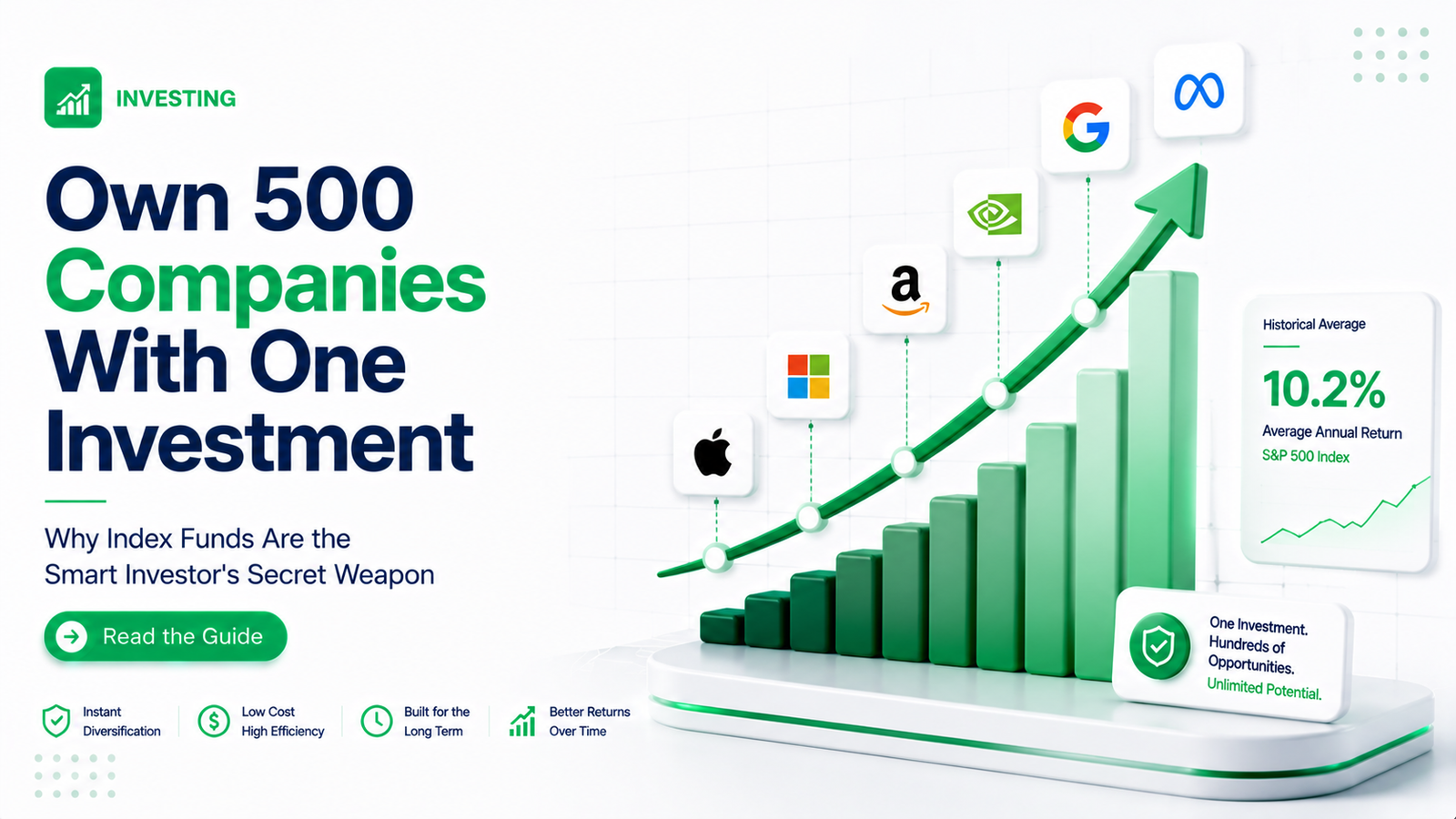
- An index fund is a basket of stocks that tracks a market index — you own a piece of hundreds of companies with one investment
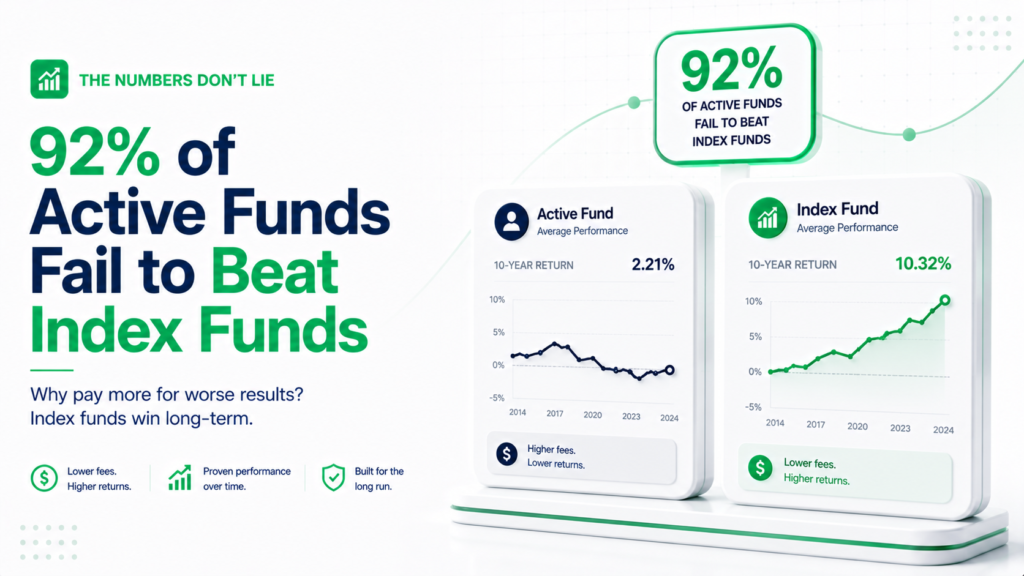
- Over 15 years, 92% of actively managed funds underperform simple index funds — experts rarely beat the market
- Index funds are low cost, low effort, and designed for long-term wealth building
- You can start investing in index funds with as little as $1 through fractional shares
- The most important step is starting early and investing consistently — time in the market beats timing the market every time
If there is one investment strategy that has stood the test of time for everyday people, it is index fund investing.
You do not need to pick winning stocks. You do not need to follow the market daily. You do not need a finance degree or a stockbroker. Index funds do the work for you — automatically, at very low cost, and with a historical track record that most professional fund managers fail to beat.
This guide explains exactly what index funds are, how they work, and how to start investing in them today — even if you have never invested a single dollar before.
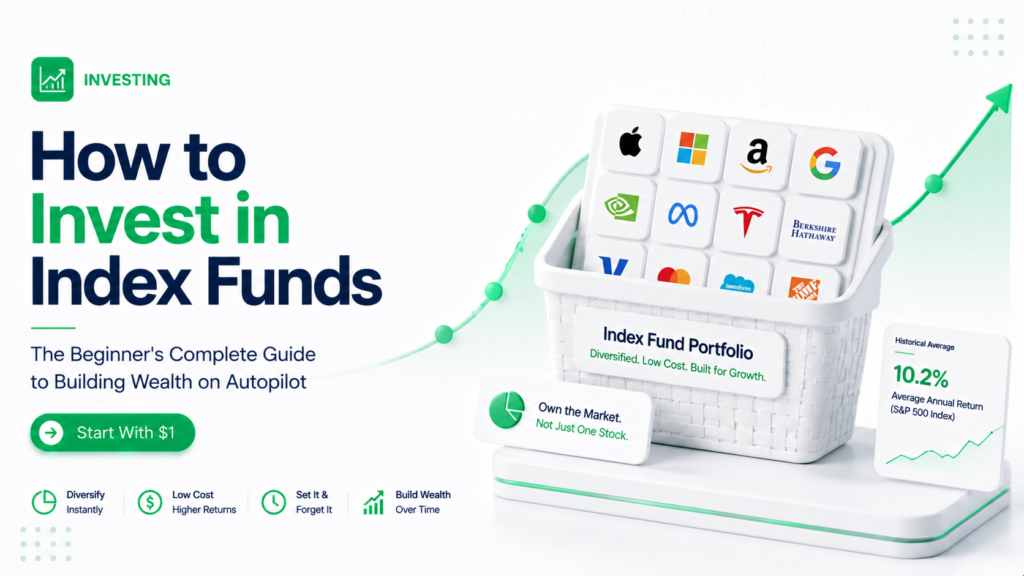
Table of Contents
What Is an Index Fund?
An index fund is a type of investment fund that tracks a specific market index — a predefined list of companies or assets. Instead of a fund manager picking individual stocks, the fund simply holds everything in the index automatically.
Think of it like a gift basket. Instead of choosing one fruit, you buy a basket that contains a little of everything — apples, oranges, grapes, and more. When the market grows, your basket grows with it.
The most well-known index is the S&P 500 — a list of the 500 largest publicly traded companies in the United States, including Apple, Microsoft, Amazon, and hundreds more. When you invest in an S&P 500 index fund, you instantly own a tiny piece of all 500 of those companies.
Other popular indexes include:
- Total Stock Market Index — covers thousands of companies across all sizes
- International Stock Market Index — companies outside the US across 40+ countries
- Emerging Markets Index — fast-growing economies including China, India, and Brazil
- Sector indexes — technology, healthcare, energy, and other specific industries
External resource: How to invest in index funds — Fidelity
Why Index Funds Beat Most Other Investments
Index funds have one of the strongest track records in investing history. Here is why they consistently outperform most alternatives for everyday investors:
1. Lower Fees Mean Higher Returns
Actively managed funds charge annual fees — sometimes 1% or more — to pay fund managers who pick stocks. Index funds charge a fraction of that, often 0.03% to 0.20% per year. Over 30 years, that fee difference can cost you tens of thousands of dollars in lost returns.
2. Most Professionals Cannot Beat Them
According to SPIVA data, over a 15-year period, 92% of actively managed funds underperformed their benchmark index. That means the vast majority of professional stock pickers failed to beat simply owning the index. If experts cannot reliably beat index funds, picking individual stocks as a beginner is an even harder game to win.
3. Instant Diversification
Buying a single index fund gives you exposure to hundreds or thousands of companies across multiple industries. If one company collapses, it barely affects your overall portfolio. Diversification is one of the most powerful tools in investing — and index funds deliver it automatically.
4. Passive and Low Maintenance
Index funds require almost no ongoing attention. You invest, set up automatic contributions, and let time do the work. There are no stocks to research, no earnings reports to read, no timing decisions to make.
5. Long-Term Track Record
The S&P 500 has delivered average annual returns of approximately 10% over long periods — including multiple recessions, crashes, and global crises. That consistent long-term performance is what makes index funds the foundation of most serious wealth-building strategies.
External resource: What is an index fund — Investopedia
Types of Index Funds for Beginners
Index funds come in two main structures. Both track indexes — the difference is how they are bought and sold.
| Type | How It Trades | Minimum Investment | Best For |
|---|---|---|---|
| ETF (Exchange-Traded Fund) | Like a stock — bought and sold throughout the day | Price of one share (or $1 with fractional shares) | Most beginners — flexible and low cost |
| Mutual Fund Index Fund | Once per day after market close | Often $0 to $1,000 depending on provider | Long-term investors who prefer simplicity |
For most beginners, ETFs are the easier starting point — lower minimums, easier to buy, and available on almost every investment platform worldwide.
Most popular index funds for beginners
- VTI — Vanguard Total Stock Market ETF. Covers the entire US stock market in one fund.
- VOO — Vanguard S&P 500 ETF. Tracks the 500 largest US companies.
- VXUS — Vanguard Total International Stock ETF. International exposure outside the US.
- VT — Vanguard Total World Stock ETF. Entire global stock market in one fund.
Also read: Best Investment Apps for Beginners with $100
How to Start Investing in Index Funds — Step by Step
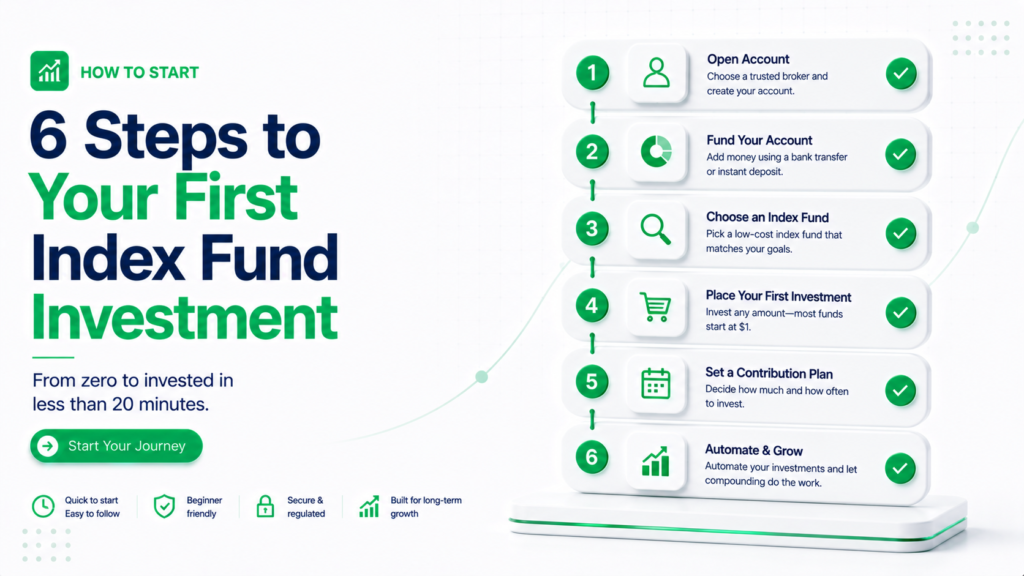
Step 1 — Build your financial foundation first
Before investing, make sure you have a small emergency fund of at least $500 to $1,000 saved. Investing money you might need in an emergency forces you to sell at the wrong time. Emergency fund first — then invest.
Step 2 — Choose an investment platform
You need a brokerage account to buy index funds. Choose a platform that offers:
- Zero or very low trading fees
- Access to ETFs and index funds
- Fractional shares (so you can invest with any amount)
- A simple, clean mobile app
- Availability in your country
Popular global platforms include eToro, Interactive Brokers, Degiro, and Trading 212. Research which platforms are available and regulated in your country before opening an account.
Step 3 — Open and fund your account
The process takes 10 to 20 minutes. You will need your ID, personal details, and a bank account to link. Most platforms allow you to start with as little as $1 through fractional shares.
Step 4 — Choose your index fund
For most beginners, one broad market index fund is enough to start. A total stock market ETF or an S&P 500 ETF gives you instant diversification across hundreds of companies. Keep it simple — you do not need multiple funds on day one.
Step 5 — Set up automatic monthly contributions
The most powerful investing habit is automating a fixed monthly contribution — even $50 or $100 — on the same date every month. This strategy is called dollar-cost averaging. By investing the same amount regularly regardless of market conditions, you automatically buy more shares when prices are low and fewer when they are high.
Step 6 — Leave it alone and let it grow
Check your portfolio quarterly — not daily. Markets go up and down constantly. Watching every move leads to emotional decisions that hurt long-term returns. Set your automatic contributions, stay consistent, and give time the chance to do its work.
External resource: How to invest in index funds — NerdWallet
How Much Should You Invest?
There is no perfect number — the right amount is whatever you can invest consistently without touching your emergency fund or stretching your monthly budget.
A common guideline is to invest 10% to 15% of your monthly take-home pay. However, even $25 or $50 per month invested consistently for 20 to 30 years compounds into a significant sum.
What consistent investing looks like over time (at 10% average annual return)
| Monthly Investment | After 10 Years | After 20 Years | After 30 Years |
|---|---|---|---|
| $50/month | $10,156 | $38,284 | $113,024 |
| $100/month | $20,312 | $76,569 | $226,049 |
| $300/month | $60,938 | $229,707 | $678,146 |
These figures are illustrative estimates based on a 10% average annual return. Past performance does not guarantee future results.
Also read: How to Start Investing with $500 or Less
Common Mistakes Beginners Make
- Waiting for the perfect moment. There is no perfect time to invest. Time in the market consistently beats timing the market. The best day to start was yesterday — the second best is today.
- Checking the portfolio every day. Daily price changes are normal and irrelevant to a long-term investor. Frequent checking leads to emotional decisions that hurt returns.
- Selling during a market downturn. Market dips are temporary. Selling during a crash locks in losses permanently and means missing the recovery. Stay invested.
- Buying too many funds at once. Owning ten different index funds does not automatically create more diversification — many funds overlap significantly. One or two broad market funds is enough for most beginners.
- Ignoring expense ratios. Always check the annual fee before buying a fund. Even a small difference — 0.03% versus 1.00% — costs tens of thousands of dollars over a 30-year investing period.
- Investing emergency fund money. Only invest money you will not need for at least three to five years. Markets can drop 30% to 50% in the short term. Your emergency fund must stay safe and accessible.
Also read: Passive Income Ideas That Work with a Full-Time Job
Frequently Asked Questions
Is investing in index funds halal?
This is an important question for Muslim investors. Most Islamic finance scholars consider investing in broadly diversified stock index funds permissible, as long as the underlying companies do not primarily operate in forbidden industries such as alcohol, gambling, conventional banking, or weapons. For stricter compliance, shariah-screened index funds and ETFs are available through specialist providers — these specifically exclude non-halal companies from the index. Consult a qualified Islamic finance scholar for guidance specific to your situation.
Can I lose all my money in an index fund?
Theoretically yes — but in practice, extremely unlikely for a broad market index fund. For an S&P 500 or total market fund to go to zero, every single major company in the index would need to simultaneously go bankrupt. While index funds do fall in value during market downturns — sometimes significantly in the short term — they have historically always recovered and reached new highs over time. The key is to invest for the long term and not sell during downturns.
How long should I hold index funds?
Index funds are long-term investments. A minimum holding period of five years is generally recommended — ideally ten years or more. The longer you hold, the more time compounding has to work and the lower the chance of experiencing a net loss. Most serious investors hold index funds for decades, letting contributions and growth accumulate over their entire working life.
Final Thoughts
Index fund investing is not exciting. It will not make you rich overnight. But it is one of the most reliable, proven, and accessible paths to long-term wealth that exists — and it is available to anyone with a smartphone and a few dollars to start.
Pick one broad market index fund. Open an account on a regulated platform. Set up a monthly automatic contribution. Then get out of the way and let time do the work.
The earlier you start, the more powerfully your money compounds. Start today.
Keep Reading
Build your investing knowledge