
Key Takeaways
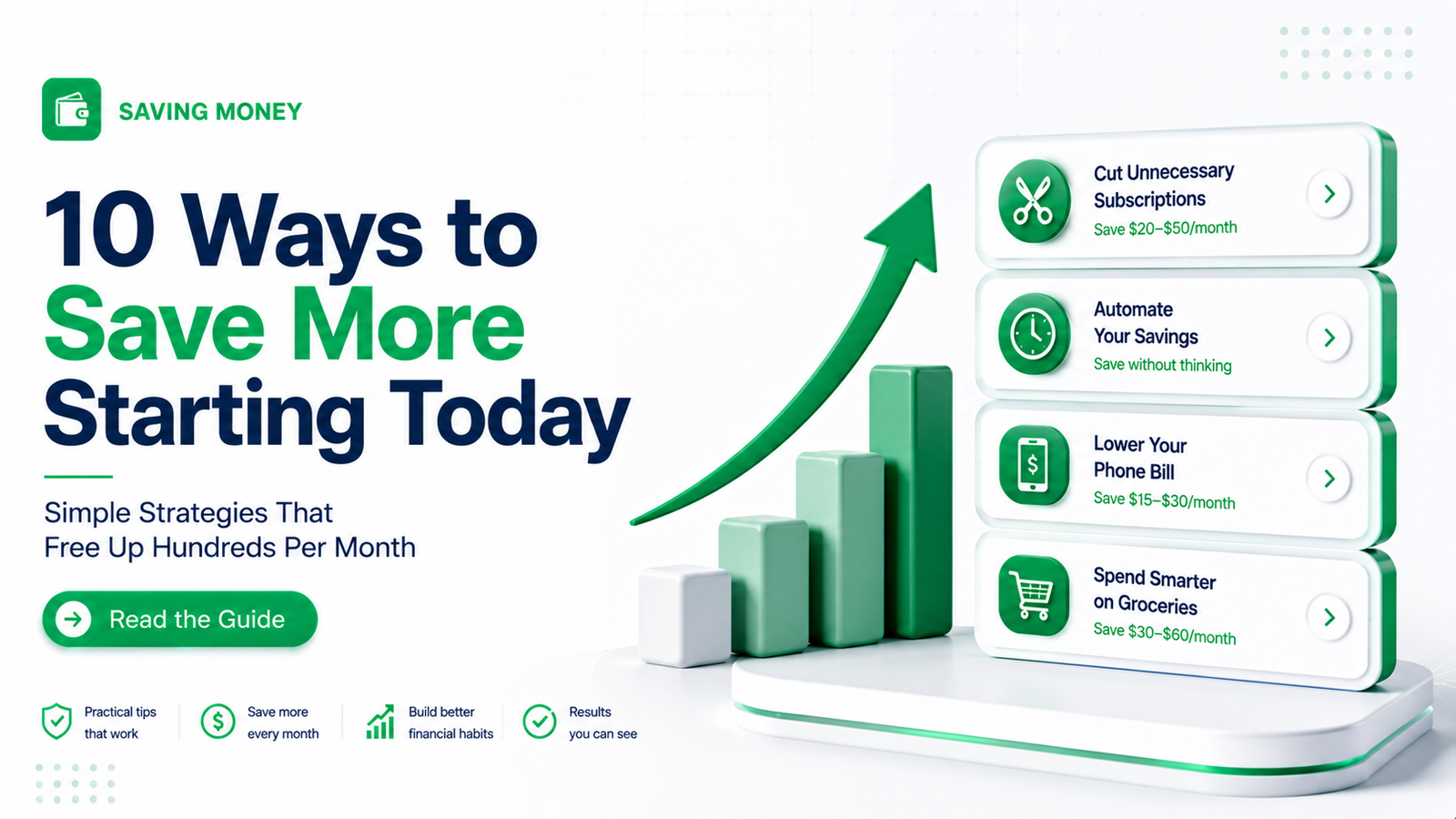
- Saving money fast starts with knowing exactly where your money goes right now
- Automating your savings removes willpower from the equation entirely
- Cutting subscriptions, dining out, and impulse purchases can free up hundreds per month immediately
- Treating savings like a fixed bill — not an afterthought — is the single most effective mindset shift
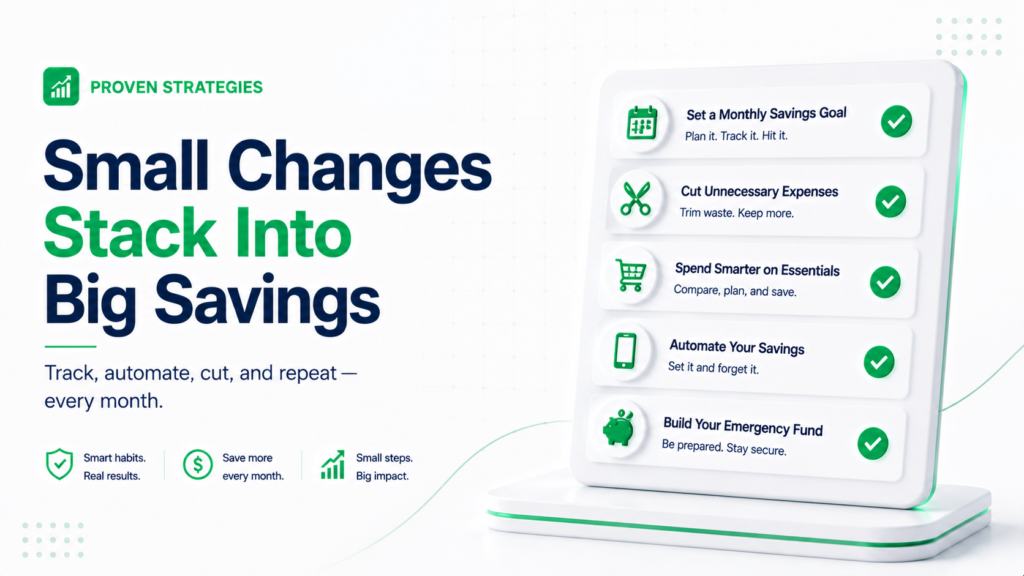
- Small consistent actions compound into major savings faster than one dramatic change
You do not need a higher salary to save more money. You need a better system.
Most people save whatever is left at the end of the month — which is usually nothing. The people who actually build savings do it differently. They save first, then live on the rest. They automate the process, cut the leaks, and treat every spare dollar as a building block toward something bigger.
This guide gives you 10 proven strategies to save money faster — starting this week, no matter your income level or where you live in the world.
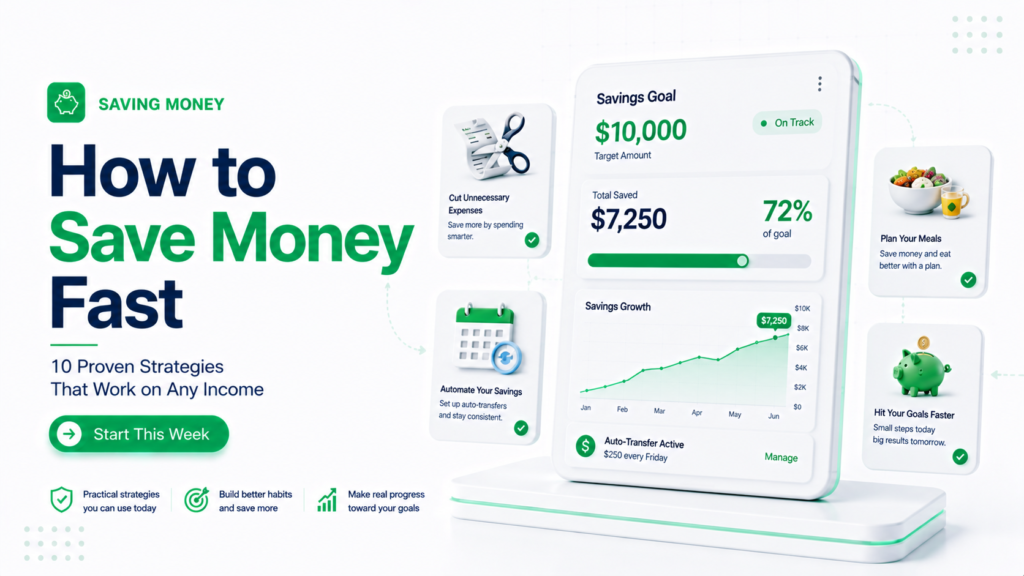
Table of Contents
Why Saving Money Feels So Hard
Saving money is simple in theory. In practice, it competes with rent, food, social pressure, convenience, and the constant temptation of instant gratification.
The real problem is not income — it is the system. Most people have no automatic mechanism that moves money into savings before they can spend it. Without that system, savings become optional. And optional savings almost never happen consistently.
The strategies below fix the system — not just the mindset.
External resource: How to save money — expert-backed strategies — U.S. News
10 Proven Strategies to Save Money Fast
1. Track Every Dollar for 30 Days
You cannot cut what you cannot see. Spend 30 days tracking every single purchase — groceries, transport, subscriptions, coffee, everything. Use a budgeting app, a spreadsheet, or even a notebook. After 30 days, patterns emerge clearly. Most people discover they are spending significant money on things they barely notice or use.
Expected result: Awareness alone often reduces spending by 10% to 15% within the first month.
2. Pay Yourself First — Automate Savings on Payday
The most powerful saving habit is also the simplest. Set up an automatic transfer from your main account to a dedicated savings account on the same day you get paid. Even if it is a small amount, the money moves before you can spend it. Over time, you simply stop noticing it is gone.
Treat your savings transfer like rent — non-negotiable, paid first, every month without exception.
Expected result: Consistent monthly savings regardless of willpower or motivation levels.
3. Do a Subscription Audit This Week
Go through your last two bank statements and highlight every recurring charge. Streaming services, gym memberships, apps, cloud storage, meal kits, news subscriptions — list them all. Cancel anything you have not used in the past 30 days. Most people find at least two to four subscriptions they forgot they were paying for.
Expected result: $30 to $150 freed up per month immediately.
4. Apply the 72-Hour Rule for Non-Essential Purchases
Before buying anything non-essential over a set amount — say $30 or $50 — wait 72 hours. Write the item down and come back to it after three days. In most cases, the urge to buy fades entirely. This single rule eliminates the majority of impulse spending without requiring constant willpower.
Expected result: Significant reduction in impulse purchases month after month.
5. Meal Plan and Cook at Home
Food is one of the biggest and most controllable spending categories for most households. Dining out, ordering delivery, and buying lunch at work adds up to hundreds per month. Meal planning and cooking at home can cut your food spending by 40% to 60% without eating worse — often while eating better.
Plan your week’s meals on Sunday. Shop from a list. Batch cook where possible. The savings are immediate and recurring.
Expected result: $100 to $400 saved per month depending on current eating habits.
6. Negotiate Your Bills
Most people pay whatever bill arrives without questioning it. Yet many providers — phone companies, internet providers, insurance companies — will offer lower rates to customers who simply ask. Call your providers, mention that you are considering switching, and ask for their best current offer. This takes 20 minutes and often results in meaningful monthly savings.
Expected result: $20 to $100 per month in reduced bills with one phone call.
7. Sell Things You No Longer Use
Most homes contain hundreds or thousands of dollars worth of unused items. Electronics, clothes, furniture, books, sports equipment — sell them on local marketplaces, online platforms, or community groups. This generates immediate cash that can go directly into savings or toward a specific goal.
Expected result: $100 to $1,000+ in one-time savings boost depending on what you own.
8. Switch to Generic Brands for Everyday Items
For most everyday products — cleaning supplies, toiletries, pantry staples, over-the-counter medicines — store brands offer the same quality as name brands at 20% to 40% less cost. The savings are small per item but significant across an entire monthly shop.
Expected result: $30 to $80 saved per month on regular shopping.
9. Set Specific Savings Goals — Not Just a Vague Target
Saving money with no clear goal is like driving with no destination. Specific goals create motivation, direction, and a measurable finish line. Instead of “I want to save more,” say “I want to save $1,500 for an emergency fund in 6 months — that means $250 per month.” Specific targets make the behaviour concrete and trackable.
Break large goals into monthly and weekly milestones. Celebrate each one without spending money to do it.
Expected result: Significantly higher follow-through compared to vague intentions.
10. Find an Accountability Partner
Sharing your savings goal with one trusted person dramatically increases the likelihood of following through. A weekly or monthly check-in — even just a brief message — creates gentle social accountability that reinforces your commitment when motivation dips.
Expected result: Meaningfully higher consistency over a 3 to 6 month savings period.
Also read: How to Save Your First $10,000
Your Simple Monthly Savings Plan
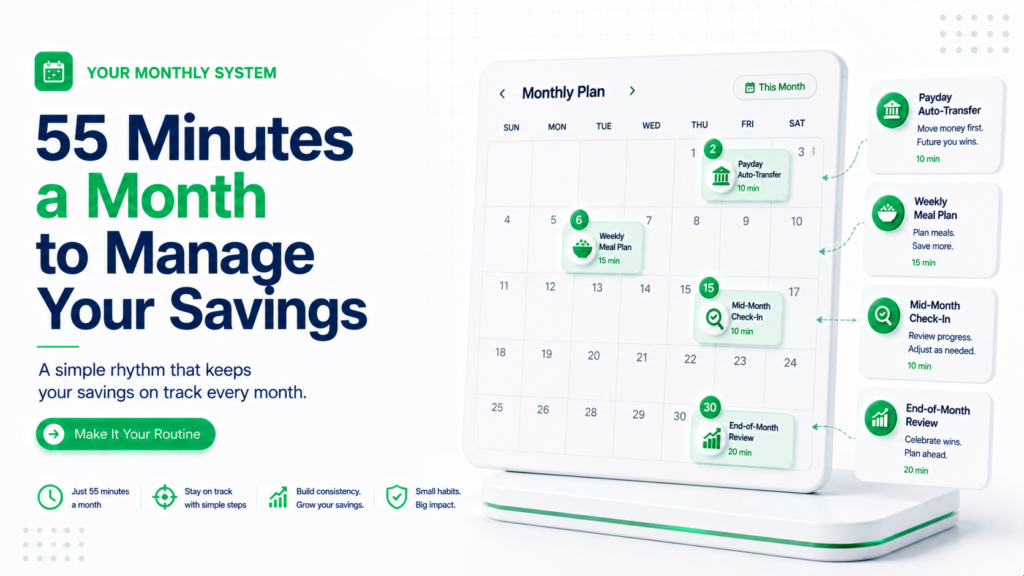
Here is how to put these strategies into a simple monthly rhythm:
| When | Action | Time Required |
|---|---|---|
| Day 1 — Payday | Automatic transfer to savings fires first | 0 minutes (automated) |
| Day 1 — Payday | Review last month’s spending by category | 15 minutes |
| Sunday each week | Plan meals and write shopping list | 20 minutes |
| Mid-month | Check spending against budget — adjust if needed | 10 minutes |
| End of month | Review progress toward savings goal — celebrate wins | 10 minutes |
Total active time required per month: approximately 55 minutes. That is less than one hour to manage your entire savings system.
Also read: Budgeting Methods Compared — 50/30/20 vs Zero-Based
External resource: How to set financial goals — Investopedia
Mistakes That Keep People From Saving
- Saving what is left over. If you wait until the end of the month to save, there will rarely be anything left. Save first, spend second — always.
- Setting one giant savings goal with no milestones. Big goals without checkpoints feel overwhelming and easy to abandon. Break every goal into monthly milestones and celebrate each one.
- Stopping after one bad month. Missing a savings target for one month does not cancel your progress. Adjust and continue — consistency over time matters far more than perfection.
- Trying to change everything at once. Implementing ten new habits simultaneously is a recipe for burnout. Start with two or three strategies, build the habit, then add more.
- Keeping savings in the same account as spending money. Money sitting in your main account will get spent. A separate dedicated savings account creates a psychological and practical barrier that protects your savings.
Also read: How to Build an Emergency Fund Fast
External resource: How to save money — Forbes Advisor
Frequently Asked Questions
How much of my income should I save each month?
A common guideline is to save at least 20% of your take-home income — this is the savings portion of the 50/30/20 rule. However, even saving 5% to 10% consistently is far better than saving nothing. Start with whatever amount you can automate without feeling the pinch, then increase it gradually as you cut expenses and grow your income.
What is the fastest way to save a large amount of money quickly?
The fastest approach combines cutting expenses and increasing income simultaneously. Identify your three biggest spending categories and reduce each one. At the same time, add any source of extra income — a side hustle, selling unused items, or extra work shifts — and direct 100% of that additional income straight into savings. The combination of reduced outflows and increased inflows accelerates savings dramatically.
Should I save money or pay off debt first?
Both at the same time — but in a specific order. First, build a small emergency buffer of $500 to $1,000 so that unexpected expenses do not push you back into debt. Then focus aggressively on paying off debt while maintaining a small monthly savings contribution. Once debt is cleared, redirect all debt payments into savings and investments.
Final Thoughts
Saving money fast is not about making one dramatic change. It is about stacking small, consistent actions that compound over weeks and months into real financial progress. Track your spending. Automate savings on payday. Cut the obvious leaks. Set a specific goal.
You do not need to be perfect. You need to start — and then keep going. The gap between where you are and where you want to be closes one saved dollar at a time.
Keep Reading
Build your savings foundation