
Key Takeaways
- The 50/30/20 rule is simple and flexible — ideal for budgeting beginners
- Zero-based budgeting gives every dollar a job — ideal for people serious about getting out of debt fast
- Neither method is universally better — the best budget is the one you will actually stick to
- You can combine elements of both methods to build a system that fits your life
- Consistency matters more than perfection — any budget beats no budget
You have decided to start budgeting. Good. Now comes the question everyone runs into: which budgeting method should you actually use?
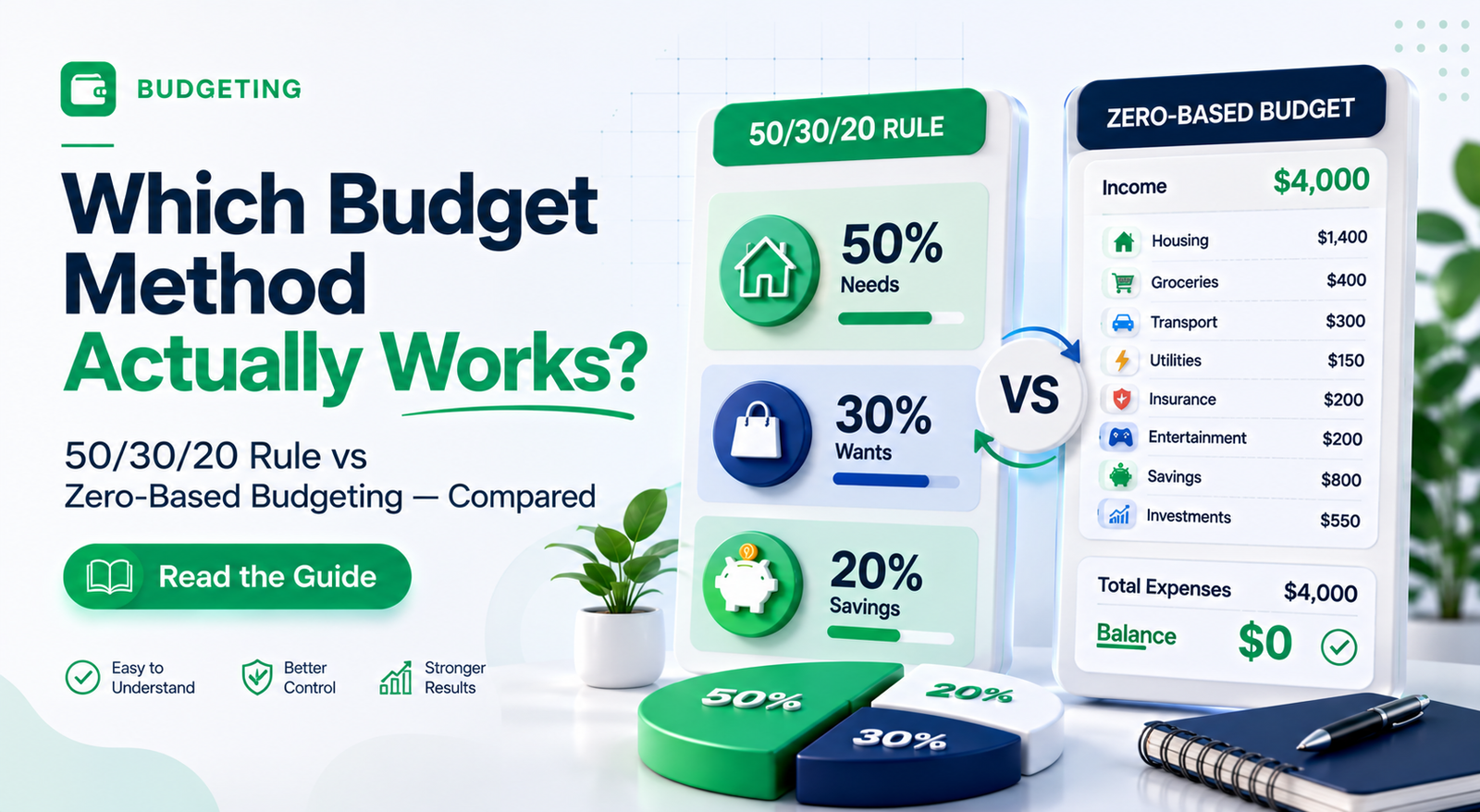
Two methods dominate the personal finance world — the 50/30/20 rule and zero-based budgeting. Both work. Both have produced real results for millions of people. But they work in very different ways and suit very different situations.
This guide breaks down exactly how each method works, who it is best for, and how to choose the right one for your life — so you can stop overthinking and start building a budget that actually sticks.
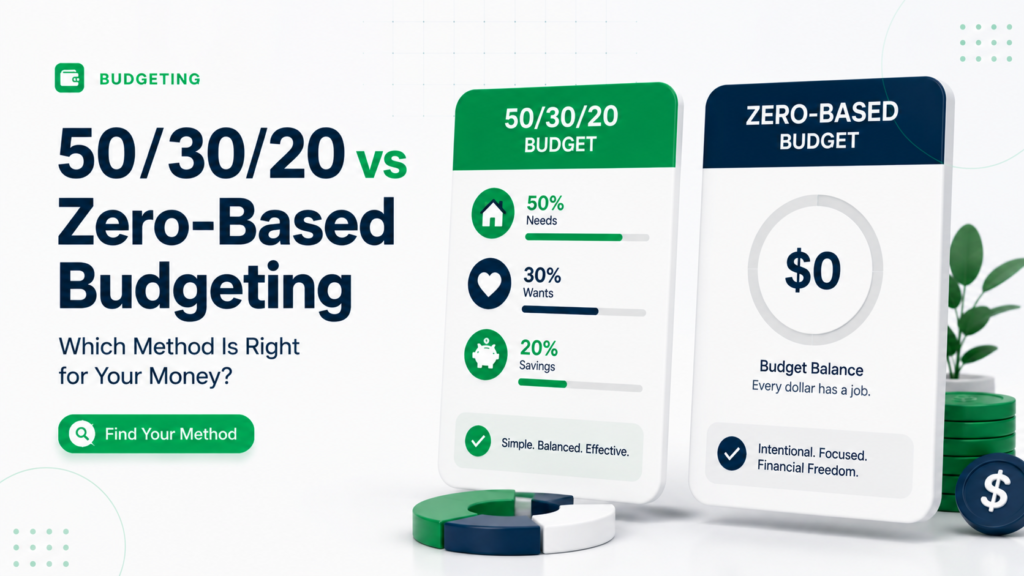
Table of Contents
Why Budgeting Methods Matter
A budget without a system is just a list of good intentions. A budgeting method gives your money a structure — rules that tell every dollar where to go before the month begins.
Without a method, most people end up doing what is called reactive budgeting — checking their account balance and hoping there is enough left. That approach almost never works.
A proper budgeting method:
- Removes the guesswork from spending decisions
- Makes saving automatic rather than optional
- Gives you a clear picture of where your money actually goes
- Creates accountability without requiring willpower every single day
External resource: Why you need a budget — Investopedia
The 50/30/20 Rule Explained
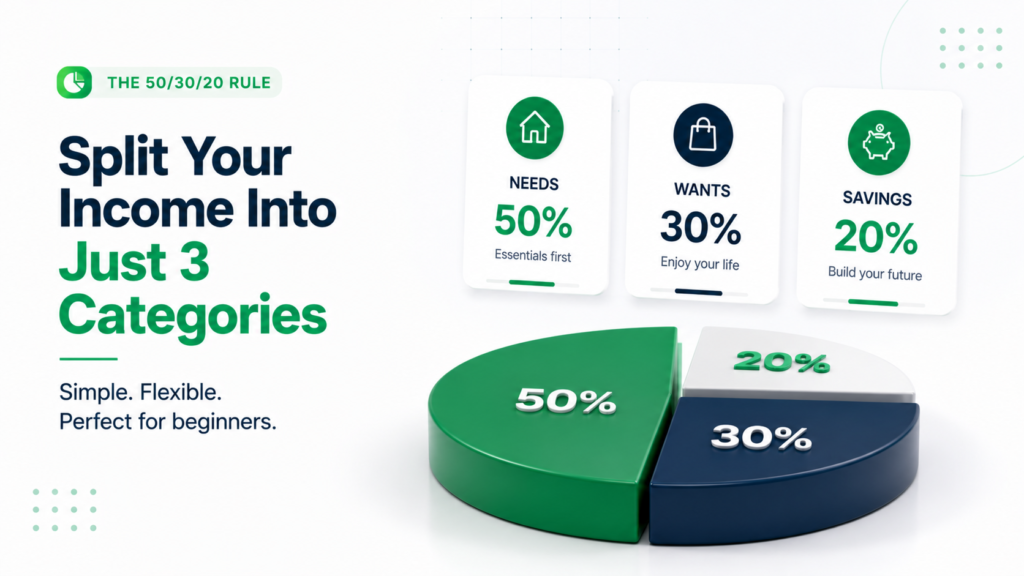
The 50/30/20 rule was popularized by US Senator Elizabeth Warren in her book All Your Worth. It divides your after-tax income into three broad categories:
| Category | Percentage | What it covers |
|---|---|---|
| Needs | 50% | Rent, utilities, groceries, transport, insurance, minimum debt payments |
| Wants | 30% | Dining out, entertainment, subscriptions, travel, hobbies |
| Savings & Debt | 20% | Emergency fund, investments, retirement, extra debt payments |
Example — $3,000 monthly take-home pay
- Needs (50%): $1,500 — rent, food, bills, transport
- Wants (30%): $900 — restaurants, Netflix, weekend plans
- Savings (20%): $600 — emergency fund, investments, debt payoff
Who is the 50/30/20 rule best for?
- Budgeting beginners who want a simple starting point
- People with stable income who are not in serious debt
- Anyone who wants flexibility without tracking every single purchase
Downsides of the 50/30/20 rule
- The percentages may not work if your cost of living is very high
- The 30% wants category can be too generous when you are trying to get out of debt fast
- It does not force you to think about specific spending categories
Zero-Based Budgeting Explained
Zero-based budgeting (ZBB) is built on one principle: income minus expenses equals zero. Every single dollar you earn is assigned a specific job before the month begins — until nothing is left unallocated.
This does not mean you spend everything. It means every dollar is intentionally directed somewhere — needs, wants, savings, investments, or debt payments — so that nothing is wasted or unaccounted for.
How zero-based budgeting works
- Write down your total monthly income
- List every expense category — rent, food, transport, subscriptions, savings, investments, debt payments, and even fun money
- Assign a specific dollar amount to each category
- Keep adjusting until income minus all categories equals exactly zero
- Track your spending throughout the month against your plan
Example — $3,000 monthly take-home pay
- Rent: $900
- Groceries: $300
- Transport: $150
- Utilities: $100
- Insurance: $100
- Subscriptions: $50
- Dining out: $150
- Entertainment: $100
- Emergency fund: $300
- Investments: $200
- Extra debt payment: $400
- Miscellaneous: $250
- Total: $3,000 — Zero remaining
Who is zero-based budgeting best for?
- People serious about paying off debt fast
- Anyone who wants maximum control over their spending
- People with variable income who need to plan carefully each month
Downsides of zero-based budgeting
- More time-consuming — requires detailed planning each month
- Can feel restrictive if you are not used to tracking every category
- Requires adjustment when unexpected expenses arise
External resource: Zero-based budgeting explained — NerdWallet
50/30/20 vs Zero-Based — Side by Side
| Feature | 50/30/20 Rule | Zero-Based Budgeting |
|---|---|---|
| Difficulty | Easy | Moderate to high |
| Time required | Low | High |
| Flexibility | High | Low |
| Best for debt payoff | Moderate | Excellent |
| Best for beginners | Excellent | Moderate |
| Spending control | Broad | Granular |
| Works with variable income | Yes | Yes (with adjustments) |
Which Method Is Right for You
Choose the 50/30/20 rule if:
- You are new to budgeting and want a simple starting point
- You have a stable income and no urgent debt crisis
- You want flexibility and do not want to track every dollar
- You are focused on building savings and investing consistently
Choose zero-based budgeting if:
- You are serious about getting out of debt as fast as possible
- You have tried budgeting before but money keeps disappearing
- You want complete visibility and control over every dollar
- You have variable income and need to plan carefully each month
Also read: [INTERNAL LINK: How to Make a Monthly Budget You Will Actually Stick To]
How to Combine Both Methods
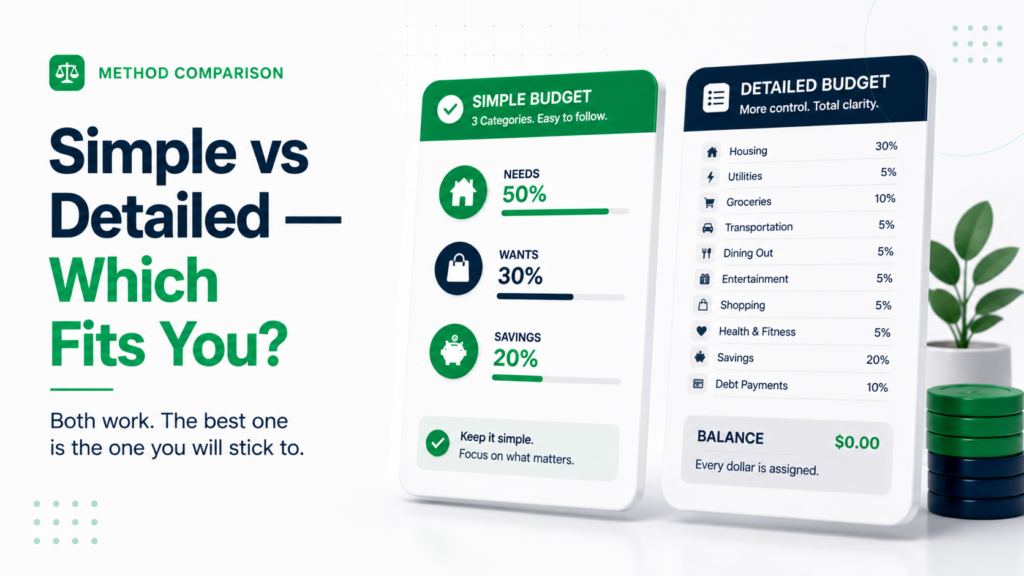
You do not have to choose just one. Many people use a hybrid approach that takes the simplicity of 50/30/20 and adds the control of zero-based budgeting where it matters most.
Here is how to combine them:
- Use the 50/30/20 percentages as your high-level framework
- Within each category, use zero-based thinking to assign specific amounts to specific expenses
- For example: your 20% savings bucket gets broken down exactly — $200 to emergency fund, $200 to investments, $200 to debt payoff
- Your 30% wants bucket gets broken down — $100 dining, $80 entertainment, $50 subscriptions, $70 miscellaneous
This gives you the big-picture simplicity of 50/30/20 with the granular control of zero-based budgeting — without the full time commitment of a pure zero-based system.
External resource: The 50/30/20 rule explained — The Balance
Also read: [INTERNAL LINK: Best Budgeting Apps — Free and Paid Compared]
Frequently Asked Questions
Is the 50/30/20 rule realistic on a low income?
It can be challenging if your essential expenses exceed 50% of your income — which is common in high cost-of-living areas. In that case, adjust the percentages to fit your reality. The goal is the framework, not the exact numbers. Even a 70/10/20 split is better than no budget at all.
How long does zero-based budgeting take each month?
The first month takes the most time — usually 1 to 2 hours to set up all your categories. After that, it typically takes 30 to 45 minutes per month to plan and 5 to 10 minutes per week to track spending. Budgeting apps like YNAB make the process much faster.
Can I switch between budgeting methods?
Absolutely. Many people start with 50/30/20 to build the habit and switch to zero-based budgeting when they are ready for more control — especially when aggressively paying off debt or saving for a major goal. There are no rules about sticking to one method forever.
Final Thoughts
The best budgeting method is the one you will actually use. Both the 50/30/20 rule and zero-based budgeting work — they have helped millions of people take control of their money and build real wealth.
If you are just starting out, begin with 50/30/20. It is simple, forgiving, and will immediately change how you think about money. If you are ready for more control — or you are in serious debt — try zero-based budgeting and give every dollar a job.
Either way, starting today is the only move that matters.