
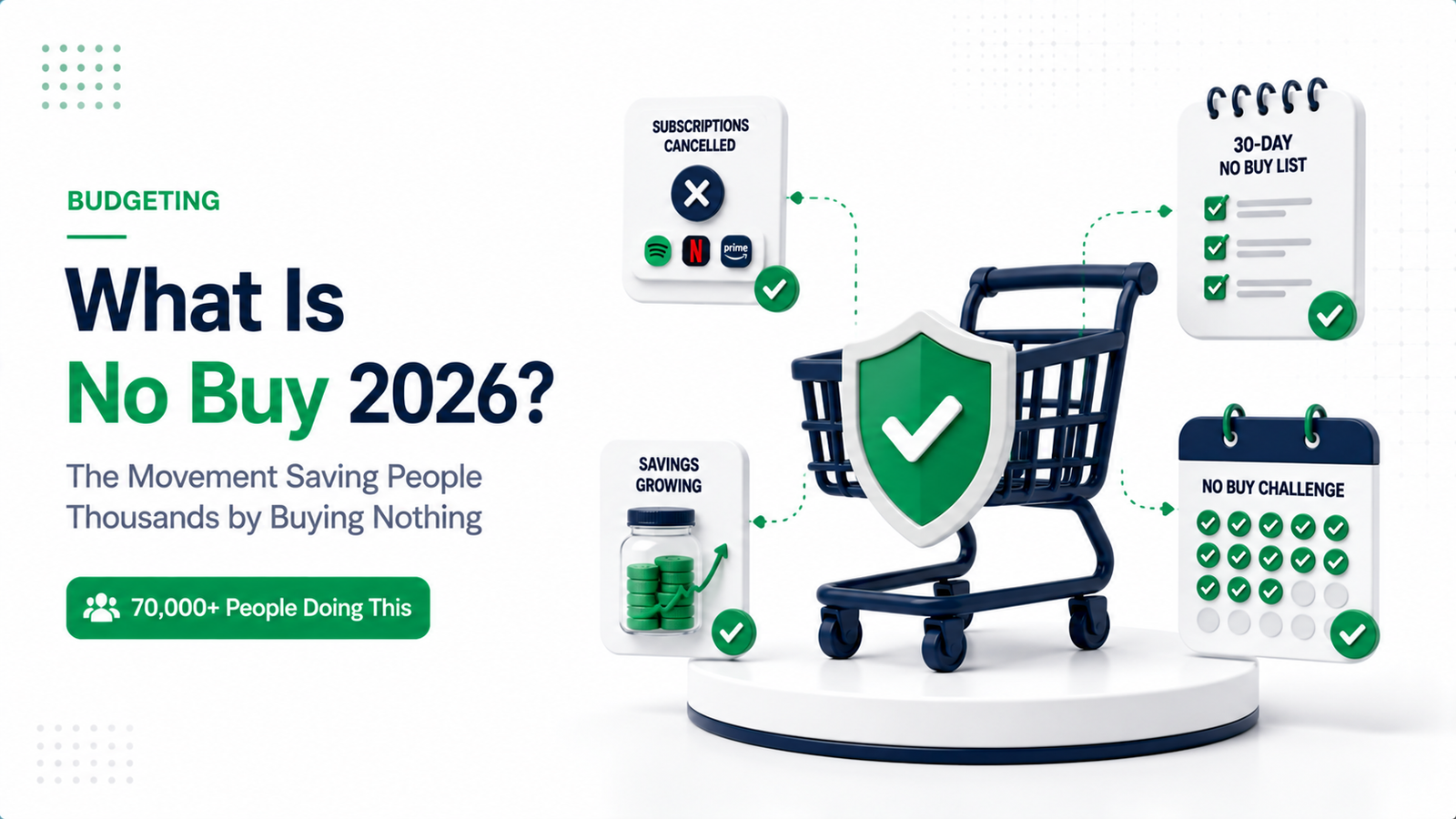
- No Buy 2026 means committing to zero non-essential purchases for a set period — a week, a month, or the entire year
- A Reddit community dedicated to the challenge has over 70,000 members actively sharing results and tips
- 26% of Americans have attempted a no-buy challenge at some point — 12% joined for the first time in 2026
- The 2026 version is more flexible than previous years — personalized rules, not total deprivation
- The habit carries over: people spend more intentionally long after the challenge ends
It did not start with a viral campaign. There were no celebrity endorsements, no billion-dollar marketing push, no app launch.
Just ordinary people — quietly deciding they had had enough.
Enough of the daily coffee they did not really need. The online cart they filled at midnight. The subscription they forgot to cancel. The item they bought because it was on sale, not because they wanted it.
No Buy 2026 is one of the most searched personal finance terms of the year — and unlike most viral money trends, it costs absolutely nothing to start. In fact, that is the entire point.
In this guide, you will learn exactly what No Buy 2026 is, how people are doing it, what it saves, whether it actually works long term, and how to start your own version today.
What Is No Buy 2026 Exactly?
No Buy 2026 is a personal finance challenge in which participants commit to avoiding all non-essential purchases for a defined period — anywhere from one week to the entire year.
Non-essential means different things to different people, which is exactly what makes the 2026 version of this trend different from earlier iterations. This year’s movement is less about cutting out everything and more about cutting down on specific types of spending that participants have identified as wasteful in their own lives.
Some examples of how people define their rules:
- Hard rules: no new clothes whatsoever, no new technology, no takeout delivery apps
- Frequency rules: takeout maximum once per month, one social outing per week, no impulse online shopping
- Category rules: no new home decor, no beauty purchases beyond essentials, no subscription upgrades
The Reddit community dedicated to the No Buy challenge has grown to over 70,000 members who share their personal rules, weekly check-ins, and savings results. What started as a fringe personal finance experiment has become one of the most active money communities on the internet.
The movement sits alongside loud budgeting and moneymaxxing as part of a broader cultural shift away from unconscious consumer spending and toward intentional financial choices.
Why It Is Exploding Right Now
No Buy 2026 is not happening in a vacuum. It is a direct reaction to a specific set of economic and cultural pressures that millions of people are feeling simultaneously.
Inflation eroded purchasing power
Prices are 25 to 30% higher than pre-pandemic levels on a cumulative basis. The same budget that felt comfortable in 2021 now runs out faster, covers less, and leaves people feeling like they are working harder for the same result. When spending feels increasingly painful, stopping it entirely — even temporarily — becomes appealing. Read more about how inflation is hitting budgets right now in our 2026 inflation breakdown.
Consumer culture fatigue
The average person in a Western country owns over 10,000 items. Closets are full. Homes are full. And yet the algorithm serves another targeted ad every 30 seconds. No Buy 2026 is partly a rejection of that loop — a deliberate pause from the constant pressure to acquire more.
Social media made it visible
Previous generations practiced frugality privately. In 2026, people share their no-buy wins publicly — weekly savings totals, before-and-after spending comparisons, decluttering results — and the social reinforcement creates momentum that individual willpower alone rarely sustains. Sharing the challenge makes it stick.
The math finally clicked for a lot of people
The average person spends $219 per month on subscriptions but thinks they spend $86. That 2.5x perception gap — discovered when people actually audit their spending — is often the trigger for a no-buy commitment. Once you see the real number, the motivation to change it arrives on its own.
What Does It Actually Save — The Real Numbers
Here is the calculation that most No Buy 2026 articles skip — what the challenge actually saves at different spending levels.
The key insight: you do not need to eliminate all discretionary spending to see meaningful results. Even cutting 50% of non-essential spending produces significant annual savings.
| Monthly Non-Essential Spending | 50% Cut (Low Buy) | 80% Cut (No Buy) | Annual Savings |
|---|---|---|---|
| $300/month | $150 saved/month | $240 saved/month | $1,800 – $2,880 |
| $500/month | $250 saved/month | $400 saved/month | $3,000 – $4,800 |
| $800/month | $400 saved/month | $640 saved/month | $4,800 – $7,680 |
| $1,200/month | $600 saved/month | $960 saved/month | $7,200 – $11,520 |
The “annual savings” column assumes consistent application for 12 months. Most participants do not maintain the challenge for a full year — but even 3 months of no-buy behavior at the $500/month discretionary level produces $1,200 in savings that did not exist before.
The contrarian point: the biggest savings from No Buy 2026 rarely come from the obvious categories like clothing or dining out. They come from the invisible ones — the subscriptions auto-renewing monthly, the small daily purchases that never feel like a decision, and the impulse buys triggered by algorithms rather than actual desire. These are the hardest to see and the easiest to eliminate once you are looking for them.
How to Build Your Personal No-Buy Rules
The most successful No Buy 2026 participants share one thing in common: they wrote their rules down before they started, not during a moment of temptation.
Here is a simple framework to build your own:
Step 1 — Audit last month’s non-essential spending
Go through your last bank statement and highlight every purchase that was not a necessity — not rent, not groceries, not utilities or transport. Add them up. That total is your baseline. Most people are genuinely surprised by the number. That surprise is the motivation you need.
Step 2 — Identify your top 3 spending leaks
From that list, circle the three categories that appear most often or cost the most. These are your personal leaks — the places where money exits your budget without producing proportional value. Common ones: food delivery apps, online clothing retailers, impulse purchases on Amazon, subscriptions never used.
Step 3 — Write hard rules and soft rules
Hard rules are absolute — “no new clothes for 90 days.” Soft rules set limits rather than bans — “takeout maximum twice per month.” Financial advisors consistently recommend a mix of both. Absolute bans on everything tend to fail around week three. A combination of hard stops on your biggest leaks and limits on everything else is more sustainable.
Step 4 — Define your timeline and your goal
No Buy 2026 works best when attached to a specific savings target. Not “I want to save more” but “I want to save $2,000 by November for an emergency fund.” A concrete goal gives the challenge a finish line and makes every skipped purchase feel like forward progress rather than deprivation.
Build that emergency fund: How to Save Your First $10,000 — Step-by-Step Plan
Step 5 — Use the 30-day list for gray areas
When you feel the urge to buy something non-essential that you are not sure about, add it to a “30-day list” instead of buying it immediately. Come back in 30 days and decide if you still want it. Most items on these lists never get purchased — the urge passes within days. This is the most effective single tool for eliminating impulse spending without requiring extreme willpower.
The Three Versions — No Buy, Low Buy, and No-Buy Week
No Buy 2026 is not one-size-fits-all. There are three distinct versions depending on how aggressive you want to be.
Full No Buy Year
Zero non-essential purchases for the entire year. This is the most extreme version and the one most commonly discussed on Reddit. It is genuinely powerful for people with serious savings goals or significant debt to eliminate — but it requires detailed rules, strong social support, and realistic planning for exceptions. Most participants build in 2 to 3 “exception days” per quarter to handle genuine needs they could not anticipate.
Low Buy 2026
The more popular and arguably more sustainable version. Instead of eliminating all non-essential spending, you dramatically reduce it in specific categories while maintaining normal spending in others. This works well for people who want meaningful savings without the psychological pressure of a total ban. Participants typically report saving 40 to 60% of their previous discretionary spending without feeling deprived.
No-Buy Week
The entry-level version — commit to zero non-essential spending for one week per month. No dining out, no online shopping, no impulse purchases, no entertainment spending beyond what you already have at home. A single no-buy week at $500/month in discretionary spending saves approximately $125 per week — $1,500 per year from four weeks total. More importantly, it rewires the habit loop around spending in a way that carries over into the other three weeks of the month.
External resource: How No Buy 2026 could help your budget — Yahoo Finance
Does It Actually Work Long Term?
The short answer: yes — but not always for the reason people expect.
The direct savings are real and measurable. But the more significant effect of No Buy 2026 is what it does to spending behavior after the challenge ends. People who complete a no-buy period consistently report spending more intentionally in the months that follow — not because they are still following the rules, but because the challenge changed what they notice.
Before a no-buy challenge, most discretionary spending happens unconsciously. The purchase is made before the decision is fully registered. After a no-buy period, that unconscious spending becomes visible — and once you can see it, you make different choices about it automatically.
Financial advisors do flag one risk: overly restrictive rules that do not account for real life tend to produce rebound spending — the same pattern seen in crash diets. The participants who sustain the results long term are the ones who built flexible, personalized rules rather than attempting total deprivation.
The movement is increasingly being viewed as more than a short-term budgeting exercise. For many participants it serves as a catalyst for permanent changes in consumption habits and financial priorities — not just a savings challenge, but a reset of the relationship with spending itself.
External resource: No Buy Challenge — how consumers are saving thousands in 2026
Frequently Asked Questions
What counts as non-essential in No Buy 2026?
There is no universal definition — which is intentional. Essentials are generally rent, utilities, groceries, transport, and healthcare. Everything else is discretionary. But within discretionary spending, different people draw the line differently: some include dining out as essential, others do not. The No Buy 2026 approach encourages you to define your own rules based on your actual spending patterns and goals, rather than following a rigid external standard. What matters is that you define it clearly before you start, not case-by-case when temptation arrives.
Is No Buy 2026 too extreme for the average person?
The full-year version is challenging and is not right for everyone. But the low-buy version and the no-buy week are accessible to almost anyone with any budget. The question is not whether to eliminate all spending — it is whether your current non-essential spending is producing value proportional to its cost. For most people, the honest answer is that at least 20 to 30% of discretionary spending is producing very little value. That is the part No Buy 2026 targets.
What should I do with the money I save from No Buy 2026?
This is the step most participants skip — and it is the most important one. Saving money by not spending it only builds wealth if the saved amount goes somewhere intentional. Transfer it immediately to a savings account or investment account the moment you decline a purchase. If you save $200 in a given week by skipping non-essential spending, move $200 to your savings goal that same day. The act of redirecting the money is what converts a spending decision into a savings win.
Final Thoughts
No Buy 2026 is not about living with nothing. It is about finding out how much of what you buy you actually wanted — and how much was just the path of least resistance.
For most people, the answer is uncomfortable. A significant portion of discretionary spending happens on autopilot — triggered by algorithms, social pressure, or habit rather than genuine desire. No Buy 2026 breaks that autopilot long enough to see what is actually there.
Start with one week. Build your rules. Write down your goal. Transfer whatever you save immediately to somewhere it will grow.
The movement has over 70,000 people on Reddit alone sharing their results every week. The numbers are real. The only question is whether you want to see yours.