
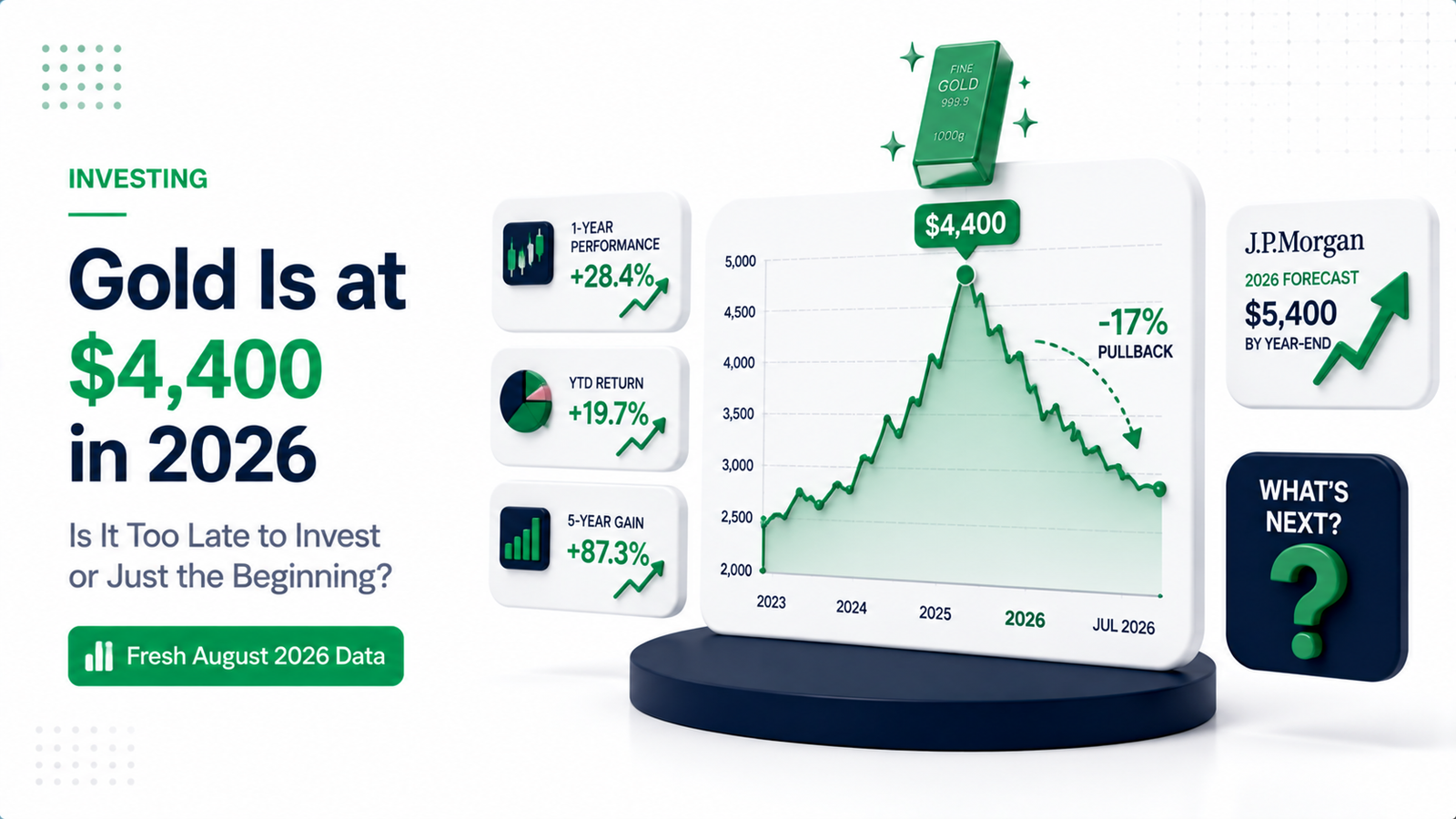
- Gold is trading at approximately $4,393 per troy ounce as of August 18, 2026 — down from its all-time high of $5,595 hit on January 29, 2026
- Over the past five years, gold has appreciated 146% while the S&P 500 returned 73% — gold has outperformed the stock market significantly
- J.P. Morgan forecasts gold to average $6,000 per ounce by Q4 2026 and reach $6,300 by end of 2027
- Gold fell 17% from its January peak due to the Iran conflict — creating what some analysts call a buying opportunity
- For most beginners, the right answer is not “should I buy gold” but “how much gold, and in what form”
On January 29, 2026, gold hit $5,595 per troy ounce — the highest price in history.
Then the Iran conflict broke out. Markets panicked. Gold, counterintuitively, fell — dropping 17% from its peak as investors sold assets to cover losses elsewhere. By August 18, 2026, gold is trading at approximately $4,393 per ounce.
And now everyone is asking the same question: is this a buying opportunity, or is gold’s big run finally over?
The honest answer is more nuanced than either the gold bulls or the gold skeptics want to admit. Gold at $4,400 is still more than double what it was three years ago. J.P. Morgan is forecasting $6,000 by the end of 2026. But it has already fallen 21% from its all-time high, and nobody knows where it goes next.
In this guide, you will get a clear, beginner-friendly breakdown of what is actually happening with gold right now, what the real data says about whether it belongs in your portfolio, and exactly how to invest if you decide it does.
What Happened to Gold in 2026 — The Full Story
Gold’s 2026 story is one of the most dramatic in the precious metal’s modern history — a record high, a geopolitical collapse, and a slow recovery, all within eight months.
Here is the timeline:
| Date | Gold Price | What Drove It |
|---|---|---|
| June 2025 | $3,303 | Central bank buying, inflation fears |
| January 29, 2026 | $5,595 — All-time high | Safe haven demand, geopolitical tensions, dollar weakness |
| February 27, 2026 | Peak before Iran conflict | Last trading day before Iran war |
| March–July 2026 | Fell 17.2% from peak | Iran conflict, energy price spike, investor sell-off |
| August 18, 2026 | ~$4,393 | Slow recovery, consolidation phase |
The counterintuitive part of the 2026 gold story is that it fell during an actual war. Gold is traditionally considered a “safe haven” — an asset people buy when they are scared. But the Iran conflict triggered a broader market sell-off where investors needed cash, and gold was one of the easiest liquid assets to sell quickly.
Now, with the conflict easing, gold is recovering. J.P. Morgan’s head of Base and Precious Metals describes gold as stuck in “technical no-man’s land” — trading above its 200-day moving average of $4,340 but capped below its 50-day moving average of $4,730. The direction from here is genuinely uncertain in the short term, which is exactly why beginners need a clear framework for thinking about it.
External resource: Is now a good time to invest in gold? — Yahoo Finance
Why Gold Has Been Rising for Years
Gold at $4,400 is not a random number. It is the result of a decade of structural forces that have not gone away — and in most cases have intensified.
Central banks are buying gold at record rates
Global central banks have been boosting their gold reserves consistently to diversify away from the U.S. dollar, particularly amid trade tensions. When central banks buy, they buy in enormous quantities — and that sustained institutional demand creates a price floor that individual market fluctuations struggle to break through permanently. The World Gold Council’s most recent survey implies that central bank buying is likely to continue.
The U.S. debt-to-GDP ratio keeps rising
A rising debt-to-GDP ratio sparks concerns about long-term currency devaluation. Investors who worry about the dollar losing purchasing power over decades buy gold as a store of value — not a short-term trade, but a long-term hedge. This structural buyer base has grown significantly in the past five years.
Inflation made gold’s value proposition obvious
When prices rose 25 to 30% cumulatively since 2021, gold’s role as an inflation hedge became more tangible and visible to everyday investors. People who previously dismissed gold as an old-fashioned relic started paying attention when everything they bought became more expensive and their cash savings were eroded. Read more about how inflation is still hitting budgets in our 2026 inflation guide.
Geopolitical instability has no end date
The Iran conflict was not the first geopolitical shock of the 2020s and will not be the last. Each new global tension event sends a fresh wave of investors toward gold. The underlying demand driver — global uncertainty — is not going away.
Gold vs the Stock Market — The Actual Numbers
This is the comparison most gold articles bury or skip entirely. Here is what the data actually says.
| Investment | 5-Year Return | 2025 Return | Pays Dividends? |
|---|---|---|---|
| Gold | +146% | +64% | No |
| S&P 500 (SPY) | +73% | Varied | Yes (~1.5%/year) |
| High-Yield Savings | ~20% cumulative | ~4.5% | Yes (interest) |
Over five years, gold has outperformed the S&P 500 by a significant margin. But this comparison has important caveats that gold enthusiasts rarely mention:
- Gold pays no dividends. Every return from gold comes from price appreciation alone. The S&P 500 pays dividends of approximately 1.5% per year on top of price gains — which compounds meaningfully over decades.
- Gold is extremely volatile. A 21% drop in eight months is not unusual for gold. The S&P 500 is volatile too, but gold’s swings are driven by sentiment and geopolitics rather than underlying business earnings — which makes them harder to predict.
- Five years is not long enough. Over 30 years, diversified index funds have consistently outperformed gold in total returns. The past five years have been unusually favorable for gold due to specific geopolitical and inflation conditions that may or may not persist.
The contrarian point: the people who made the most money from gold in 2026 bought it in 2022 and 2023 when nobody was talking about it. If you are reading about gold because it hit $5,595 in January, you are not early — you are following a trend that has already matured significantly. That does not mean it is over, but it does mean the easy gains are behind you.
New to investing? Start here: What Is Moneymaxxing? The Viral Trend Making People Richer in 2026
Should You Invest in Gold Right Now?
The honest answer depends entirely on one question: what do you already have?
Gold is not a starting point for building wealth. It is a diversification tool for people who have already built a financial foundation. Here is the framework most financial advisors use:
Do not buy gold if:
- You do not have an emergency fund covering 3 to 6 months of expenses
- You have high-interest debt that is actively growing
- You have no investment account at all — gold should not be your first investment
- You are hoping to get rich quickly — gold is a store of value, not a get-rich vehicle
- You are planning to sell within 12 months — gold’s short-term price is unpredictable
Consider adding gold if:
- You already have a diversified portfolio of index funds and want to reduce overall volatility
- You are concerned about long-term dollar devaluation and want a hedge
- You want exposure to an asset class that moves differently from stocks and bonds
- You have a long-term horizon of 5+ years and can tolerate short-term price swings
Most financial advisors suggest keeping gold to 5 to 10% of a total investment portfolio maximum. A 100% gold portfolio is speculation. A 5 to 10% gold allocation inside a diversified portfolio is risk management.
Build your investment foundation first: How to Save Your First $10,000 — Step-by-Step Plan
How to Invest in Gold as a Beginner
There are five ways to invest in gold. Most beginners choose the wrong one.
1. Gold ETFs — the best option for most beginners
A gold ETF holds physical gold on your behalf and trades like a stock on any standard brokerage platform. You buy shares, each representing a fraction of an ounce of gold, and your investment moves with the gold price. Three major gold ETFs hold physical bullion: SPDR Gold Shares (GLD), iShares Gold Trust (IAU), and Aberdeen Standard Physical Gold Shares ETF (SGOL). Management fees are low (0.10 to 0.40% per year) and cover storage and insurance. This is the simplest, most liquid, and most cost-efficient way for a beginner to get gold exposure.
2. Gold mining stocks — higher risk, higher potential return
Instead of buying gold directly, you buy shares in companies that mine gold. When gold prices rise, mining company profits often rise faster — creating leverage to the gold price. But mining stocks also carry company-specific risks (management, costs, geography) that pure gold does not. This is a more aggressive way to bet on gold and is not recommended as a starting point.
3. Physical gold (coins and bars) — not recommended for most beginners
Buying physical gold sounds appealing but comes with real practical problems: storage costs, insurance requirements, dealer premiums of 3 to 8% above spot price when buying, and significant discounts when selling. Unless you are buying in large quantities with a specific purpose, a gold ETF achieves the same economic result at a fraction of the cost and complexity.
4. Gold mutual funds — similar to ETFs but with higher fees
Gold mutual funds hold a basket of gold-related assets. They are less tax-efficient and more expensive than ETFs for the same exposure. Most beginners are better served by a gold ETF.
5. Gold futures — not for beginners
Futures contracts allow you to speculate on the future price of gold with significant leverage. This is the domain of professional traders and carries the potential for losses exceeding your initial investment. Avoid entirely until you have significant investment experience.
External resource: How to invest in gold — Forbes Advisor
The Mistakes Most Beginners Make With Gold
Gold attracts a specific type of financial mistake that is worth naming directly.
Buying at all-time highs because of headlines
Gold hit $5,595 in January 2026. The headlines were everywhere. Millions of people who had never considered buying gold started researching it. Most of them bought at or near the peak — and have watched the price fall 21% since. The pattern repeats with every asset class: media attention peaks when prices peak, which is the worst time to buy. The people who profit from gold buy it quietly when nobody is talking about it.
Treating gold as a substitute for an emergency fund
Gold is not cash. Its price can drop 20% in a matter of months, as 2026 has demonstrated. Using gold as your emergency fund means that exactly when you need money most — during a personal or economic crisis — your gold might be worth significantly less than you paid for it. Emergency funds belong in cash or a high-yield savings account, not in volatile assets.
Going all-in based on forecasts
J.P. Morgan forecasts $6,000 gold by Q4 2026. Morningstar is more cautious. Other analysts expect consolidation. The honest truth about gold price forecasts is that they are directional opinions, not certainties. Anyone who invested their entire savings based on a $6,000 price target and got a $4,000 outcome instead would face a serious financial problem. Treat forecasts as one input among many, never as guaranteed outcomes.
Frequently Asked Questions
Is gold a good investment for beginners in 2026?
Gold can be a useful part of a beginner’s portfolio once the financial basics are in place — emergency fund, no high-interest debt, and a core position in diversified index funds. As a first investment or a large allocation, gold is too volatile and unpredictable for most beginners. A 5 to 10% allocation within a broader portfolio gives you the inflation hedge and diversification benefit without excessive exposure to gold’s price swings.
Will gold reach $6,000 in 2026?
J.P. Morgan forecasts gold to average $6,000 per ounce by Q4 2026 and $6,300 by end of 2027. That would represent a 36% rise from current levels. It is possible — central bank demand remains strong, inflation is still above the Fed’s target, and geopolitical uncertainty has not disappeared. But gold has already fallen 21% from its all-time high this year, demonstrating that it can move sharply in either direction. Treat the $6,000 forecast as a possibility to be aware of, not a certainty to bet on.
What is the easiest way to invest in gold with a small amount of money?
A gold ETF like IAU (iShares Gold Trust) is the simplest entry point. It trades on any standard brokerage platform, has a low expense ratio of 0.25%, and allows you to invest with as little as the price of one share — currently under $50. You get direct exposure to the gold price without the storage, insurance, and dealer premium complications of physical gold. Most major brokers offer fractional shares, meaning you can invest as little as $10 to $20 to start.
Final Thoughts
Gold at $4,400 is not cheap. It is not at an all-time high either. It is in the middle of a consolidation after one of the most dramatic runs in its modern history — and nobody, including J.P. Morgan, knows exactly where it goes from here.
What the data does tell us clearly: gold has outperformed the stock market over five years, central banks are still buying, and the structural forces driving demand — inflation concerns, dollar uncertainty, geopolitical instability — have not resolved.
For a beginner, the right move is not to chase the headline or wait for the perfect entry point. It is to build the financial foundation first, then add a modest gold allocation as part of a diversified portfolio — and hold it for years, not months.
The people who made real money from gold in this cycle bought it before it became a dinner party conversation. The next opportunity will look the same way — quiet, uncomfortable, and not trending on social media yet.