
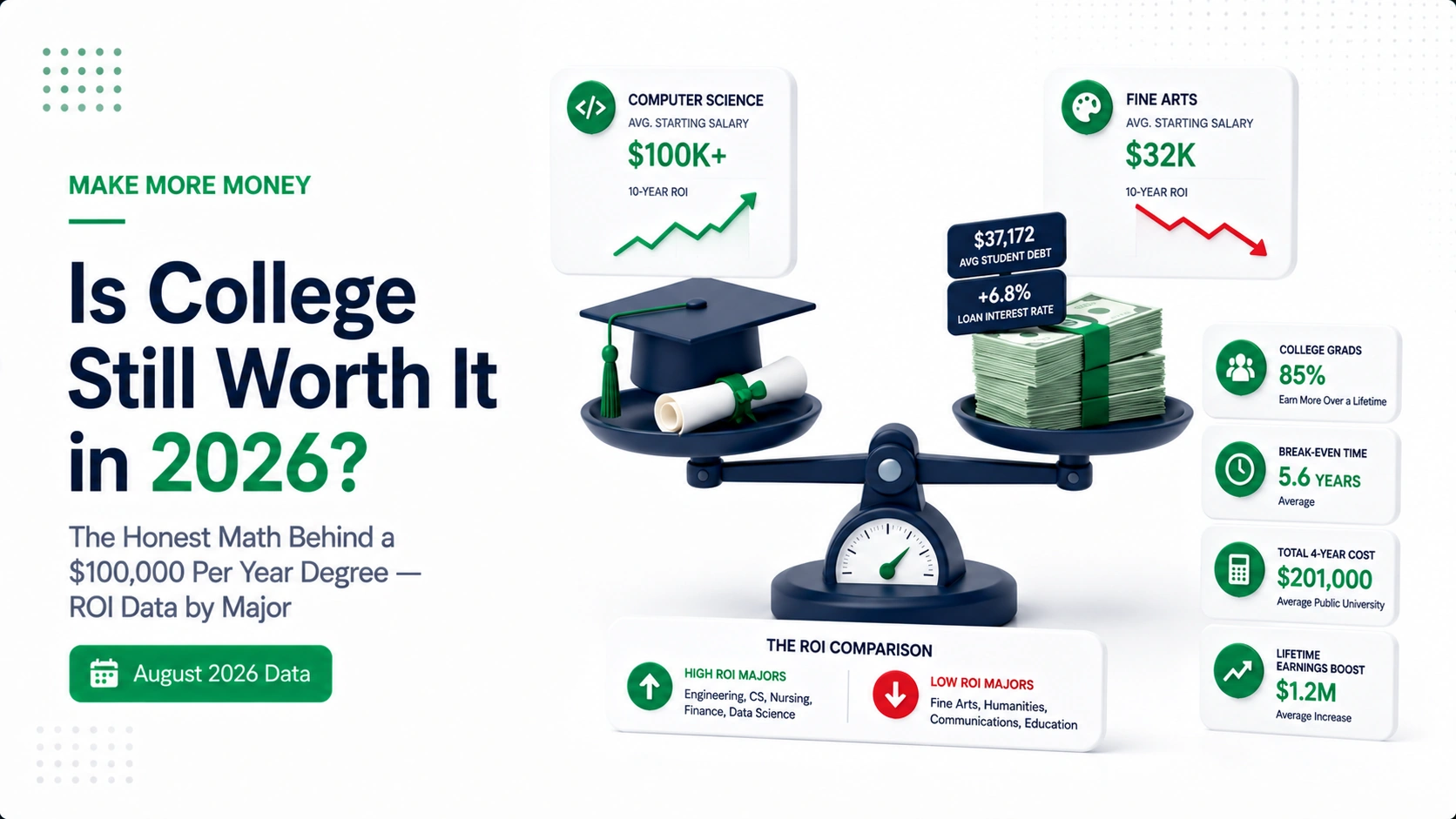
- Some US schools now charge over $100,000 per year — the total cost of a bachelor’s degree including opportunity cost can reach $270,000
- College graduates still earn approximately $1.2 million more over a lifetime than high school graduates — but that average hides enormous variation by major
- A record 41% of parents now expect to cover their children’s college tuition — threatening their own retirement savings
- The same campus, same tuition: a computer science degree vs an education degree can differ by $600,000+ in lifetime earnings
- College is a poor investment when projected debt exceeds your expected starting salary — a rule that eliminates many popular majors at expensive schools
Yale now charges $67,250 per year in tuition alone. Add room, board, fees, and books and the all-in cost at some elite private universities exceeds $100,000 per year. Four years. $400,000.
A record 41% of parents say they expect to cover their children’s college tuition — and many are raiding retirement accounts to do it.
Meanwhile, Google, Apple, IBM, and the US federal government have all dropped degree requirements for significant categories of jobs in the past two years. College enrollment has fallen more than 15% since 2010.
So is college still worth it in 2026? The honest answer is the same as it has always been — yes, but with a massive asterisk that most guidance counselors, admissions offices, and parents never put front and center.
The value of a college degree depends almost entirely on what you study and what you pay — not whether you go.
- What college actually costs in 2026 — the full number
- The earnings premium — what the data actually says
- ROI by major — the $600,000 gap nobody talks about
- The formula for knowing if your degree is worth it
- The parent trap — when paying for college destroys retirement
- The alternatives that actually compete with college in 2026
- Frequently Asked Questions
What College Actually Costs in 2026 — The Full Number
The price on the brochure is never the real price. Here is what a bachelor’s degree actually costs when you count everything.
| School Type | Tuition Only | All-In (4 years) | With Opportunity Cost |
|---|---|---|---|
| Community college (2 yr) | $3,800/yr | ~$15,000 | ~$85,000 |
| Public university (in-state) | $11,600/yr | ~$107,000 | ~$270,000 |
| Public university (out-of-state) | $28,000/yr | ~$180,000 | ~$340,000 |
| Private university | $43,000/yr | ~$240,000 | ~$400,000 |
| Elite private (Yale, Columbia) | $67,000+/yr | ~$350,000+ | $500,000+ |
The “opportunity cost” column is the number most college cost discussions leave out entirely. Every year you spend in school is a year you are not earning income. At $35,000 per year (the median entry-level wage without a degree), four years of foregone income adds $140,000 to the real cost of a degree — before a single dollar of tuition is counted.
The average student borrower graduates with $38,000 in federal student loan debt in 2026. At the current federal loan rate of 6.52%, that costs $432 per month over 10 years — $51,800 total, including $13,800 in interest. And that same $432 per month invested at 7% for 10 years would grow to $74,800. The debt cost is not just the principal — it is the compounding you could have done with that money instead.
The hidden cost that gets almost nobody’s attention: the average student now takes over five years to complete a bachelor’s degree, not four. Every additional semester adds tuition, living expenses, and foregone income. The five-year reality adds $50,000 to $100,000 to the actual cost compared to the four-year assumption in most ROI calculations.
External resource: Full college degree ROI analysis with 2026 data — Education Data Initiative
The Earnings Premium — What the Data Actually Says
The case for college has always rested on one number: the lifetime earnings premium. Here is what that number actually looks like in 2026 — and where it breaks down.
According to the Bureau of Labor Statistics, bachelor’s degree holders earn a median of $1,493 per week in 2026, compared to $899 per week for high school diploma holders. That is a 66% premium — approximately $31,000 more per year.
Over a 40-year career, that premium compounds to over $1.2 million in additional lifetime earnings. Even accounting for tuition, living costs, and four years of lost income, the median bachelor’s degree produces a positive ROI of $160,000 to $306,000 depending on the school, major, and career path.
So yes — on average, college is still worth it in 2026.
But here is where the average becomes dangerous:
- The median ROI for on-time graduates is $306,000 — but factor in the 40% of students who drop out before finishing and the average drops to $129,000
- Drop out before completing your degree and you have debt with no credential — the single worst financial outcome in the entire college decision tree
- The earnings premium assumes you enter a field where the degree is actually required. For the growing number of jobs where it is not — coding, sales, trades, content creation, entrepreneurship — the premium disappears
- Google, Apple, IBM, Delta Air Lines, and the federal government have all dropped degree requirements for significant job categories in the past two years. The list is growing.
ROI by Major — The $600,000 Gap Nobody Talks About
The most important financial decision in the college conversation is not which school you attend — it is what you study. The difference between the highest and lowest ROI majors at the same school can exceed $600,000 in lifetime earnings.
| Major | Median Starting Salary | Mid-Career Salary | ROI Verdict |
|---|---|---|---|
| Computer Science | $75,000–$95,000 | $100,000+ | ✅ Excellent |
| Electrical Engineering | $80,000–$95,000 | $95,000+ | ✅ Excellent |
| Nursing (BSN) | $65,000–$75,000 | $81,000+ | ✅ Excellent |
| Finance / Accounting | $55,000–$70,000 | $85,000+ | ✅ Strong |
| Business Administration | $50,000–$60,000 | $70,000+ | ⚠️ Moderate |
| Education | $42,000–$50,000 | $55,000 | ⚠️ Low at expensive schools |
| Communications / Media | $38,000–$48,000 | $55,000 | ❌ Poor at private schools |
| Fine Arts / General Studies | $32,000–$40,000 | $45,000 | ❌ Negative ROI at most private schools |
The same campus, the same tuition, the same four years — a computer science graduate and a fine arts graduate will have lifetime earnings that differ by $600,000 or more. This is the number that changes the entire college conversation.
The contrarian point on computer science in 2026: the entry-level CS job market has tightened significantly as AI reshapes junior developer hiring. Graduates from top programs still command strong salaries, but the assumption that any CS degree from any school guarantees $90,000 starting salary is no longer accurate. School selectivity and specialization within CS (AI, cybersecurity, data science) now matter more than they did three years ago.
Build the financial skills your career needs: 10 Best Side Hustles That Actually Pay in 2026
The Formula for Knowing If Your Degree Is Worth It
Instead of asking “is college worth it?” — ask these three specific questions about your specific situation.
Question 1 — What is your projected debt vs your expected starting salary?
The most reliable rule in college finance: never borrow more than 80% of your expected first-year salary. If you will start at $50,000, limit total debt to $40,000. If your degree requires $120,000 in debt for a career starting at $45,000, the math does not work — regardless of the school’s name or ranking.
A nursing graduate who borrows $120,000 total and starts at $75,000 breaks even by year 8 and pulls ahead by $500,000 over a career. A communications graduate who borrows $180,000 and starts at $40,000 may spend their entire career paying off a credential that never closes the income gap.
Question 2 — What are your actual completion odds?
The median bachelor’s degree ROI assumes you graduate. 40% of students who enroll do not finish within six years. At for-profit schools, the dropout rate is even higher. Dropping out before completing your degree is the worst possible outcome — you carry the debt without the credential that makes the debt worthwhile. Before enrolling anywhere, look up the school’s six-year graduation rate on the Department of Education’s College Scorecard. Below 50% is a serious warning sign.
Question 3 — Does your target career actually require the degree?
For medicine, law, engineering, nursing, and teaching — yes, the degree is a legal or professional requirement. For software development, sales, marketing, design, content creation, data analysis, and a growing list of business roles — the degree is increasingly a preference, not a requirement. Google, Apple, IBM, and Delta have all explicitly dropped degree requirements in recent years. In fields where the degree is optional rather than required, the ROI calculation changes fundamentally.
The Parent Trap — When Paying for College Destroys Retirement
A record 41% of parents now expect to cover their children’s college tuition — and the financial consequences for their own retirement are severe and underreported.
Yahoo Finance reported today that some schools are now charging over $100,000 per year in total costs — and the parents writing those checks are often doing so at the expense of their own financial security.
The math is unforgiving. A parent who withdraws $50,000 from a retirement account at age 55 to pay for one year of college loses not just the $50,000 — they lose the compounding that money would have produced over the next 10 to 15 years before retirement. At 7% annual growth, $50,000 invested for 12 years becomes $113,000. The real cost of that withdrawal is not $50,000 — it is $113,000 in lost retirement savings.
Parents navigating this decision need to understand one non-negotiable principle: you can borrow for college. You cannot borrow for retirement. A student who takes on a reasonable debt load for a high-ROI degree has 40 years of earning ahead of them to repay it. A parent who depletes their retirement savings at 55 has no equivalent recovery mechanism.
The financially responsible approach: cover what you can from income and savings without touching retirement accounts. Let the student take federal loans up to the sensible debt limit for their chosen field. And choose schools where the net price — after grants and scholarships — makes the math work.
Protect your savings: What Is No Buy 2026 — The Movement Saving People Thousands
The Alternatives That Actually Compete With College in 2026
For the first time in a generation, there are legitimate alternatives to a four-year degree that compete on income, timeline, and ROI — not just for trade jobs, but for knowledge-economy careers.
Trade and vocational programs
Electricians, plumbers, HVAC technicians, and welders earn $55,000 to $90,000 per year after completing apprenticeships that cost a fraction of a four-year degree and take 2 to 4 years instead of 4 to 6. The trades are experiencing a significant labor shortage — demand is high, competition is low, and the career path does not require ongoing debt service. For the right person, a trade is not a fallback — it is a financially superior choice.
Coding bootcamps
Selective bootcamps like App Academy, Flatiron School, and Lambda School graduate students in 3 to 6 months with job-ready skills for entry-level software development roles. Job placement rates at top bootcamps run 70 to 85%, with starting salaries of $55,000 to $80,000. Cost: $10,000 to $20,000, with many programs offering income-share agreements instead of upfront payment. The ROI timeline is dramatically faster than a four-year CS degree at a costly school — though elite CS programs still produce better long-term outcomes.
Professional certifications
Google, AWS, Microsoft, and Salesforce certifications now carry genuine hiring weight in tech and cloud computing roles. A Google Cloud Professional certification costs under $300, takes 3 to 6 months to prepare for, and can qualify for roles starting at $70,000 to $90,000. For someone already in the workforce looking to transition careers, a certification path often delivers better ROI than returning to school for a second degree.
The 2+2 strategy
Community college for two years followed by transfer to a four-year university can save $20,000 to $50,000 in tuition while producing the same bachelor’s degree credential. The catch: only 16% of community college starters complete a bachelor’s degree within six years. The strategy requires a clear transfer plan, a target school with a solid articulation agreement, and deliberate execution. Done right, it is one of the most financially effective paths to a four-year degree.
External resource: Is college worth it in 2026? Data-driven analysis — DegreeCalc
Frequently Asked Questions
Is college worth it financially in 2026?
On average, yes — a bachelor’s degree still produces a median lifetime earnings premium of $160,000 to $306,000 over a high school diploma, after accounting for tuition and lost wages during school. But that average conceals enormous variation. A computer science or engineering degree from an affordable school with modest debt is one of the best financial investments available. A fine arts or general studies degree from an expensive private university funded by large loans may produce a negative ROI after 40 years. The answer depends almost entirely on what you study and what you pay — not simply whether you attend.
How much student debt is too much for college?
The most widely used rule: never borrow more than 80% of your expected first-year salary in your chosen field. If you plan to become a teacher starting at $45,000, limit total student debt to $36,000. If you plan to become a software engineer starting at $85,000, up to $68,000 in debt can be justified. Borrowing $150,000 for any degree with a starting salary under $60,000 creates a debt burden that typically takes decades to resolve and significantly impairs wealth building during the most important compounding years of your financial life.
Should parents pay for their kids’ college?
Parents should support their children’s education to the extent they can without compromising their own retirement security. The non-negotiable principle: retirement savings come first. You can borrow for college — there are no loans for retirement. Contributing from income and designated college savings (529 plans) is appropriate. Withdrawing from retirement accounts, taking on personal debt, or significantly reducing retirement contributions to pay for college is a serious financial mistake with consequences that compound for 10 to 20 years. The student having a reasonable loan payment is a far better outcome than the parent reaching retirement with insufficient savings.
Final Thoughts
College is still worth it in 2026 — for the right major, at the right price, with the right amount of debt relative to expected earnings.
It is not worth it as a default. It is not worth it because everyone goes. It is not worth it when the debt load exceeds what the career pays back within a reasonable timeframe. And it is not worth it when a parent’s retirement security is the price of admission.
The students who come out ahead are not the ones who blindly follow the “college is always worth it” advice. They are the ones who run the numbers first — total cost, expected salary, debt limit, graduation odds — and make a deliberate decision based on those numbers rather than tradition, prestige, or social pressure.
The most expensive college decision in 2026 is not choosing the wrong school. It is choosing the wrong major at the wrong price without doing the math first.