
- Food away from home has risen 24.2% since 2022 — outpacing grocery inflation by nearly double
- A Chipotle chicken burrito cost $5.30 in 2006 and $10.95 in 2026 — a 107% increase vs 61% headline CPI over the same period
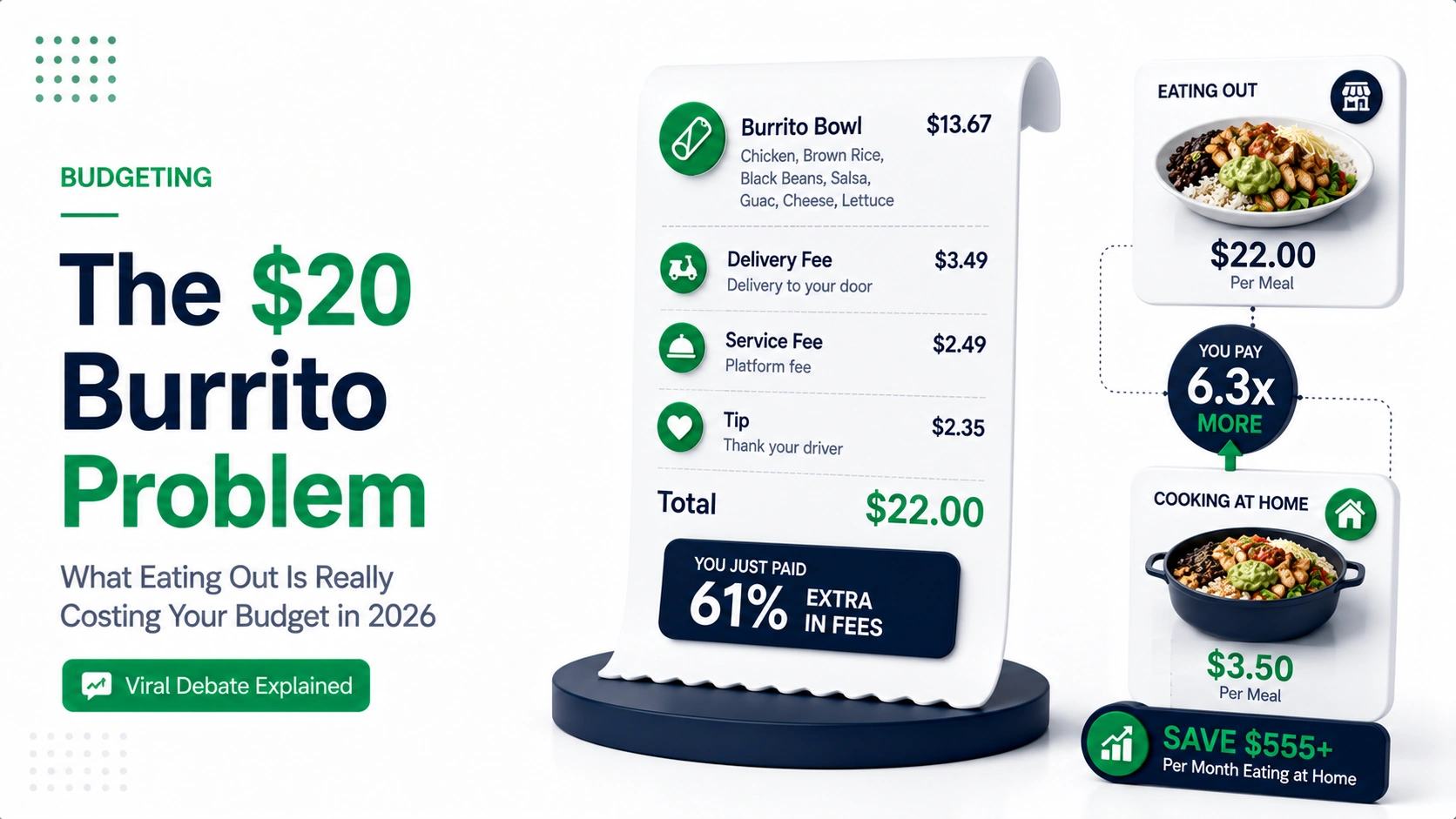
- The median burrito price across US restaurants in July 2026 was $13.67 — but delivery fees, service charges, and tips routinely push the total to $18–$22
- The average American household spending $400/month eating out is losing $1,152 per year compared to cooking the same meals at home
- Cutting restaurant spending by 50% and redirecting it to savings or investments is one of the highest-impact budget moves available to most people
On August 4, 2026, a tweet went viral.
Conservative commentator Andrew Kolvet posted about the absurdity of a $20 burrito, calling it a symbol of how “basic things cost too much.” Within hours, JD Vance, Ben Shapiro, Tucker Carlson, and millions of ordinary Americans were debating whether a $20 burrito was a sign of broken economic policy or a sign of poor personal financial choices.
Ben Shapiro said it plainly: “A burrito does not cost $20. If you’re paying $20 for a burrito and you’re not independently wealthy, you’re doing life wrong.”
JD Vance saw it differently — siding with those who said dismissing Americans’ affordability concerns was tone-deaf.
Both sides missed the more important question: whether the burrito costs $13 or $20, what is eating out actually doing to your budget in 2026 — and what should you do about it?
Here is the honest math.
What the $20 Burrito Debate Got Right — And Wrong
Both sides of the viral burrito debate captured something real — and both missed the point that actually matters for your wallet.
Here is what the data actually shows. According to restaurant point-of-sale platform Toast, the median burrito price across US restaurants in July 2026 was $13.67. A Chipotle chicken burrito — the reference point for most of the debate — averages $10.95 nationwide before tax. Add guacamole ($3.15), double meat ($5.00), and you are at $19.10 before tax, tip, or delivery fees.
So is the $20 burrito real? At a sit-down restaurant with add-ons, absolutely. At Chipotle with a basic order, not quite. But the debate was never really about the precise price of one burrito. It was about something the data confirms clearly: food costs in America have risen dramatically, and restaurant food has risen faster than almost anything else.
Food away from home rose 24.2% since the start of 2022 according to the Bureau of Labor Statistics. That is nearly double the rate of grocery inflation over the same period. A Chipotle chicken burrito cost $5.30 in 2006. Today it costs $10.95 — a 107% increase over 20 years, compared to 61% headline CPI inflation over the same period. The burrito has outrun official inflation by 1.6 times.
Ben Shapiro was right that a basic burrito order does not cost $20. JD Vance was right that ordinary Americans are genuinely feeling a cost squeeze. Both were arguing about the symptom. The actual question — what is eating out doing to your financial life in 2026 — is the one worth answering.
External resource: The great burrito debate of 2026 — Yahoo Finance
The Real Math on Eating Out Costs in 2026
Here is the price data most people never look at directly — what common restaurant meals actually cost in 2026, before and after delivery.
| Menu Item | Median Price (Dine-In) | With Delivery Fees + Tip | Home Cost (Approx.) |
|---|---|---|---|
| Burrito | $13.67 | $19–$22 | $3–$4 |
| Burger | $14.39 | $20–$24 | $4–$6 |
| Wings (order) | $13.75 | $19–$23 | $5–$7 |
| Coffee (premium) | $4.50 | $4.50–$6 | $0.40–$0.80 |
| Lunch (sit-down) | $16–$22 | $22–$30 | $4–$7 |
The home cost column is where the real story lives. A burrito you make at home with chicken, rice, beans, cheese, and salsa costs $3 to $4 in ingredients. The restaurant version costs $13.67 at the counter — or $19 to $22 delivered. That is a 4x to 7x markup on the same meal, depending on how you order it.
The geographic dimension most people miss: the same Chipotle chicken burrito is 51% more expensive in Brooklyn than in Houston. A Chipotle in cities with minimum wages above $15 per hour averages $12.49 — versus $11.54 in cities below that threshold. Where you live changes your food costs significantly even before delivery fees enter the picture.
External resource: The great burrito panic of 2026 — real economics explained
The Delivery App Multiplier — Why $13 Becomes $22
The single biggest driver of the $20 burrito phenomenon is not restaurant pricing — it is delivery app economics.
When you order a $13.67 burrito through DoorDash, Uber Eats, or Grubhub, here is what happens to the final price:
| Fee Component | Typical Amount |
|---|---|
| Menu price | $13.67 |
| Delivery fee | $2.99–$5.99 |
| Service fee (platform cut) | $1.50–$3.50 |
| Tax | $1.10–$1.50 |
| Tip (18–20%) | $2.50–$4.00 |
| Total | $21.76–$28.66 |
A $13.67 burrito becomes a $22 to $28 transaction through a delivery app. The 60% markup between the menu price and the delivered total is the hidden cost that most delivery users never calculate explicitly.
This is the most important number in the entire burrito debate. The restaurant did not charge you $20 for a burrito. The delivery ecosystem added $8 to $15 in fees and tips on top of a $13 burrito — and normalized an all-in cost that would have been unthinkable five years ago.
The annual cost of weekly delivery orders: one $22 delivery order per week totals $1,144 per year. Two per week: $2,288. At that spending level, the delivery fees alone — not the food — amount to $400 to $700 per year in charges on top of what you actually ate.
Related: What Is No Buy 2026 — The Movement Saving People Thousands
What Eating Out Is Actually Costing Your Annual Budget
Here is the calculation most people have never done — what their current restaurant and delivery spending actually costs per year, and what that money could do instead.
Americans spent 30% of their monthly food budgets on restaurants in 2026 — down from 40% two years ago, as inflation pushed more people to cook at home. But 30% of a typical household food budget still represents significant money.
| Monthly Restaurant Spending | Annual Cost | Home Cooking Equivalent | Annual Savings if Halved |
|---|---|---|---|
| $200/month | $2,400 | ~$600 | $900/year |
| $400/month | $4,800 | ~$1,200 | $1,800/year |
| $600/month | $7,200 | ~$1,800 | $2,700/year |
| $800/month | $9,600 | ~$2,400 | $3,600/year |
The “annual savings if halved” column assumes you redirect 50% of your current restaurant spending to home cooking instead. The home cooking equivalent is calculated at approximately 25% of the restaurant cost for similar meals — the real cost ratio of ingredients to restaurant prices.
The investment framing that changes the conversation: $1,800 per year in savings redirected to an index fund at 7% annual return grows to $90,000 over 25 years. The $400/month restaurant habit — reduced by half — could fund a significant portion of an early retirement contribution, all from meals that took 20 minutes to prepare.
This is not an argument for never eating out. It is an argument for knowing what your current habit actually costs — and deciding deliberately whether that is where you want your money going.
Build your savings: How to Save Your First $10,000 — Step-by-Step Plan
5 Practical Moves to Cut Your Food Spending Without Misery
The goal is not to stop eating food you enjoy. It is to stop paying 4x to 7x more than necessary for it without noticing.
Move 1 — Delete one delivery app, keep one
The average person with three delivery apps uses all three because they are there — not because three platforms offer meaningfully different options. Delete two. Keep the one you use most. The friction of having one fewer app reduces impulse delivery orders by 30 to 50% in most households. You still get delivery when you genuinely want it. You stop getting it because it was slightly easier than deciding what else to do.
Move 2 — Set a specific weekly restaurant budget and track it
Most people who overspend on restaurants do not know how much they spend. They have a vague sense that it is “a lot” but no specific number. Decide on a weekly restaurant budget — $60, $80, $100, whatever fits your income — and track every food purchase against it. The act of tracking alone reduces spending by 15 to 20% in the first month, without any additional effort. What gets measured gets managed.
Learn the method: How to Make a Monthly Budget You Will Actually Stick To
Move 3 — Cook one extra meal per week and freeze it
The primary reason people order delivery is not that restaurants are better — it is that cooking feels like effort at the end of a long day. Batch cooking one extra meal per week and freezing portions eliminates the “I have nothing to eat and no energy to cook” moment that drives most impulse delivery orders. One batch cooking session per week — one to two hours on Sunday — typically covers three to four weeknight meals that would otherwise have been delivery orders.
Move 4 — Pick up instead of delivering
When you genuinely want restaurant food, order online for pickup instead of delivery. You pay the menu price plus tax — eliminating the delivery fee, service fee, and delivery tip that add $7 to $12 to every delivery order. The food is identical. The cost is 30 to 40% lower. For the same annual restaurant spending, switching from delivery to pickup saves $600 to $1,400 per year depending on your current delivery frequency.
Move 5 — Apply the $20 burrito test to every order
Before placing any food delivery order, calculate the actual all-in total — menu price plus all fees plus tip. Then ask: would I pay this amount if I could see it as one number before I clicked? The answer is often no. The delivery app UI is deliberately designed to obscure the total until the final screen — and by then, the psychological commitment to the order has already been made. Calculating the total first gives you the information before the commitment forms.
Frequently Asked Questions
Does a burrito actually cost $20 in 2026?
At a basic Chipotle counter order, no — a chicken burrito averages $10.95 nationwide. Add guacamole, double meat, and tax and you reach $16 to $18. Order the same burrito through a delivery app with service fees and tip and the total typically lands between $20 and $26. So the $20 burrito is real — it just requires delivery fees and add-ons to get there. The median burrito price across all US restaurants tracked by Toast was $13.67 in July 2026, which becomes $19 to $22 once delivery is factored in.
How much has restaurant food actually gone up since 2020?
Food away from home rose 24.2% since the start of 2022 according to BLS data — outpacing grocery inflation significantly over the same period. Over 20 years, a Chipotle chicken burrito rose 107% from $5.30 in 2006 to $10.95 in 2026, compared to 61% headline CPI inflation over the same period. Restaurant food has consistently risen faster than general inflation because it is exposed to multiple cost pressures simultaneously: food ingredient costs, labor costs (minimum wage increases), rent for restaurant space, and energy costs all feed into the final menu price.
Is it worth it to eat out less to save money?
The math is unambiguous — cooking at home costs approximately 25% of what the equivalent restaurant meal costs. Whether the savings are worth the trade-off is a personal decision about how you value your time, convenience, and enjoyment. What the burrito debate made clear is that many people are paying $20+ for meals without consciously deciding that the experience was worth $20 — they are paying it because the delivery app made it frictionless. Making the cost visible and deliberate — deciding in advance how much restaurant spending fits your budget and tracking it — typically reduces spending by 20 to 40% without requiring any meals you did not want to give up.
Final Thoughts
The $20 burrito debate generated millions of views and accomplished almost nothing. Politicians argued about whether prices were too high. Commentators argued about whose fault it was. Nobody gave you a practical answer to the question that actually matters: what is your food spending doing to your financial life, and what can you do about it today?
Food away from home has risen 24% since 2022. Delivery fees add 40 to 60% on top of menu prices. The average household spending $400 per month at restaurants is spending $3,600 more per year than if they cooked the same meals at home.
None of that means you should never eat out. It means you should know what you are spending, decide deliberately whether it is worth it, and make one or two specific changes — delete a delivery app, track your weekly food spending, cook one extra batch per week — that reduce the unconscious spending without eliminating the enjoyment.
The burrito is not the problem. The autopilot is.