
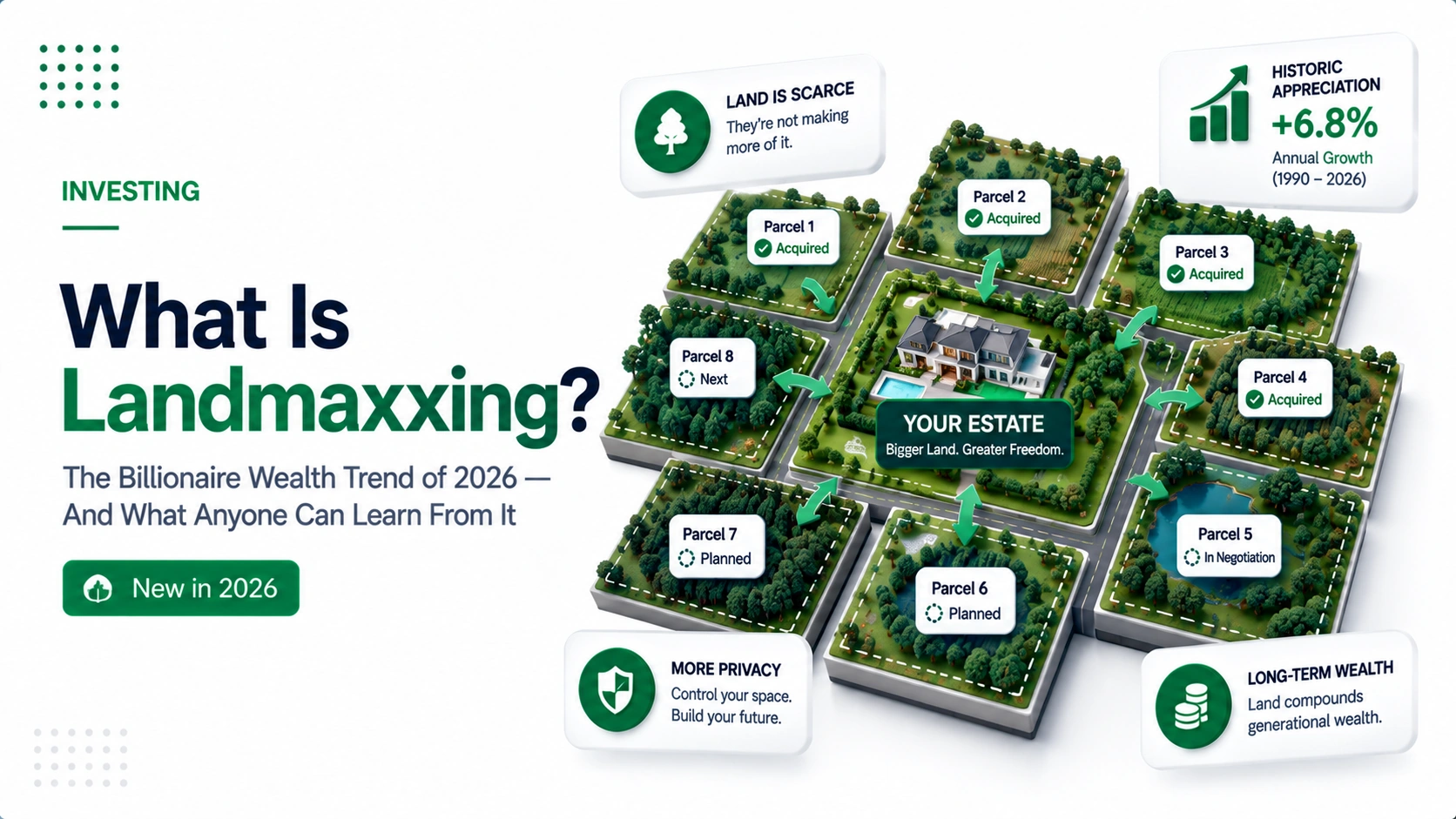
- Landmaxxing is the practice of acquiring neighboring or adjacent land to create privacy, control, and long-term wealth — named by Coldwell Banker’s 2026 Mid-Year Luxury Report
- US luxury property searches doubled in the first five months of 2026 — searches for buildable land jumped 97% year over year
- Ken Griffin spent $450 million assembling a 27-acre Palm Beach compound. Jeff Bezos put $230 million into Miami’s Indian Creek Island. Larry Ellison is buying prolifically across Malibu and Florida.
- You do not need billions to apply the landmaxxing philosophy — the core principles of land as a scarce, appreciating, inflation-resistant asset apply at any scale
- Agricultural land returned an average of 11.5% annually over the past decade — outperforming most traditional investment assets
Ken Griffin spent more than $450 million assembling a 27-acre compound in Palm Beach. Jeff Bezos put over $230 million into neighboring properties on Miami’s Indian Creek Island. Larry Ellison is quietly buying across Malibu, Incline Village, and Manalapan, Florida.
Mark Zuckerberg did it a decade ago — spending over $30 million buying four adjacent Palo Alto homes. Now the strategy has a name, a Wall Street Journal investigation, and a Coldwell Banker luxury report dedicated to it.
It is called landmaxxing — and it is the hottest wealth trend of 2026.
The obvious reaction: this is a billionaire problem with billionaire solutions. But that reaction misses what is actually interesting about landmaxxing — the underlying principles behind why the world’s wealthiest people are pivoting to land, and why those principles apply at almost any wealth level.
Here is exactly what landmaxxing is, why it is happening in 2026 specifically, and what the average person can learn from it.
What Landmaxxing Actually Is
Landmaxxing is the practice of acquiring adjacent or neighboring land parcels to expand control, create privacy, protect views, and build long-term wealth through land scarcity.
The term was coined in Coldwell Banker’s Global Luxury 2026 Mid-Year Report — released in July — and subsequently spotlighted by The Wall Street Journal in a dedicated investigation. It describes a pattern that has been quietly accelerating among high-net-worth buyers: instead of buying a second mansion in another city, they are buying the land around their existing property.
Landmaxxing has two distinct motivations that often overlap:
Defensive landmaxxing
Buying adjacent parcels to prevent unwanted development, preserve ocean or mountain views, and create a security buffer around a primary residence. When a neighboring lot is developed into a dense apartment complex or a commercial property, it permanently changes the character of the surrounding area. Buying that lot before development occurs is the ultimate defensive real estate play — you are not just buying land, you are buying control over what happens next to you.
Offensive landmaxxing
Assembling multiple parcels into a unified compound — with space for guest quarters, security staff, private docks, tennis courts, and multi-generational family living — that could never be recreated once the individual lots are developed separately. The scarcity created by assembly dramatically increases resale value. Some owners who spent tens of millions assembling compounds now estimate their properties are worth substantially more than their original acquisition costs.
External resource: Landmaxxing explained — TheStreet
Why It Is Happening in 2026 Specifically
Landmaxxing is not a new concept — Zuckerberg was doing it in 2012. What changed in 2026 is the scale, the speed, and the reasons behind it.
US luxury property searches doubled
US luxury property searches doubled in the first five months of 2026 versus the same period in 2025. Searches for buildable land jumped 97% year over year. That is not a marginal trend — it is a fundamental reallocation of wealthy capital toward land specifically.
Inflation and market volatility drove the pivot
With inflation running at 3.5% and financial markets navigating geopolitical uncertainty from the Iran conflict, wealthy investors are increasingly viewing land as a tangible, inflation-resistant store of value. Unlike stocks or bonds, land cannot be printed, copied, or digitally replicated. Its supply is fixed. And in desirable locations — coastal, recreational, agricultural — that fixed supply is meeting dramatically rising demand.
K-shaped wealth concentration accelerated the trend
The 2026 economy produced two very different realities: luxury sales rising while starter-home buyers struggle. The wealth concentration at the top accelerated significantly post-pandemic, and that concentrated wealth is flowing into the most scarce, defensible assets available — which means trophy land in desirable locations.
Privacy became a genuine luxury good
In an era of social media, drone technology, and paparazzi, physical privacy is increasingly difficult to buy with money alone. Land — particularly land that creates a buffer between a primary residence and the outside world — has become a genuine status and security purchase for the ultra-wealthy in a way it was not a decade ago.
The Billionaires Doing It — And What They Know
The specific buyers driving the landmaxxing trend are not buying randomly — they are applying a consistent investment philosophy that has produced extraordinary returns.
| Buyer | Location | Estimated Spend | Strategy |
|---|---|---|---|
| Ken Griffin | Palm Beach, FL | $450M+ | 27-acre compound assembly |
| Jeff Bezos | Indian Creek Island, Miami | $230M+ | Neighboring waterfront parcels |
| Larry Ellison | Malibu, Incline Village, FL | Undisclosed | Multi-market land accumulation |
| Mark Zuckerberg | Palo Alto + Kauai, HI | $100M+ | Adjacent homes + 1,400-acre Hawaii estate |
What these buyers share is not just wealth — it is a specific investment philosophy: assemble what cannot be replicated. Once Bezos owns the neighboring lots on Indian Creek Island, nobody else can. Once Griffin’s Palm Beach compound is assembled, that 27-acre parcel of oceanfront land in one of the world’s most desirable zip codes does not exist anywhere else. The value is not just in the land — it is in the irreproducibility of the assembled whole.
For others, it’s a tangible hedge against inflation or a means of insulating wealth from volatile financial markets. Land does not go bankrupt. It does not get diluted. It cannot be hacked. In a world of financial complexity and digital uncertainty, something you can physically stand on and legally own has an appeal that goes beyond its yield.
External resource: Landmaxxing — billionaire compound economics explained
The Landmaxxing Principles Anyone Can Borrow
You do not need $450 million to apply the philosophy behind landmaxxing. Here are the core principles that work at any scale.
Principle 1 — Scarcity is the ultimate investment moat
The reason Griffin and Bezos are buying land is the same reason anyone should think carefully about land as an asset: its supply is permanently fixed. They are not making more oceanfront in Palm Beach. They are not creating new buildable lots on Indian Creek Island. Once desirable land is assembled and held, its relative scarcity only increases as surrounding areas develop.
At a smaller scale: a lot adjacent to a growing town, farmland near an expanding suburb, or recreational land near a popular national park all share the same scarcity characteristic at a fraction of the price. The principle is identical — only the zeros are different.
Principle 2 — Defensive assets protect what you have built
Landmaxxing’s defensive version — buying adjacent property to prevent unwanted development — is essentially insurance. The wealthy are willing to pay significant premiums to protect the value of their primary asset from external threats they cannot control. The average homeowner can apply this logic by paying attention to what is being built or developed near their property and understanding how zoning changes affect their asset’s future value.
Principle 3 — Physical assets hedge inflation differently than financial assets
Agricultural land is projected to remain one of the most stable land investments in 2026. While commodity prices may fluctuate, farmland continues to benefit from long-term fundamentals: food demand, limited supply, and institutional investment. Agricultural land returned an average of 11.5% annually over the past decade — outperforming the S&P 500 in several years and maintaining value during financial market volatility because its underlying demand (food production) is non-negotiable.
Principle 4 — Concentration around your best asset beats diversification for generational wealth
The landmaxxing philosophy explicitly rejects the conventional wisdom of geographic diversification. Instead of owning five mediocre properties across five cities, the strategy is to own deeply around one exceptional asset. This is the opposite of most investment advice — and it is what the world’s wealthiest people are increasingly doing with their real estate capital.
Put your money to work smarter: 12 Passive Income Ideas That Actually Work in 2026
How Regular Investors Are Applying Land Investing in 2026
You cannot buy the lot next to Jeff Bezos. But the land investing principles behind landmaxxing are accessible to investors with far more modest budgets.
Vacant land investing — the accessible entry point
Raw land investing — buying vacant parcels in growing areas and selling at a premium as development spreads — is one of the most accessible real estate strategies for individual investors. Entry prices for rural or semi-rural vacant land start at $5,000 to $50,000 for parcels in areas with long-term growth potential. Unlike rental properties, vacant land has no tenants, no maintenance, no plumbing to fix. You hold it, pay property taxes, and sell when the market moves to you.
Land investing is the purchase of raw or vacant land to generate profit through resale, development, or leasing. Unlike traditional real estate, land investing excludes buildings and focuses solely on the land itself. 2026 offers favorable conditions such as increased demand for land near expanding urban areas and infrastructure improvements.
Farmland REITs — institutional land access for $1
For investors who want farmland exposure without buying actual farmland, REITs like Farmland Partners (FPI) and Gladstone Land (LAND) own agricultural land across the US and pay dividends from farm lease income. You can buy a single share — currently under $20 for both — and gain exposure to farmland’s inflation-resistant appreciation and income without any of the management complexity of direct ownership.
Recreational land — the demand wave nobody is talking about
Demand for renewable energy sites and recreational land is rising. Hunting land, fishing properties, and parcels adjacent to public land with recreational access are in high demand from buyers priced out of traditional vacation real estate. A 10-acre recreational parcel in a popular hunting or fishing region can be purchased for $15,000 to $80,000 and leased to hunting clubs or outdoor enthusiasts for $500 to $3,000 per year in passive income.
Minor subdividing — the land investor’s value-add strategy
Minor subdividing continues to be one of the most reliable ways to create value in land investing. Instead of selling one large parcel, you split it into multiple smaller parcels that are easier to sell and often worth more on a per-acre basis. A well-executed minor subdivide can turn one deal into several profitable exits. This strategy requires understanding local zoning regulations and subdivision requirements — but for investors willing to do that work, the returns can be substantial.
Learn to invest: How to Invest in Index Funds — Complete Beginner Guide
The Risks Nobody Is Talking About
Land investing and landmaxxing carry real risks that the trend coverage consistently underplays.
Illiquidity
Land is one of the least liquid assets you can own. Unlike stocks or ETFs, you cannot sell a parcel of land in seconds — or even weeks. Finding the right buyer for a specific piece of land can take months or years. If you need cash quickly, land cannot provide it. Never invest in land money you might need within 3 to 5 years.
Zoning and regulatory risk
Land value is heavily dependent on what is legally allowed to be built on it. Zoning changes, environmental regulations, and local government decisions can dramatically alter a parcel’s value — in both directions. Land that appears suitable for residential development may face environmental protection restrictions that prevent building. Always conduct thorough due diligence on zoning status and applicable regulations before purchasing.
No income while you hold
Unlike rental properties, most vacant land produces no income while you own it. You still pay property taxes, potentially for years, with no offsetting cash flow. This carrying cost erodes returns if the land does not appreciate as expected. Farmland and recreational land leasing can offset this — but requires finding tenants and managing lease agreements.
Local market knowledge is everything
National averages matter less than local dynamics. Population growth, water availability, zoning policies, and proximity to outdoor recreation will continue to shape regional performance. Landowners should evaluate trends at the county and watershed level rather than relying on broad market narratives. Buying land in the wrong market at the wrong time can produce decades of stagnant value.
Frequently Asked Questions
What is landmaxxing exactly?
Landmaxxing is the practice of buying adjacent or neighboring land parcels to create privacy, protect existing property values, build larger compounds, or establish a long-term wealth asset in a scarce location. The term was coined in Coldwell Banker’s 2026 Global Luxury Mid-Year Report and subsequently covered by The Wall Street Journal. At the ultra-luxury level, it involves billionaires assembling multi-acre compounds by buying out neighbors. The underlying principles — land scarcity, inflation hedging, and defensive asset ownership — apply at far more modest scales.
Can a regular person invest in land?
Yes — raw vacant land is one of the most accessible real estate asset classes for individual investors. Entry-level parcels in rural or semi-rural areas near growing markets can be purchased for $5,000 to $50,000. Farmland REITs like Farmland Partners (FPI) provide land exposure for under $20 per share with no management required. Recreational land leasing provides passive income from hunting and fishing access. The strategies billionaires use at the top of the market — scarcity, inflation hedging, long-term appreciation — work the same way at any scale. The zeros are different; the principles are identical.
Is land a good investment in 2026?
Agricultural farmland returned an average of 11.5% annually over the past decade — outperforming many traditional investment assets while providing inflation protection. In desirable locations near growing urban areas, recreational destinations, or infrastructure improvements, vacant land has historically appreciated as development spreads. The 2026 land market is stabilized after pandemic-era surges, with buyers and sellers operating with clearer price expectations. The risks — illiquidity, no income during holding, zoning uncertainty, and local market dependency — are real and require careful due diligence. Land rewards long-term strategic thinking rather than short-term speculation.
Final Thoughts
Landmaxxing is a billionaire trend with a name that sounds like internet slang. But the reason the world’s wealthiest people are pivoting to land in 2026 is not complicated: they are buying the one thing that cannot be manufactured, replicated, or inflated away.
You do not need $450 million to understand why. Land’s fixed supply, inflation resistance, and scarcity-driven appreciation work the same way at $50,000 as they do at $50 million. The principles behind what Griffin and Bezos are doing — owning the irreplaceable, defending what you have built, concentrating around your best asset — are applicable at any wealth level.
Whether that means a farmland REIT position in your investment account, a recreational parcel near a growing outdoor destination, or simply paying attention to what is being built next to your home — the landmaxxing philosophy is worth understanding even if the billionaire version is not in your budget.