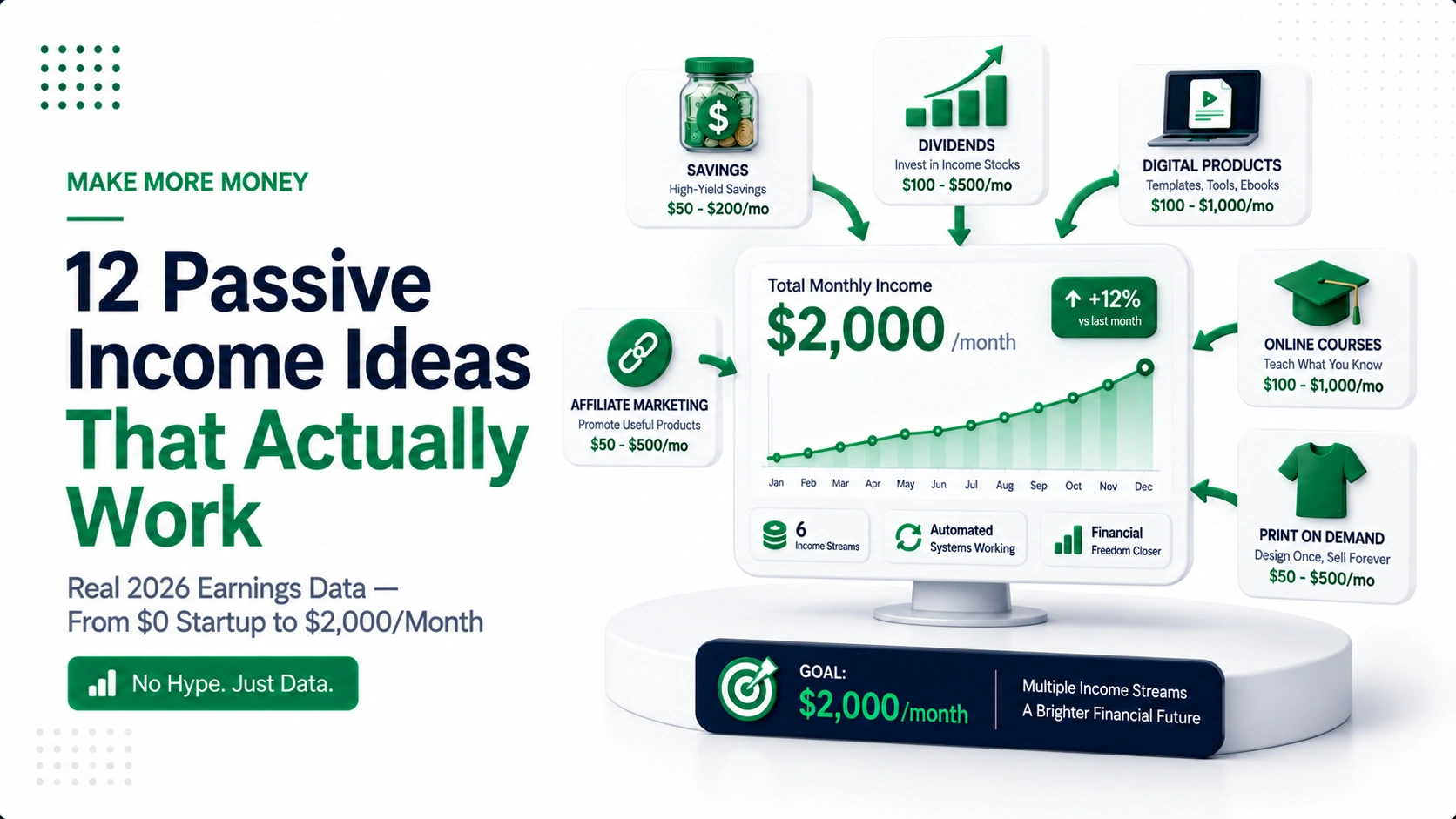
- 36% of American adults now earn some form of passive income in 2026 — up from 22% five years ago
- The creator economy hit $310 billion in 2026 — digital products are the most accessible path to earning money while you sleep
- True passive income requires upfront work or capital — the difference is that it pays you repeatedly after that initial investment
- The fastest path to $1,000/month passive income in 2026: digital products (6–12 months) or dividend investing (requires $25,000–$40,000 in capital)
- The single biggest mistake: starting 3 streams simultaneously instead of mastering 1 first
Let us be honest about something most passive income articles never say: there is no such thing as income that requires zero effort.
What passive income actually means is front-loading your effort — building something once, investing capital once, or creating an asset once — so that it generates income repeatedly with minimal ongoing work. The “passive” part comes after the upfront investment. Not before it.
With that honest framing in place: passive income in 2026 is more accessible than at any point in history. The creator economy hit $310 billion. Digital product platforms make global distribution free. High-yield savings accounts are paying 4.5 to 5% APY. Dividend ETFs are yielding 3 to 5% annually. The tools exist. What most people lack is the honest guide to which ones actually work — and which ones are recycled hype wearing a different headline.
Here are 12 that actually work in 2026, ranked from easiest to start to highest ceiling — with real earnings data and honest timelines for each one.
The Passive Income Reality Check
Before the list — the three things most passive income content never tells you.
1. It takes longer than you think
The best passive income ideas in 2026 take 6 to 24 months to reach meaningful monthly income. Digital products need an audience. Dividend portfolios need capital to accumulate. Affiliate marketing needs SEO to rank. Anyone promising $5,000/month in your first 30 days is selling a course, not passive income.
2. The first 90 days produce almost nothing
This is where most people quit — right before compounding kicks in. The income curve for passive streams is not linear. It looks flat for months, then turns sharply upward once distribution, SEO, or compound returns take hold. The people who build meaningful passive income are not the ones who found a better strategy. They are the ones who did not quit at month three.
3. One stream mastered beats six streams started
The most common passive income mistake in 2026: reading a list like this one, starting six different streams simultaneously, and producing nothing meaningful from any of them. Pick one. Commit to it for 90 days. Build it to its first $100/month. Only then consider adding a second stream.
12 Passive Income Ideas Ranked by Ease and Earnings
1. High-Yield Savings Account — Easiest Start
Startup cost: Any amount | Time to first dollar: Immediate | Monthly income on $20,000: $75–$85/month
The most boring idea on this list and one of the most reliable. High-yield savings accounts in 2026 pay 4.5 to 5.1% APY — meaning $20,000 sitting in the right account earns $900 to $1,020 per year in completely passive, fully liquid income. Your emergency fund should already be here. If it is not, moving it from a standard savings account to a HYSA is the fastest passive income upgrade available with zero risk and zero effort beyond the initial transfer.
Honest ceiling: At 5% APY, you need $240,000 to generate $1,000/month. This is a foundation, not a path to financial independence on its own.
2. Dividend Index Funds — Most Reliable Long-Term
Startup cost: $1+ (fractional shares) | Time to first dollar: First dividend payment (quarterly) | Monthly income on $10,000: $25–$42/month
Buy shares in a dividend-paying index fund, set up automatic dividend reinvestment, and do nothing. The Vanguard High Dividend Yield ETF (VYM) and Schwab US Dividend Equity ETF (SCHD) are the two most commonly recommended options in 2026 — both yield between 3 and 5% annually with expense ratios under 0.10%.
At a 3% yield, $10,000 generates $300 per year — $25/month. Meaningful income requires meaningful capital: $100,000 generates $250 to $417 per month. The power of dividend investing is compounding over decades — reinvested dividends buy more shares, which pay more dividends, which buy more shares. A 25-year-old investing $500/month consistently into SCHD will have a genuinely life-changing passive income stream by 50.
Honest ceiling: Unlimited — but requires capital and time. Not a quick win. The most powerful long-term passive income stream on this list.
Learn how to start: How to Invest in Index Funds — Complete Beginner Guide
3. Digital Products — Highest ROI for Creators
Startup cost: $0–$50 | Time to first dollar: 2–8 weeks | Monthly income potential: $200–$5,000+/month
Create a product once — a template, spreadsheet, ebook, Notion dashboard, Canva design, prompt pack, or printable — and sell it indefinitely with zero marginal cost. Every sale after the first is pure profit with no additional effort.
The 2026 data from 5,000+ digital product creators shows the most successful categories: budget spreadsheets and financial trackers ($500–$2,000/month on Etsy), Canva social media templates ($300–$1,500/month), AI prompt packs ($200–$800/month on Gumroad), and Notion dashboards ($400–$3,000/month). A UX designer selling a Figma component library for $29 on Gumroad can generate $1,500 to $3,000 per month once the product gains traction through organic search and social proof.
Honest ceiling: High — but traffic is the constraint. A great product with no audience earns nothing. Distribution (SEO, social media, email list) is the real work.
4. Affiliate Marketing — Best for Content Creators
Startup cost: $0–$100 (website hosting) | Time to first dollar: 3–9 months | Monthly income potential: $500–$10,000+/month
Recommend products and services you genuinely use and earn a commission when someone buys through your link. You do not create the product, handle shipping, or manage customer service. In 2026, the affiliate marketing landscape rewards authenticity and specificity — generic “best products” content is being replaced by niche expertise and genuine recommendations.
The highest-paying affiliate categories in 2026: SaaS tools ($50–$200/referral, recurring), financial products ($50–$200/signup), web hosting ($65–$150/sale), and online education platforms ($20–$100/enrollment). A personal finance blog with 20,000 monthly visitors can realistically earn $2,000 to $8,000/month from affiliate commissions across investment apps, budgeting tools, and financial products.
Honest ceiling: Very high — but SEO takes 6 to 12 months to build. This is the highest-effort upfront option with one of the highest long-term ceilings.
5. Online Courses — Highest Per-Sale Income
Startup cost: $0–$500 (recording equipment) | Time to first dollar: 4–12 weeks | Monthly income potential: $500–$20,000+/month
Record a course teaching something you know — a skill, a process, a system — and sell it on Teachable, Gumroad, or Udemy. The course is created once and sold repeatedly. The per-sale income is significantly higher than most digital products: courses priced at $97 to $497 are common, with successful creators selling hundreds of copies per month.
In 2026, the most successful online course categories are skills with clear professional ROI: Excel and data analysis, video editing, coding and no-code tools, personal finance fundamentals, and AI prompt engineering. A well-structured course on a high-demand skill taught by someone with genuine expertise can reach $5,000 to $20,000 per month with a built audience and effective marketing.
Honest ceiling: Very high — but requires an existing audience or significant marketing investment to reach meaningful sales velocity. The course itself is the easy part. Selling it is the work.
6. Print-on-Demand — Zero Inventory Passive Income
Startup cost: $0 | Time to first dollar: 2–6 weeks | Monthly income potential: $100–$3,000/month
Upload designs to platforms like Redbubble, Merch by Amazon, or Printful integrated with Etsy. When someone orders, the platform prints and ships — you earn the margin between your retail price and the base cost. No inventory. No shipping. No customer service.
The 2026 opportunity: niche designs dramatically outperform generic ones. A shop targeting a specific hobby, profession, or cultural identity consistently earns more than a generalist shop with similar design quality. Sellers using AI tools to generate design concepts quickly — then refining for quality — are launching faster than at any previous point in the platform’s history.
Honest ceiling: Margins are thin ($3 to $10 per sale) — volume is everything. Reaching $1,000/month requires consistent sales velocity that takes 6 to 18 months to build without paid advertising.
7. Stock Photography and Media Licensing
Startup cost: Equipment you likely already own | Time to first dollar: 2–8 weeks after upload approval | Monthly income potential: $50–$5,000+/month
Upload photos, illustrations, video clips, UI kits, or sound effects to licensing platforms like Shutterstock, Adobe Stock, or Creative Market. Each download earns a royalty — typically $0.25 to $2.85 per download on major platforms, or $5 to $200+ for premium assets on niche platforms.
In 2026, the highest-demand categories are authentic lifestyle photography (not staged), business and technology imagery, food and wellness content, and 3D assets for digital design. A contributor with 500+ approved assets on multiple platforms realistically earns $1,000 to $5,000 per month. A beginner’s first library of 50 well-chosen images earns $50 to $300 per month.
Honest ceiling: The passive element is near-total once uploaded — each asset earns indefinitely with no ongoing effort. Building a library large enough to generate meaningful income requires months of consistent creation upfront.
8. Niche Blog with Display Ads — Compounding Traffic Income
Startup cost: $50–$150/year (hosting) | Time to first dollar: 4–9 months | Monthly income potential: $500–$10,000+/month
Build a blog targeting a specific niche audience, publish SEO-optimized content consistently, and earn display advertising revenue once you hit traffic thresholds. Mediavine accepts sites with 50,000 sessions/month and pays $20 to $60 RPM in the personal finance niche — one of the highest-paying categories for display advertising. Ezoic works at lower traffic levels for earlier monetization.
The key distinction between blogs that succeed and those that do not in 2026 is non-commodity content — original data, unique perspectives, and firsthand expertise that AI cannot replicate. Generic “top 10 tips” content no longer ranks. Specific, data-backed, original content does.
Honest ceiling: Very high — a well-ranked personal finance blog with 100,000 monthly visitors can earn $3,000 to $8,000/month from ads alone, plus affiliate income on top. The compound nature of SEO — where existing content keeps ranking and driving traffic — makes this one of the most scalable long-term passive income streams available.
9. YouTube Ad Revenue — Slowest to Build, Highest Visibility
Startup cost: $0–$500 (basic equipment) | Time to first dollar: 6–18 months | Monthly income potential: $200–$50,000+/month
Create videos, upload them, and earn advertising revenue once you hit 1,000 subscribers and 4,000 watch hours. YouTube videos earn indefinitely — a video uploaded in 2023 still earns ad revenue in 2026 if it continues receiving views. The platform favors evergreen content that answers specific questions or covers specific topics people search for repeatedly.
Finance and money content on YouTube pays among the highest CPM rates of any niche — $15 to $30 per 1,000 views compared to $2 to $5 for entertainment content. A finance channel with 50,000 subscribers and strong engagement realistically earns $2,000 to $8,000/month from ads alone, plus sponsorships and affiliate commissions on top.
Honest ceiling: Extremely high — but the 6 to 18 months before monetization eligibility is a significant barrier. YouTube is a long game with a very high ceiling for those willing to play it.
10. Renting Assets You Already Own
Startup cost: $0 (use existing assets) | Time to first dollar: 1–2 weeks | Monthly income potential: $100–$1,500/month
Your car, your parking space, your storage space, your camera equipment, your tools — all of these can be rented through platforms that handle the logistics. Turo lets you rent your car when you are not using it (average $500 to $800/month for a regularly rented vehicle). Neighbor.com lets you rent unused storage space in your home or garage ($50 to $400/month depending on size and location). Fat Llama and ShareGrid handle equipment rentals for cameras, audio gear, and production equipment.
Honest ceiling: Limited by what you own and how frequently it can be rented. This is supplemental income rather than a primary passive income stream — but it is the fastest path to first dollars because it requires no creation, no audience, and no capital beyond what you already have.
11. Securities Lending — New in 2026
Startup cost: Requires existing investment account with eligible holdings | Time to first dollar: Immediate once enrolled | Monthly income potential: $20–$500/month on a $50,000 portfolio
Many brokerages — including Robinhood, Interactive Brokers, and Fidelity — now offer securities lending programs where they loan your stocks to short-sellers and share the interest income with you. You opt in, the brokerage handles everything, and the interest posts automatically to your account. Your holdings remain yours — you can sell at any time.
In 2025 and 2026, AI and energy sector volatility created unusually high demand for borrowed shares, generating meaningful income for participants. The income varies significantly based on which stocks you hold and how much short interest exists — highly shorted stocks earn much more than widely held index funds.
Honest ceiling: Supplemental income rather than primary — but genuinely passive for existing investors with no additional effort required beyond enrollment.
12. REITs — Real Estate Without the Landlord Headaches
Startup cost: $1+ (fractional shares) | Time to first dollar: First dividend payment | Monthly income potential: $30–$80/month on $10,000
Real Estate Investment Trusts (REITs) are companies that own income-producing real estate — apartment buildings, shopping centers, warehouses, data centers — and are required by law to distribute 90% of their taxable income to shareholders as dividends. Buying REITs through a standard brokerage account gives you real estate income without owning property, managing tenants, or dealing with maintenance.
In 2026, the most popular REIT ETFs are Vanguard Real Estate ETF (VNQ) yielding approximately 4.1% annually and Schwab US REIT ETF (SCHH). On $10,000 invested, that generates $410 per year — $34/month — in passive dividend income paid quarterly.
Honest ceiling: Similar to dividend stocks — requires significant capital for meaningful monthly income. Best as one component of a diversified passive income portfolio rather than the sole stream.
Side-by-Side Comparison Table
| Stream | Startup Cost | Time to $1 | Monthly Potential | Effort Level |
|---|---|---|---|---|
| High-Yield Savings | Any amount | Immediate | $75–$85 on $20K | ⭐ Lowest |
| Dividend Index Funds | $1+ | 1st quarter | $25–$42 on $10K | ⭐ Lowest |
| Digital Products | $0–$50 | 2–8 weeks | $200–$5,000+ | ⭐⭐ Medium upfront |
| Affiliate Marketing | $0–$100 | 3–9 months | $500–$10,000+ | ⭐⭐⭐ High upfront |
| Online Courses | $0–$500 | 4–12 weeks | $500–$20,000+ | ⭐⭐⭐ High upfront |
| Print-on-Demand | $0 | 2–6 weeks | $100–$3,000 | ⭐⭐ Medium |
| Stock Photography | Existing equipment | 2–8 weeks | $50–$5,000+ | ⭐⭐ Medium upfront |
| Niche Blog + Ads | $50–$150/yr | 4–9 months | $500–$10,000+ | ⭐⭐⭐ High upfront |
| YouTube Ad Revenue | $0–$500 | 6–18 months | $200–$50,000+ | ⭐⭐⭐ Highest upfront |
| Renting Your Assets | $0 | 1–2 weeks | $100–$1,500 | ⭐ Low |
| Securities Lending | Existing holdings | Immediate | $20–$500 on $50K | ⭐ Lowest |
| REITs | $1+ | 1st dividend | $30–$80 on $10K | ⭐ Lowest |
Which One Should You Start With?
The right starting point depends entirely on what you have — time, capital, or skills — not which idea has the highest ceiling.
- You have savings sitting in a low-interest account → Move it to a HYSA immediately. Instant passive income, zero risk, five minutes of effort.
- You have $1,000+ to invest → Start a dividend ETF position (SCHD or VYM). Set up automatic monthly contributions. Do not touch it for years.
- You have a skill or knowledge worth teaching → Digital product or online course. Create something once, sell it indefinitely.
- You have a car, storage space, or equipment sitting idle → Rent it through Turo, Neighbor.com, or Fat Llama. Fastest path to first dollars with zero creation required.
- You have time but limited capital → Niche blog with affiliate marketing. Longest runway but highest long-term ceiling with minimal upfront cost.
- You already have an investment account → Enable securities lending. Zero additional effort, immediate supplemental income from existing holdings.
The Doolars recommendation for most beginners: start with the HYSA (immediate, risk-free), add a monthly dividend ETF contribution (long-term compounding), and — if you have a skill worth monetizing — spend 90 days building one digital product. Those three streams together cover all time horizons: immediate income now, compound growth over decades, and creative income in between.
Get started: 7 Best Investment Apps for Beginners in 2026 — Start With Just $100
Frequently Asked Questions
How much money do I need to start earning passive income?
You can start with $0. High-yield savings accounts require no minimum beyond whatever you already have saved. Digital products, print-on-demand, affiliate marketing, and YouTube all have zero startup costs. Renting assets you already own requires no additional capital. The income from these zero-cost streams is smaller in the early stages — but it is real and it compounds. Capital-based streams like dividend investing and REITs scale with how much you invest, but fractional shares mean you can start with $1 and add consistently over time.
How long does it take to make $1,000/month in passive income?
The timeline varies significantly by stream. Capital-based streams like dividends require $25,000 to $40,000 invested at a 3 to 5% yield to generate $1,000/month — which takes years of consistent saving and investing to accumulate. Creative streams like digital products and affiliate marketing can reach $1,000/month within 6 to 12 months with consistent effort — but require real upfront work building the asset and the audience to distribute it. The most realistic path for most beginners: $200 to $500/month from a combination of HYSA interest, small dividend positions, and one digital product within 12 months.
Is passive income taxable?
Yes — all passive income is taxable. Dividend income is taxed at qualified dividend rates (0%, 15%, or 20% depending on your income bracket) or ordinary income rates for non-qualified dividends. Digital product and affiliate income is self-employment income taxed at ordinary income rates plus 15.3% self-employment tax — set aside 25 to 30% of every dollar earned for taxes and make quarterly estimated tax payments if earnings exceed $1,000 per quarter. REIT dividends are typically taxed as ordinary income rather than at the lower qualified dividend rate — factor this into your after-tax return calculation.
Final Thoughts
Passive income is not a fantasy. 36% of American adults are earning some form of it in 2026 — and the tools available to beginners have never been better or more accessible.
But it is also not what most of the headlines about it suggest. It requires upfront work, capital, or both. It takes longer than you think to reach meaningful income. And the people who build it successfully are not the ones who found a clever shortcut — they are the ones who picked one stream, built it past the point where most people quit, and reinvested the early earnings to compound faster.
Pick one idea from this list that matches what you actually have right now — time, money, or skills. Give it 90 days. Build it to its first $100/month. Then decide whether to add a second stream.
The first $100/month of passive income is the hardest. The next $100 comes faster. And the compounding — financial and psychological — is what eventually changes everything.