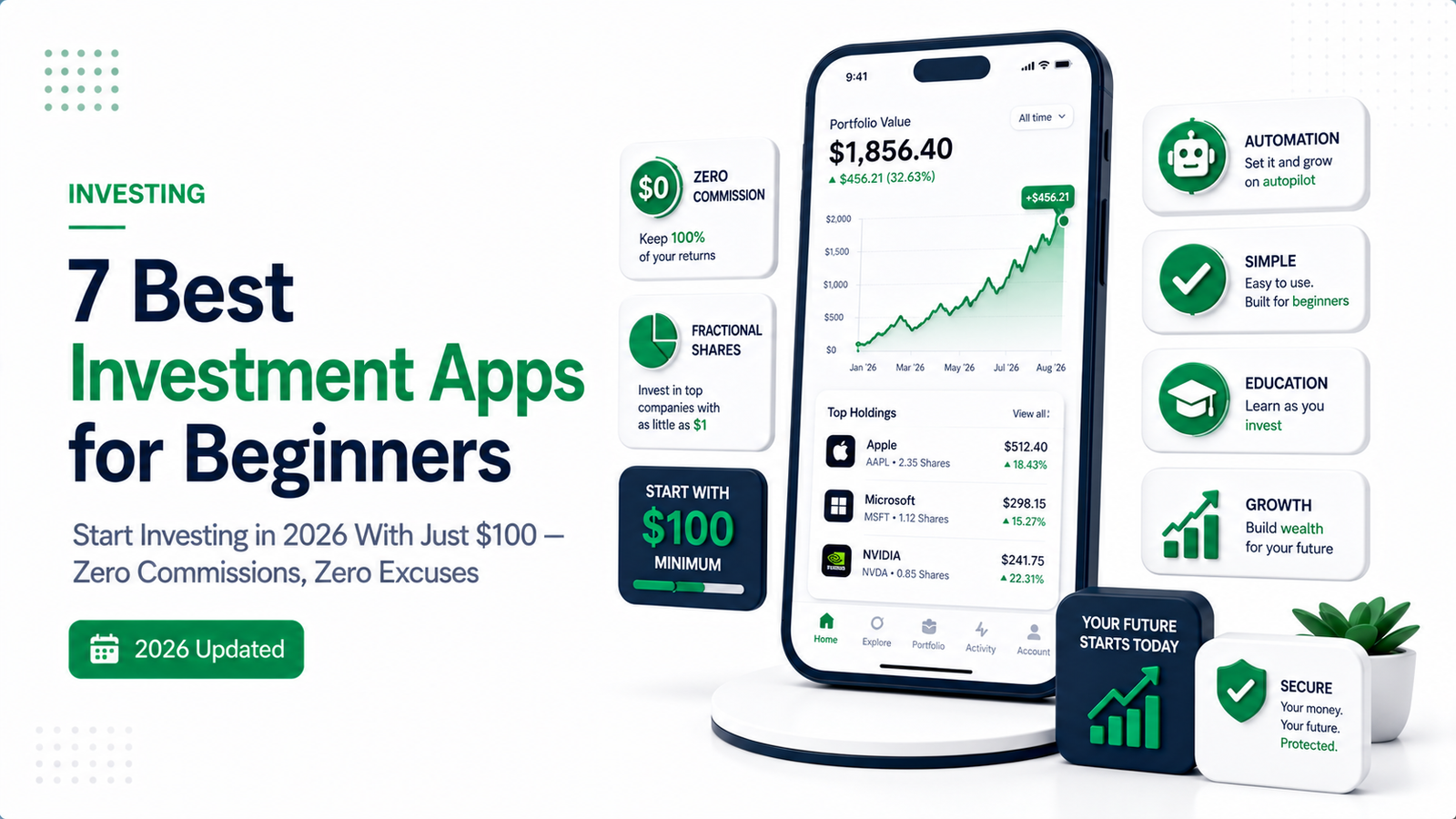
- You can start investing with as little as $1 on apps like Robinhood, SoFi, and Fidelity — no minimum required
- Zero-commission stock and ETF trading is now standard across all major beginner investment apps
- The biggest mistake beginners make is waiting to have “enough” money — starting with $100 today beats starting with $1,000 next year
- Each app on this list serves a different type of beginner — the best one for you depends on whether you want hands-on or hands-off investing
- A 1% annual fee compounded over 30 years costs you roughly 27% of your total portfolio — choosing a low-fee app matters enormously long term
The most common reason people do not start investing is the same one that was never true: “I do not have enough money yet.”
In 2026, the best investment apps let you start with $1. Zero commissions. No minimum deposit. Fractional shares of any stock you want for as little as a dollar. The barrier is not money — it is knowing which app to use and how to start.
This guide cuts through the noise. No sponsored rankings, no vague descriptions, no apps that look beginner-friendly but hide fees in the fine print. Just 7 apps that actually work for beginners, clearly explained, with the honest trade-offs for each one.
By the end, you will know exactly which app fits your situation — whether you want to pick your own stocks, let an algorithm handle everything, or start by investing spare change.
What to Look for in a Beginner Investment App
Not all investment apps are built for beginners — and the ones that look simplest are not always the ones that serve you best long term.
Here are the four things that actually matter when choosing your first investment app:
1. Fees — the number that silently destroys returns
A 1% annual management fee sounds small. Over 30 years on a $10,000 portfolio growing at 7% annually, that 1% fee costs you approximately $27,000 in lost returns — nearly three times your original investment. Zero-commission apps are now standard. Any app charging trading commissions or high management fees should be avoided until you understand exactly what you are getting for them.
2. Minimum investment — can you actually start today?
Some apps require $500 or $1,000 to open an account. Others let you start with $1. For a beginner with $100, the minimum matters enormously. Look for apps that support fractional shares — meaning you can buy a piece of an expensive stock like Apple or Amazon for as little as $1.
3. Simplicity vs control
Some beginners want to pick their own stocks. Others want an app to handle everything automatically. These are fundamentally different needs that require different apps. Knowing which type of beginner you are — hands-on or hands-off — before you download anything saves significant confusion.
4. Education built in
The best beginner apps teach you while you invest. Look for apps with built-in explainers, tutorials, and clear labeling of what you are actually buying. An app that lets you click “buy” on a stock without explaining what it is serves brokers, not beginners.
The 7 Best Investment Apps for Beginners in 2026
1. Robinhood — Best for Simplicity
Minimum: $0 | Commissions: $0 | Best for: Beginners who want the simplest possible experience
Robinhood pioneered commission-free trading and its mobile app remains the simplest on this list. Clean interface, portfolio performance visible at a glance, and buying a stock takes three taps. Fractional shares start at $1, meaning you can own a piece of any stock regardless of its price.
What makes it stand out: 24-hour weekday trading, no account minimums, and a free stock just for linking your bank account. Robinhood Gold ($5/month) adds premium features including FDIC-insured cash sweep up to $2.25 million.
The honest trade-off: Robinhood’s educational content is thinner than Fidelity or Schwab. It is excellent for executing trades — less excellent for teaching you what to buy and why. Best for beginners who already know they want to buy index ETFs and want the cleanest experience to do it.
2. Fidelity — Best Overall for Beginners
Minimum: $0 | Commissions: $0 | Best for: Beginners who want everything in one place
Fidelity is the most complete beginner investment app available in 2026. Zero commissions, fractional shares from $1, access to retirement accounts (IRA, Roth IRA), and one of the best educational content libraries of any investment platform. It also offers over 3,600 mutual funds with no transaction fees.
What makes it stand out: Fidelity’s research tools and educational content genuinely teach you to invest rather than just execute trades. For a beginner who wants to build a long-term portfolio and actually understand what they are doing, Fidelity is the strongest all-around choice.
The honest trade-off: Beginning in June 2026, Fidelity started charging a 5% fee (capped at $100) on purchases of certain ETFs from issuers that have not reached a payment agreement with Fidelity. This applies to over 100 ETFs. Always check whether your chosen ETF is on the fee list before buying. For standard index ETFs like S&P 500 funds, you will not encounter this fee.
3. Betterment — Best for Hands-Off Investing
Minimum: $0 | Fee: $4/month or 0.25%/year | Best for: Beginners who want automation
Betterment is a robo-advisor — it builds and manages a diversified portfolio of low-cost ETFs for you automatically, based on your goals and risk tolerance. You answer a few questions, deposit money, and Betterment handles everything else: asset allocation, rebalancing, and tax optimization.
What makes it stand out: Betterment is the best option for beginners who want to invest but do not want to think about it. No stock picking, no rebalancing decisions, no wondering whether your portfolio is set up correctly. The $4/month fee switches to 0.25% annually once you hit $20,000 in assets — competitive for what you get.
The honest trade-off: Betterment does not offer individual stock trading or crypto. It is purely a managed investing platform. If you want to pick individual stocks alongside automated investing, Fidelity or SoFi are better fits. Betterment’s Premium tier (0.65% annually, $100,000 minimum) adds unlimited access to human financial advisors.
4. SoFi Invest — Best for Banking + Investing Combined
Minimum: $1 | Commissions: $0 | Best for: Beginners who want investing and banking in one app
SoFi Invest combines commission-free stock and ETF trading with automated investing, crypto access, and a high-yield savings account all in one platform. For a beginner who wants to manage their entire financial life in a single app, SoFi offers the most complete package.
What makes it stand out: SoFi’s combination of banking features, investment tools, and built-in financial planning guidance makes it uniquely suited for beginners who are building their financial foundation while starting to invest simultaneously. Fractional shares start at $5.
The honest trade-off: SoFi’s investment selection is narrower than Fidelity’s and its research tools are more basic. It is better for simplicity than for depth. If you plan to become an active investor over time, you may outgrow SoFi and want to migrate to Fidelity or Schwab.
5. M1 Finance — Best for Custom Automated Portfolios
Minimum: $100 | Fee: $3/month | Best for: Beginners who want control with automation
M1 Finance sits between self-directed trading and robo-advising. You build a custom portfolio — called a “pie” — by selecting stocks and ETFs and assigning percentage weights. Then M1 automatically rebalances by directing new deposits toward underweight positions. It is the only app on this list that gives you both full customization and automated management at $0 commissions.
What makes it stand out: if you want to own 60% index funds, 20% dividend stocks, and 20% individual picks, M1 lets you build that once and automate it forever. It is a uniquely powerful concept that no other app on this list replicates. New users can receive up to $500 in their brokerage account with an initial deposit.
The honest trade-off: M1’s $100 minimum and $3/month platform fee are higher barriers than Robinhood or SoFi. The monthly fee is worth it for the automation features — but for a beginner with exactly $100, starting on Robinhood or Fidelity and moving to M1 later as your balance grows is a practical approach.
6. Webull — Best for Beginners Ready to Learn Actively
Minimum: $0 | Commissions: $0 | Best for: Beginners who want to graduate into active investing
Webull is built for beginners who want more advanced tools than Robinhood provides — without the complexity of a professional trading platform. It offers commission-free stock, ETF, options, and crypto trading with significantly more analytical tools and charting than most beginner apps.
What makes it stand out: Webull’s paper trading feature is genuinely valuable for beginners. It gives you a virtual account with $1 million in fake money to practice buying and selling stocks before risking real cash. Learning to invest on paper for 30 to 60 days before committing real money is one of the most underused strategies for reducing costly beginner mistakes.
The honest trade-off: Webull’s interface is more complex than Robinhood or Betterment. There is a learning curve. It is the right app for a beginner who wants to actively learn investing — not the right app for someone who wants investing to be effortless.
7. Acorns — Best for Investing Spare Change
Minimum: $0 | Fee: $3/month | Best for: Beginners who struggle to save money to invest
Acorns takes a completely different approach to beginner investing: it rounds up every purchase you make to the nearest dollar and automatically invests the spare change. Buy a coffee for $3.40 and Acorns invests $0.60. Over time, those micro-investments build into a real portfolio managed automatically in diversified ETFs.
What makes it stand out: Acorns solves the most common beginner problem — not starting. By automating investments from everyday spending, it removes the need to consciously decide to invest. For someone who has never been able to set aside money to invest, Acorns builds the habit invisibly. The $3/month fee includes a checking account, a retirement account, and an investment account.
The honest trade-off: Acorns’ round-up amounts are genuinely small. The average user invests $30 to $50 per month through round-ups. At $3/month in fees on $40 invested, you are paying a 7.5% annual fee — extremely high by any standard. Acorns is best used as a starting point for building the habit, then migrating to a zero-fee app like Fidelity or Robinhood as your invested amounts grow.
Side-by-Side Comparison Table
| App | Minimum | Fee | Best For | Hands-Off? |
|---|---|---|---|---|
| Robinhood | $0 | $0 | Simplest experience | No |
| Fidelity | $0 | $0 | Best all-around | Optional |
| Betterment | $0 | $4/mo or 0.25% | Full automation | Yes |
| SoFi Invest | $1 | $0 | Banking + investing | Optional |
| M1 Finance | $100 | $3/month | Custom auto-portfolio | Yes |
| Webull | $0 | $0 | Active learning | No |
| Acorns | $0 | $3/month | Spare change investing | Yes |
Which App Is Right for You?
The best investment app is the one that matches how you actually want to invest — not the one with the most features or the most media coverage.
- You want the simplest possible experience → Robinhood
- You want everything in one place and to learn properly → Fidelity
- You want to invest without thinking about it → Betterment
- You want banking and investing in one app → SoFi Invest
- You want to build a custom portfolio that runs on autopilot → M1 Finance
- You want to learn actively before risking real money → Webull (start with paper trading)
- You struggle to save money to invest in the first place → Acorns
The Doolars recommendation for most beginners starting with $100: open a Fidelity account, buy one share of a total market index ETF (like FZROX — Fidelity’s zero expense ratio index fund), set up an automatic $25 weekly deposit, and do not touch it for 5 years. That is the entire strategy. Everything else is optimization you can add later.
Learn the foundation: How to Invest in Index Funds — Complete Beginner Guide
3 Mistakes Beginners Make When Choosing an Investment App
The app you choose matters less than the habits you build — but these three mistakes consistently cost beginners time and money.
Mistake 1 — Choosing based on what is trending
Robinhood went viral in 2020 during the meme stock craze. Acorns got massive press coverage in 2023. Neither of those facts has anything to do with which app is right for your specific situation. Choose based on your investing style, your starting amount, and whether you want hands-on or hands-off control — not based on which app appeared in the most recent article you read.
Mistake 2 — Opening multiple apps at once
A common beginner pattern: download 3 apps, put $50 in each, lose track of all of them, and end up with three tiny fragmented portfolios that are harder to manage and easier to forget about. Pick one app, start there, and add complexity only when you have outgrown the first option. Concentration beats diversification at the app level — diversification is for assets inside the app, not for the number of apps you use.
Mistake 3 — Waiting for the “right time” to start
Time in the market consistently beats timing the market. A beginner who invests $100 today at age 25 and earns 7% annually will have $1,497 by age 65. A beginner who waits until age 35 to invest the same $100 will have $761 — half as much, from a 10-year delay. The cost of waiting is not hypothetical. It is compounding that never happened.
Read more: What Is Moneymaxxing? The Viral Trend Making People Richer in 2026
Frequently Asked Questions
Can I really start investing with just $100?
Yes — and in most cases with even less. Robinhood, Fidelity, SoFi, and Webull all allow you to open an account with $0 and buy fractional shares for as little as $1. With $100, you can buy a diversified slice of the entire US stock market through a total market index ETF. The amount matters less than starting the habit. A $100 investment made consistently every month for 30 years at 7% average annual return grows to over $113,000.
Is it safe to invest through an app?
All seven apps on this list are regulated by the SEC and FINRA, and carry SIPC insurance up to $500,000 per account — protecting your investments if the brokerage fails. This is the same protection you get at any major bank or traditional brokerage. Your investments can still lose value due to market movements, but the apps themselves are legally required to meet strict financial and security standards. Always enable two-factor authentication on any investment account you open.
What should a beginner actually buy on these apps?
For most beginners, the single best first investment is a low-cost total market index ETF — a fund that owns a small piece of hundreds or thousands of companies simultaneously. On Fidelity, FZROX has a 0% expense ratio. On any platform, VTI (Vanguard Total Stock Market ETF) charges 0.03% annually. Buying one of these with your first $100 gives you instant diversification across the entire US economy without needing to pick individual stocks. Add money consistently, hold for years, and let compounding do the work.
Final Thoughts
The best investment app for beginners in 2026 is the one you will actually use. Not the one with the most features. Not the one your friend uses. The one that matches your investing style, fits your starting budget, and removes enough friction that you actually open it and deposit money.
For most beginners with $100, Fidelity or Robinhood gets you started in under 10 minutes with zero fees. For beginners who want automation, Betterment handles everything. For beginners who struggle to save money to invest, Acorns builds the habit invisibly.
Pick one. Start today. The most expensive investing mistake you can make is not making one — it is waiting another year to begin.