
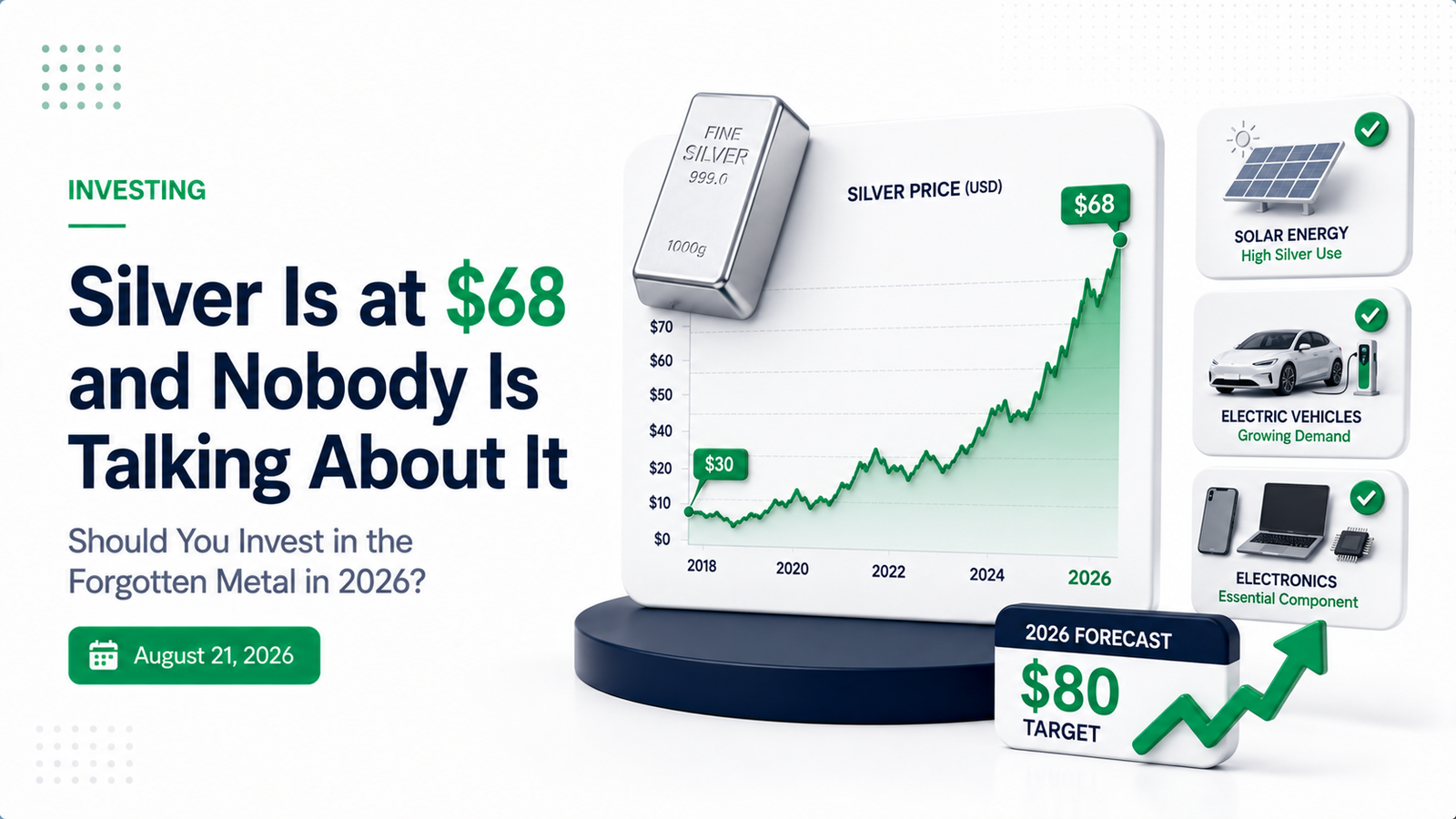
- Silver opened at $68.20 on August 21, 2026 — its highest price in two months, driven by strong industrial demand and the debasement trade
- Silver more than tripled between early 2025 ($30) and early 2026 ($79) — one of the strongest commodity runs in recent history
- Silver is down about 9% for the year after peaking in January 2026 — creating what some analysts call a buying opportunity
- BlackRock and J.P. Morgan both forecast silver surpassing $80 per ounce by end of 2026, with $100 possible by 2030
- Silver has a dual role — precious metal and industrial material — which makes it behave differently from gold and creates unique opportunities and risks
Everyone is watching Bitcoin surge to $73,000 today. Everyone is talking about gold at $4,577. The financial feeds are full of both.
Nobody is talking about silver.
That is exactly why it deserves your attention.
Silver opened at $68.20 per ounce this morning — its highest price in two months — driven by strong industrial demand and a renewed investor pivot toward hard assets. It more than tripled between early 2025 and early 2026. It has been quietly recovering from a mid-year dip while the headlines focus elsewhere.
Silver is the forgotten metal. And in investing, forgotten often means underpriced.
In this guide, you will get a complete, honest picture of what is happening with silver right now, why it moves differently from gold, what the forecasts say, and whether it belongs in a beginner’s portfolio in 2026.
- What makes silver different from gold
- Silver’s 2026 price story — the full timeline
- Why silver is rising today specifically
- What the experts are saying — forecasts for 2026 and beyond
- Should a beginner invest in silver right now?
- How to invest in silver — 4 options compared
- Frequently Asked Questions
What Makes Silver Different From Gold
Silver and gold are both precious metals — but they behave very differently, and understanding why is the most important thing a beginner can know before investing in either.
Gold is almost purely a monetary asset. Approximately 47% of gold demand comes from jewelry, about 21% from central bank purchases, and the rest from investors and technology. When people are scared about the economy, they buy gold. When they feel confident, they sell it. Gold’s price is driven almost entirely by sentiment and fear.
Silver is different. Silver has two distinct demand drivers:
- Monetary demand — like gold, silver is bought as a store of value and inflation hedge during economic uncertainty
- Industrial demand — unlike gold, silver is a critical industrial material used in solar panels, electric vehicles, electronics, medical devices, and semiconductors
This dual role creates a unique dynamic. When the economy is strong, silver benefits from industrial demand. When the economy is weak, silver benefits from safe-haven demand. In theory, silver should win in both directions. In practice, it means silver is significantly more volatile than gold — it rises faster in bull markets and falls harder in bear markets.
The key number that tells you a lot: the gold-to-silver ratio, currently near 68. This means one ounce of gold buys approximately 68 ounces of silver. The long-term historical average is between 50 and 80. When the ratio is above 80, silver is considered cheap relative to gold. When it falls below 50, silver is expensive. At 68, silver is in fair value territory — neither a screaming bargain nor obviously overpriced relative to gold.
External resource: Silver price forecast 2026 — J.P. Morgan Global Research
Silver’s 2026 Price Story — The Full Timeline
Silver’s 2026 journey has been dramatic — a historic run, a sharp reversal, and a slow recovery that most investors missed entirely.
| Date | Silver Price | What Drove It |
|---|---|---|
| Early 2025 | ~$30 | Base level — widely ignored by investors |
| Early 2026 | ~$79 — 2026 peak | Safe haven demand, solar panel boom, inflation fears |
| Feb–Mar 2026 | Fell sharply | Iran conflict, rising real yields, dollar strength |
| June 2026 | ~$63–65 | Consolidation, rate hike fears weighing on silver |
| Aug 21, 2026 | $68.20 — 2-month high | Industrial demand surge, debasement trade revival |
The most striking data point: silver was at $30 in early 2025. Today it is at $68.20. That is a 127% gain in approximately 18 months — even after the mid-year pullback. Anyone who bought silver when nobody was talking about it has more than doubled their money.
The contrarian observation: silver is currently down about 9% for 2026 and has received almost no media attention compared to gold and Bitcoin. That combination — strong long-term performance, recent underperformance, and low media coverage — is historically the setup that precedes silver’s biggest moves.
External resource: Silver price analysis August 2026 — Yahoo Finance
Why Silver Is Rising Today Specifically
Today’s move to $68.20 — the highest in two months — is being driven by two specific forces that are worth understanding.
1. The debasement trade is back
The U.S. Treasury announced it would double the buyback of long-term bond maturities — a signal that the federal government is actively attempting to keep longer-term yields from rising too fast. For silver investors, this matters because it signals increased dollar liquidity, higher deficit spending risks, and a weaker purchasing power outlook. When investors expect the purchasing power of cash to erode, they pivot toward hard assets like silver and gold. This is called the debasement trade — and it is the same force that drove silver from $30 to $79 in 2025.
2. Industrial demand remains structurally strong
Silver’s industrial applications — particularly in solar panels, electric vehicles, and electronics — are not going away. The global solar panel market continues to expand rapidly, and silver is a critical component in photovoltaic cells. Each new solar installation requires silver. As the world’s energy transition accelerates, silver demand from industry grows regardless of investor sentiment. This creates a demand floor that pure monetary metals like gold do not have.
The combination of monetary demand revival and persistent industrial demand is what pushed silver to a 2-month high today despite receiving almost no media coverage.
What the Experts Are Saying — Forecasts for 2026 and Beyond
The analyst consensus on silver is more bullish than the current price suggests — but with significant disagreement on timing.
| Institution | 2026 Forecast | 2030 Forecast |
|---|---|---|
| BlackRock | Surpass $80/oz by year end | — |
| J.P. Morgan | Average $70/oz, Q4 target $63/oz | — |
| Yahoo Finance consensus | Surpass $80/oz by year end | $100/oz possible |
| CBS News analyst survey | $68 resistance, floor at $50–55 | — |
The forecasts reveal a genuine split. BlackRock and the broader analyst consensus see silver surpassing $80 by year end — which would represent a 17% gain from today’s price. J.P. Morgan is more cautious, noting that rising real yields increase the opportunity cost of holding a non-yielding asset like silver, and forecasting Q4 at $63.
One technical analyst notes that $68 is a key resistance level — meaning silver is currently testing the ceiling of its recent range. If it breaks through $68 convincingly, the next target is $75 to $80. If it fails at $68, a retest of $55 to $60 is possible.
What this means for a beginner: nobody knows with certainty whether silver goes to $80 or $55 from here. The bull case is strong. The bear case is real. This is why position sizing — how much of your portfolio goes into silver — matters more than the entry price.
Should a Beginner Invest in Silver Right Now?
The honest answer: silver can be a small, smart addition to a diversified portfolio — but only after the financial basics are in place.
The case for silver in 2026
- At $68.20, silver is 14% below its 2026 peak of $79 — buying at a discount to recent highs
- Industrial demand from solar panels and EVs creates structural long-term support that gold does not have
- Silver is far more affordable than gold ($68 vs $4,577 per ounce) — making it accessible for small investors
- The gold-to-silver ratio at 68 is within its historical range, suggesting silver is not overvalued relative to gold
- Expert consensus from BlackRock and others points to $80+ by year end — a 17% potential gain from today
The case against buying silver right now
- Silver is testing a key resistance level at $68 — if it fails, a drop to $55 is technically possible
- Rising real yields make non-yielding assets like silver less attractive compared to bonds
- Silver has dramatically underperformed the S&500 over the long term — since 1921, silver has lost approximately 96% of its value relative to stocks
- J.P. Morgan’s Q4 forecast of $63 suggests the metal could actually be lower by year end
The framework for beginners
Apply the same logic as any commodity investment. Build your financial foundation first — emergency fund, core index fund position, no high-interest debt. Then consider silver as a small diversification addition of 3 to 5% of your total portfolio maximum. At $68 per ounce, a $500 investment buys approximately 7 ounces — enough for meaningful upside if silver reaches $80 or $100, without catastrophic damage if it falls to $55.
Build the foundation: How to Save Your First $10,000 — Step-by-Step Plan
How to Invest in Silver — 4 Options Compared
Silver is more accessible than gold for beginners — there are four ways to invest, each with different trade-offs.
| Method | Best For | Cost | Downside |
|---|---|---|---|
| Silver ETF (SLV, SIVR) | Most beginners | 0.30–0.50%/year | No physical ownership |
| Physical silver (coins/bars) | Hands-on investors | 5–10% dealer premium | Storage, insurance needed |
| Silver mining stocks | Higher risk tolerance | Standard brokerage fees | Company-specific risk |
| Silver futures | Experienced traders only | Variable | Losses can exceed investment |
The best option for most beginners: Silver ETF
The iShares Silver Trust (SLV) and Aberdeen Standard Physical Silver Shares ETF (SIVR) are the two most liquid silver ETFs. Both hold physical silver and trade on standard brokerage platforms. You can buy as little as one share — currently around $30 to $35 — giving you direct exposure to silver’s price movements without needing to store physical metal. The annual management fee of 0.30 to 0.50% covers storage and insurance of the underlying silver.
Physical silver — the beginner advantage over gold
Unlike gold at $4,577 per ounce, silver at $68 means a single ounce is genuinely affordable. A one-ounce American Silver Eagle coin costs approximately $75 to $80 from a reputable dealer (spot price plus a 5 to 10% premium). This makes physical silver one of the few precious metal investments accessible to someone with a small budget. The downside: dealer premiums eat into returns, and you need secure storage.
Learn more about investing options: Best Investment Apps for Beginners with $100
Frequently Asked Questions
Is silver a better investment than gold right now?
Neither is universally better — they serve different purposes and behave differently. Gold is a purer safe-haven asset with lower volatility. Silver offers more upside potential due to industrial demand but also more downside risk. At a gold-to-silver ratio of 68, silver is neither historically cheap nor expensive relative to gold. For a beginner, a small allocation to silver as part of a broader precious metals position (if any) is more prudent than choosing one over the other exclusively. If budget is a constraint, silver’s lower per-ounce price makes it more accessible.
Why is silver down 9% for the year if it is such a good investment?
Silver peaked at approximately $79 in January 2026 and has pulled back due to rising real bond yields — which increase the opportunity cost of holding assets that pay no interest or dividends. When a 10-year Treasury bond pays a real return of 2.41% above inflation, silver’s zero yield looks less attractive by comparison. This is the primary headwind silver faces in 2026. If the Fed begins cutting rates or real yields fall, silver’s relative attractiveness increases significantly — which is why many analysts remain bullish despite the year-to-date decline.
How much silver should a beginner buy?
Most financial advisors suggest keeping total precious metals (gold plus silver combined) to 5 to 10% of an investment portfolio maximum. Within that, splitting between gold and silver or focusing entirely on one is a personal choice. For a beginner with a $5,000 investment portfolio, $150 to $250 in a silver ETF provides meaningful exposure without excessive concentration. The most important rule: never invest more in silver than you could watch fall 40% without needing to sell.
Final Thoughts
Silver at $68.20 is at a two-month high, recovering quietly while the financial headlines focus on Bitcoin and gold. It more than tripled in 18 months. It has strong industrial demand from solar panels and electric vehicles that gold simply does not have. And at $68 per ounce, it is genuinely accessible to investors with small budgets.
The experts are split on where it goes next. BlackRock sees $80 by year end. J.P. Morgan sees $63. The technical picture shows $68 as a key resistance level that will determine which direction silver breaks.
What the data makes clear: the people who made the most from silver bought it at $30 in early 2025 when nobody was writing articles about it. Whether $68 becomes the next ignored entry point or the next false peak is something only time will tell.
For a beginner, the answer is not to try to predict the price. It is to decide whether a small silver allocation fits your portfolio, keep it proportional, and hold it with a long enough time horizon to weather the volatility.