
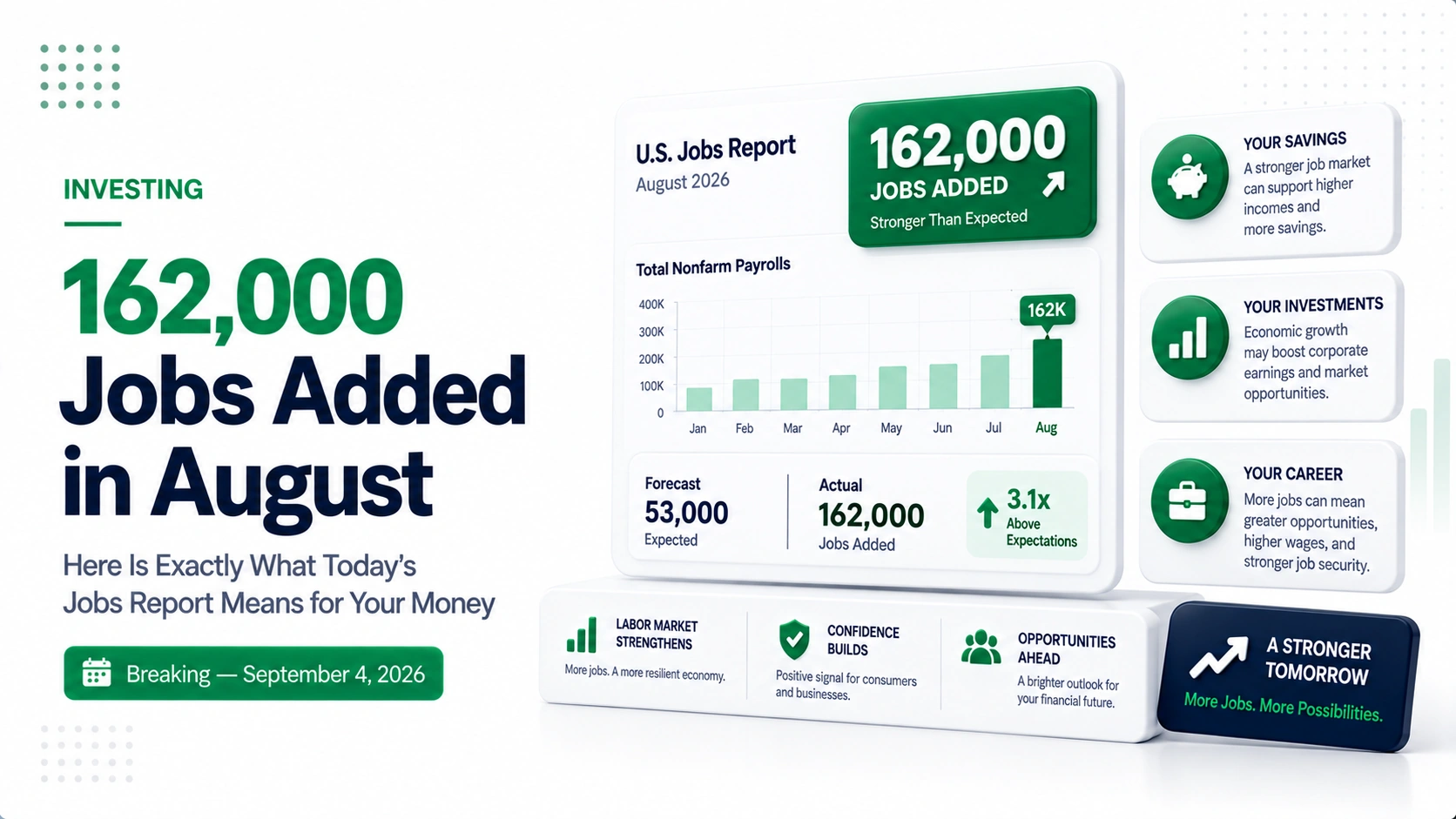
- The US economy added 162,000 jobs in August 2026 — far exceeding the 53,000 economists forecast and the strongest monthly gain since March
- The unemployment rate held steady at 4.1% with 7.0 million total unemployed persons
- June and July were both revised upward — combined employment in those two months is 55,000 higher than previously reported
- Wage growth continues to lag inflation — workers are earning more in dollars but losing ground in purchasing power
- The strong report raises odds of a Fed rate hike at the September 15–16 FOMC meeting — which directly affects stock markets, savings rates, and borrowing costs
The Bureau of Labor Statistics released the August 2026 jobs report at 8:30 AM ET today — Friday September 4, 2026.
The headline number: 162,000 jobs added.
Economists had forecast 53,000. The actual number came in at three times that level — the strongest monthly job creation since March 2026 and a dramatic reversal from the summer slowdown that had markets nervous entering September.
On the surface, this sounds like great news. More jobs mean more people earning income, which should mean a stronger economy. But the full picture is more complicated — and for your personal finances, the implications run in multiple directions simultaneously.
Here is exactly what the August jobs report means for your wallet, your career, your savings, and your investments right now.
The August Numbers — What Was Reported
Here is every key number from today’s BLS release — translated from economic jargon into plain English.
| Metric | August 2026 | Forecast | What It Means |
|---|---|---|---|
| Jobs added | 162,000 | 53,000 | 3x better than expected — labor market recovering |
| Unemployment rate | 4.1% | 4.1% | Stable — 7.0 million people unemployed |
| Average workweek | 34.4 hours | — | Up 0.1 hour — employers expanding hours |
| June revision | +11,000 | — | June revised from 20,000 to 31,000 |
| July revision | +44,000 | — | July revised from -23,000 to +21,000 — not a loss |
| Biggest job gains | Food services, local government education | — | Consumer spending still strong; public sector hiring |
The July revision is arguably the most important number in the entire report. July was previously reported as a loss of 23,000 jobs — the kind of number that triggers recession fears. Today’s revision flipped that to a gain of 21,000. Combined with the June revision, employment over the summer was 55,000 higher than anyone thought. The summer slowdown was largely a data measurement issue, not an actual economic deterioration.
The contrarian read: 162,000 jobs is strong — but the prior 12-month average was only 31,000 jobs per month. August came in at five times the recent average. Economists cautioned that August employment data frequently faces downward revisions in subsequent months due to seasonal adjustment factors. This number may look different in the October report when August gets revised.
External resource: Full August 2026 Employment Situation Report — Bureau of Labor Statistics
The Wage Problem Nobody Is Celebrating
162,000 jobs added sounds like a win. The wage data tells a more complicated story for working Americans.
Wage growth in August continued to lag inflation — meaning workers are earning more dollars but those dollars buy less than they did a year ago. With Brent crude oil trading at $95 per barrel today — up nearly 20% since August 4 — energy costs are feeding through to transportation, food production, and nearly every goods category simultaneously.
The August inflation data will not be released until September 11. But economists warned that any uptick from July’s inflation reading would widen the gap between wage growth and rising prices further — compounding the affordability squeeze that a majority of Americans are already reporting at the grocery store and gas pump.
What this means for your paycheck right now: if your salary has not increased by at least the current inflation rate (approximately 3.5% annually), you have received a real pay cut regardless of what your nominal pay stub shows. A worker earning $60,000 in 2025 who received no raise in 2026 is effectively earning $57,900 in purchasing power — a $2,100 annual reduction in what their income can actually buy.
This is exactly the moment to revisit your salary. A strong jobs report — where employers added 162,000 workers despite a challenging macro environment — is evidence that companies are still competing for talent. That competition gives you negotiating power. If you have not asked for a raise in the past 12 months, today’s data is your argument.
Build your earning power: 10 Best Side Hustles That Actually Pay in 2026
What This Means for the Fed — And Why It Matters to You
The August jobs report has immediate implications for the Federal Reserve’s September 15–16 meeting — and the Fed’s decision directly affects your savings, your investments, and the cost of everything you borrow.
A strong jobs report changes the calculus for the Fed significantly. Here is how:
Before today’s report
After July’s initially reported loss of 23,000 jobs, many economists believed the labor market was weakening enough to keep the Fed on hold or possibly even cut rates. A weakening job market typically signals lower inflationary pressure — which gives the Fed room to ease policy.
After today’s report
162,000 jobs added — three times the forecast — signals the labor market is stronger than expected. A strong labor market means workers have more income to spend, which maintains demand-side inflationary pressure. This gives the Fed less reason to hold back from raising rates further.
According to CNBC’s reporting published this morning, traders raised bets on a potential hike at the September 15–16 policy meeting following today’s data. New York Fed President John Williams said earlier this week he is in “wait-and-see” mode, while both Governor Barr and Fed official Waller indicated they would be ready to raise rates if the data supports it.
What a rate hike means for you specifically:
- Savings accounts: a rate hike typically pushes high-yield savings account rates higher — good news if your emergency fund is in a HYSA
- Stock market: rate hikes historically create short-term pressure on stock prices — relevant given we already discussed September being historically weak
- Borrowing costs: any variable-rate debt becomes more expensive with a hike — this affects credit cards and adjustable-rate anything
- The dollar: rate hikes strengthen the dollar, which affects international purchasing power and import prices
The next critical data point: August inflation numbers release on September 11 — one week from today. If inflation ticks up alongside the strong jobs number, a September rate hike becomes significantly more likely. If inflation moderates, the Fed may hold despite today’s strong labor data.
What It Means for Your Investments
A strong jobs report is not automatically good for your investment portfolio. Here is the nuanced picture.
Short term — mixed signals
Markets are processing two competing forces simultaneously today. The strong jobs number is positive for corporate earnings expectations — more employed people means more consumer spending. But the same strong number raises Fed rate hike odds, which historically pressures stock valuations. These two forces are pulling in opposite directions and markets will take time to process which dominates.
Additionally, today’s report lands on the Friday before a weekend, entering the historically worst month of the year for stocks, with a critical FOMC meeting 11 days away. Volatility today and next week should be expected regardless of whether the jobs number is ultimately read as positive or negative by markets.
Long term — the picture is clearer
A labor market that added 162,000 jobs in August is not a labor market heading into recession. For long-term investors in diversified index funds, a strong economy — even one with some inflationary pressure — is ultimately better than a weak one. The best response to today’s report for a long-term investor is the same as it was yesterday: stay the course, keep contributions running, and avoid making portfolio decisions based on a single data point.
Stay invested properly: September Is the Worst Month for Stocks — Here Is What To Do With Your Money
What It Means for Your Career and Income
The jobs report is not just a macro statistic — it directly describes the environment your career is operating in right now.
If you are employed — leverage the data
An economy that added 162,000 jobs in a single month — against a forecast of only 53,000 — is an economy where employers are actively hiring. That means your current employer has competition for your skills. Use that as leverage in a salary negotiation, a request for a promotion, or a conversation about remote work arrangements. The strongest position in any salary conversation is “the market is actively hiring, and I would prefer to stay here — what can we do?”
If you are job searching — accelerate now
Strong job creation months historically see increased hiring activity in the weeks following the report as companies respond to positive economic signals by accelerating previously paused hiring plans. If you have been searching for work, the next 30 to 60 days represent a window of elevated opportunity. Update your resume, activate your network, and apply with urgency.
If you work in information/tech — read carefully
The one sector that lost jobs in August was the information industry — likely reflecting continued AI-driven restructuring in tech companies. Food services and local government education were the strongest sectors. If you are in information or tech, today’s report is a reminder that AI’s impact on employment is concentrated rather than broad — and that developing skills in areas AI cannot easily replicate remains the most durable career protection available.
3 Smart Money Moves to Make Today
Based on everything in today’s report, here are three specific actions worth taking before the weekend.
Move 1 — Check your savings account rate before September 11
If rate hike odds are rising after today’s strong jobs report, and August inflation data releases September 11 confirms continued inflationary pressure, a Fed rate hike on September 15–16 becomes significantly more probable. High-yield savings accounts typically respond to Fed rate decisions within days — but you need to be in the right account to benefit. If your savings are in a standard account earning near zero, moving to a high-yield account before any potential hike puts you in position to benefit immediately.
Move 2 — Keep your investment contributions running this weekend
Markets may be volatile this afternoon and next week as they process the jobs report alongside rising rate hike odds and September’s historical weakness. The correct response to this volatility is not to pause contributions — it is to let dollar-cost averaging do exactly what it is designed for. Automated contributions that buy during volatile periods improve your average entry price over time. Do not cancel or pause scheduled investment contributions based on one week’s macro data.
Move 3 — Mark September 11 and September 15–16 on your calendar
Two dates will define the rest of September financially. The August CPI release on September 11 will tell us whether inflation is cooperating with the Fed’s goals. The FOMC meeting on September 15–16 will tell us whether the Fed chooses to hike based on today’s strong jobs data and September 11’s inflation reading. Neither event requires you to take action — but understanding what is coming prevents the fear and confusion that leads to poor financial decisions when headlines get loud.
Build your financial foundation: How to Build an Emergency Fund Fast
Frequently Asked Questions
Is 162,000 jobs added in August good or bad for the economy?
It is unambiguously stronger than expected — economists forecast only 53,000 and the actual number came in three times higher. It is the strongest monthly gain since March 2026 and reverses the narrative of a summer labor market slowdown. The complication is that a strong labor market gives the Federal Reserve less reason to pause rate hikes — and rate hikes create their own economic headwinds through tighter financial conditions. A truly perfect jobs number would be strong enough to indicate economic health but moderate enough to keep the Fed on hold. August’s 162,000 lands on the strong side of that balance.
What happens to stocks after a strong jobs report?
Historically, the immediate market reaction to a strong jobs report is mixed — the positive economic signal competes with the negative rate-hike implication. Over the subsequent weeks, the more important factor is usually what the report means for the Fed’s next decision. If today’s strong report leads to a September rate hike, markets will likely face additional pressure on top of September’s already negative historical seasonal tendency. If the Fed holds despite the strong number — citing other moderating factors — markets may interpret that as the best possible outcome and rally.
What does the jobs report mean for everyday spending?
More people employed means more people earning income and spending — which supports consumer businesses and generally positive economic conditions. The concern is on the wage side: if wages are rising but not keeping pace with inflation (which remained elevated at 3.5% in June), the purchasing power of those wages is still declining in real terms. The August inflation data releasing September 11 will be the clearest signal of whether the wage-inflation gap is widening or narrowing for workers.
Final Thoughts
The August 2026 jobs report is the best single-month labor market reading since March — and a significant upside surprise relative to what markets expected. 162,000 jobs added. July revised from a loss to a gain. The summer slowdown was overstated.
For most Americans, the practical implications are clear: the job market is stronger than the headlines suggested last month, wages need to keep climbing to beat inflation, and the Fed now has fresh reason to consider a September rate hike that will ripple through savings rates, stock prices, and borrowing costs.
The two dates that matter most from here: September 11 for inflation data, September 15–16 for the Fed’s decision. Between now and then, the best financial move is the same one it always is — stay invested, keep your emergency fund intact, and avoid making major financial decisions based on a single morning’s data release.