
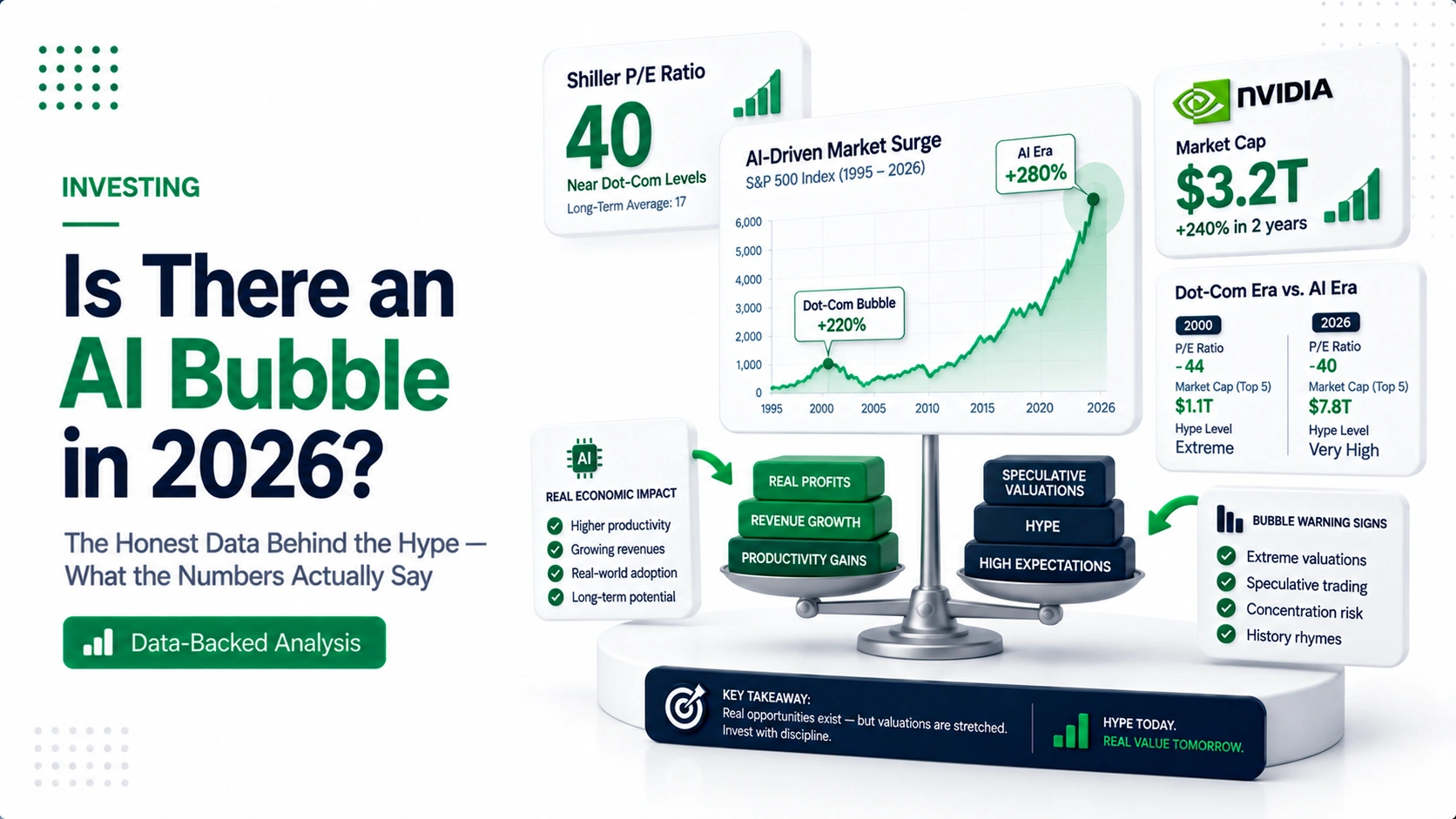
- Nvidia surged over 880% in three years and commands a $3–5 trillion market cap — but unlike dot-com stocks, it generated $215.9 billion in real revenue in fiscal year 2026
- The Shiller Cyclically Adjusted P/E ratio exceeded 40 in 2025 — a level reached only once before in history, immediately before the dot-com crash
- AI startups captured 61% of all global venture capital in 2025 ($258.7 billion) — extreme capital concentration not seen since the late 1990s
- The honest answer: bubble-like conditions exist in specific AI segments — but today’s leaders are fundamentally different from 1999’s profitless dot-com companies
- The three signals that will tell you if the bubble is actually bursting — and what to do with your portfolio right now
In January 2025, a Chinese AI startup called DeepSeek released a model that matched OpenAI’s best — built for a fraction of the cost. In a single day, Nvidia’s stock dropped $600 billion in market value. The Nasdaq fell sharply. Hundreds of billions evaporated from AI-related portfolios in hours.
Then, within weeks, Nvidia recovered. It kept going. By fiscal year 2026, Nvidia had generated $215.9 billion in revenue — up 65% year over year. Its market cap has sat between $3 and $5 trillion for most of 2026. And the AI capex buildout — the trillion-dollar wave of spending on data centers, chips, and infrastructure — has not slowed.
So which is it? Are we in a bubble? Or is this the early stage of a genuine technological revolution that will make the current valuations look cheap in ten years?
The honest answer — backed by the actual data — is more nuanced than either the bulls or the bears want to admit. And understanding that nuance is the difference between making a smart investing decision and a fear-driven one.
- What a bubble actually is — and why the definition matters
- The evidence that looks like a bubble
- The evidence that says this time is different
- AI vs dot-com — the real comparison
- The 3 signals that will tell you if it is actually bursting
- What to do with your portfolio right now
- Frequently Asked Questions
What a Bubble Actually Is — And Why the Definition Matters
Most people use “bubble” as a synonym for “expensive.” They are not the same thing — and confusing them leads to very different investing decisions.
A financial bubble has a specific definition: it is when asset prices rise far beyond what underlying fundamentals can justify, driven primarily by speculative momentum rather than real value — and when the inevitable correction causes widespread financial damage.
The key word is “fundamentals.” In the dot-com bubble of 1999 to 2000, companies with zero revenue and no path to profitability were trading at valuations that implied they would one day dominate entire industries. Pets.com raised $82.5 million in its IPO and was worth $300 million on the first day of trading — a company that lost $147 million in its only year of operation and sold pet food online for less than it cost to ship it.
That is a bubble: price completely disconnected from any conceivable economic reality.
The 2026 AI situation is more complicated. Some of it looks like a bubble. Some of it does not. The analysis below separates the two — because your investing decisions should be based on that distinction, not on a blanket “bubble” or “no bubble” verdict.
External resource: AI bubble vs dot-com bubble — a data-driven comparison
The Evidence That Looks Like a Bubble
There is genuine bubble-like data in the 2026 AI market. Dismissing it is as dangerous as panicking over it.
1. The Shiller P/E ratio hit 40 — seen only once before
The Shiller Cyclically Adjusted Price-to-Earnings ratio — which smooths earnings over 10 years to remove cyclical distortions — exceeded 40 in 2025. This level has been reached only once before in recorded market history: in 1999 to 2000, immediately before the dot-com crash, which wiped out 78% of the Nasdaq’s value. The current Shiller P/E does not guarantee a crash — but it does tell you the market is priced for near-perfection with very little margin for error.
2. AI captured 61% of all global venture capital
AI startups captured 61% of all global VC investment in 2025 — $258.7 billion — up from 30% in 2022. This represents an extreme concentration of capital versus a single sector. When more than half of all venture money on earth flows into one technology category, it creates the conditions for misallocation — funding marginal ideas that would not survive scrutiny in a more balanced capital environment.
3. The Magnificent Seven concentration is extreme
The seven largest AI-related tech companies now comprise roughly one-third of the S&P 500’s total value — a concentration of market cap in a handful of companies not seen in modern market history. When index funds buy the S&P 500, approximately 30 cents of every dollar flows into seven companies. This creates circular buying pressure: index fund inflows push up the Magnificent Seven, their rising prices increase their index weight, which causes more index fund buying, which pushes them higher again.
4. Some private AI valuations have no earnings anchor
OpenAI’s $300 billion valuation and Anthropic’s fundraising at $61 billion+ are based entirely on projected future revenue in a market that is still forming. These are not bubble-level absurdities — both companies have real revenue and real enterprise customers. But the multiples applied to that revenue reflect expectations of market dominance that may or may not materialize as competition intensifies and open-source models improve.
5. Nvidia’s valuation implies flawless execution indefinitely
NVIDIA’s $3 trillion market cap implies 25 to 30x forward revenue. Three risks dominate: custom silicon from Google, Amazon, and Microsoft could route 30 to 40% of hyperscaler AI training workloads away from NVIDIA GPUs within two years; hyperscalers cannot grow AI capex at 50%+ per year indefinitely; and China export controls have cost Nvidia 15 to 20% of its prior revenue. A valuation that requires everything to go right for years is, by definition, fragile.
The Evidence That Says This Time Is Different
The bubble case is real — but it is not the complete picture. Here is the evidence that distinguishes 2026 from 1999.
1. The leaders are actually profitable
Unlike the dot-com bubble, where companies with minimal revenue commanded astronomical valuations, today’s AI leaders are generating substantial profits. Nvidia’s trailing twelve-month revenue of approximately $187 billion and net income of $99 billion demonstrate that the AI boom is translating into real economic value. In 1999, the most celebrated dot-com companies were losing money. Nvidia’s net margin is 53% — extraordinary for any company at any market cap.
2. Enterprise adoption is measurably real
Unlike the dot-com era’s promise that consumers would eventually use the internet for everything, AI adoption by enterprises is happening now and generating measurable productivity gains. Goldman Sachs has deployed AI tools that reduced the time required for certain legal document reviews from weeks to hours. JPMorgan’s AI-assisted trading systems have meaningfully improved execution. These are not theoretical future revenues — they are current deployments generating current value.
3. The infrastructure spend is real and accelerating
Microsoft, Google, Amazon, and Meta committed a combined $320 billion in AI infrastructure capital expenditure for 2026 — the largest synchronized corporate investment in a single technology in history. This is real money being spent on real hardware producing real services. The question is whether the return on that investment will justify the spend — but the spend itself is not speculative.
4. Nvidia’s forward P/E is elevated but not insane
Nvidia’s trailing P/E of 44 and forward P/E near 25, while elevated, are far from bubble territory when considering the growth trajectory. AMD reported 38% year-over-year revenue growth in Q1 2026 to $10.25 billion, with adjusted earnings jumping 43%. For comparison, the dot-com era Nasdaq traded at forward P/Es of 60 to 100x for companies with no earnings whatsoever. Nvidia at 25x forward earnings, growing at 65% annually, is expensive — not irrational.
5. The DeepSeek correction showed the market still functions
When DeepSeek demonstrated that AI could be built far more cheaply than assumed, the market punished expensive AI infrastructure stocks immediately. This is exactly what a functioning, non-bubble market does — it prices new information rapidly. The correction was sharp, then partially reversed as the market assessed DeepSeek’s actual implications more carefully. Markets that are in true bubble territory do not respond rationally to negative news — they ignore it until they cannot.
AI vs Dot-Com — The Real Comparison
The dot-com comparison is the most common framework for the AI bubble debate — and it is both illuminating and misleading in specific ways.
| Metric | Dot-Com Peak (2000) | AI Market (2026) | Verdict |
|---|---|---|---|
| Nasdaq forward P/E | ~60x | S&P 500 at ~23x | ⚠️ Stretched but not extreme |
| Leader profitability | ~14% of companies profitable | Nvidia: 53% net margin | ✅ Fundamentally different |
| VC concentration | High — internet sector | 61% of global VC into AI | 🚨 Bubble-like signal |
| Real enterprise adoption | Mostly promise | Widespread and measurable | ✅ Fundamentally different |
| Shiller P/E | ~44 at peak | Exceeded 40 in 2025 | 🚨 Concerning signal |
| Market correction response | Ignored negative news | DeepSeek → rapid repricing | ✅ Market functioning |
| Infrastructure investment | Fiber optic overbuilding | $320B+ hyperscaler capex | ⚠️ Real but possibly excess |
The honest verdict from the data: the evidence suggests we are witnessing bubble-like conditions in specific segments rather than a market-wide speculative frenzy. The AI investment landscape of 2026 defies simple bubble characterization. While valuations are elevated and certain segments display bubble-like behavior, today’s AI leaders differ fundamentally from the speculative companies of the dot-com era. Real profits, robust cash flows, and measurable productivity gains provide a foundation that was absent during previous technology bubbles.
The 3 Signals That Will Tell You If It Is Actually Bursting
Debating whether we are in a bubble is less useful than knowing what to watch for. Here are the three specific signals that would indicate the AI investment cycle is genuinely breaking down — not just correcting.
Signal 1 — Hyperscaler capex guidance cuts
Microsoft, Google, Amazon, and Meta are the primary buyers of Nvidia’s chips. If any of them materially cut their AI infrastructure spending guidance — signaling that AI is not generating the returns they expected — that is the most direct evidence that demand is failing to meet the supply being built. Watch every quarterly earnings call from these four companies closely. Capex guidance cuts are the earliest warning signal available.
Signal 2 — Nvidia revenue growth deceleration below 30%
Nvidia’s current valuation is defensible only if revenue growth continues at extraordinary rates. Nvidia’s valuation will compress to more reasonable multiples of 25 to 35x earnings as growth normalizes. If Nvidia’s quarterly revenue growth falls below 30% year-over-year — from its current pace of 65%+ — the multiple compression could be significant and rapid. This is not a bubble burst — it is a normalization. But the price impact could feel like one.
Signal 3 — Tech high-yield credit spread widening
The spread between high-yield tech bond yields and Treasury yields has historically been a reliable bubble indicator. As of July 2026, the tech high yield spread stands at approximately 2.56%, indicating low immediate risk — but investors should monitor this metric closely for deterioration. When credit markets start pricing higher risk premiums for tech companies, it often precedes equity market corrections by weeks. The bond market sees problems before the stock market does.
What to Do With Your Portfolio Right Now
The bubble debate is interesting. What you actually do with your money is what matters. Here is a clear framework based on the data.
If you own broad index funds — do nothing different
A total market index fund or S&P 500 index fund already owns Nvidia, Microsoft, Google, and the other AI leaders — proportionally, based on their actual market weight. If AI stocks correct significantly, your index fund will decline. It has also benefited from the AI-driven rally of the past three years. The diversification within an index fund means you are exposed to the upside without the single-stock catastrophe risk of owning individual AI names. Continue your regular contributions. Do not panic-sell based on bubble concerns that professional investors have been voicing since 2023 without the crash materializing.
If you own individual AI stocks — know your thesis
For every AI stock you hold, be able to answer clearly: why do I own this specific company, and at what valuation does my thesis break? If you own Nvidia because you believe the AI capex supercycle will continue for years and Nvidia will maintain GPU dominance — that is a defensible thesis with real evidence behind it. If you own a small AI software company because it has “AI” in its marketing materials and the stock went up 200% last year — that is speculation, not investing.
If you have no AI exposure — you do not need to add it
A beginner investor with a diversified index fund portfolio does not need to specifically add AI exposure. You already have it through the index. The desire to add more AI exposure on top of an existing index fund position is a form of market timing — betting that AI stocks will outperform the broader market from here. That is a bet that professional fund managers with full-time research teams consistently get wrong. Stick to your plan.
Keep your emergency fund and financial foundation intact
Whatever happens with AI stocks in September 2026, the right response to market uncertainty is always the same: make sure your emergency fund is funded, keep contributing to your retirement accounts, and do not invest money in volatile growth stocks that you might need within three to five years.
Build the foundation first: How to Build an Emergency Fund Fast
Frequently Asked Questions
Is Nvidia in a bubble in 2026?
Nvidia is expensive by historical standards — trading at approximately 44x trailing earnings and 25x forward earnings with a market cap between $3 and $5 trillion. But it is not in bubble territory by the metrics that defined the dot-com bubble. Its 53% net margin, $215.9 billion in fiscal 2026 revenue, and 65% year-over-year revenue growth are real and measurable. The risk is not that Nvidia is a fraud or that its business is fake — the risk is that its valuation requires years of flawless execution and continued GPU dominance that may not materialize as custom silicon from Google, Amazon, and Microsoft improves. Expensive is not the same as a bubble.
Should I sell my AI stocks before the bubble bursts?
If you owned AI stocks through the 2025 AI boom and are sitting on significant gains, the rational approach is not to sell everything — it is to assess whether your current allocation still matches your risk tolerance and time horizon. If AI stocks now represent 40% of your portfolio because of appreciation, rebalancing toward your target allocation is prudent regardless of bubble concerns. If you own AI stocks as a small portion of a diversified portfolio, there is no compelling reason to sell based on bubble concerns that have been voiced for two years without a major crash. The three signals to watch — hyperscaler capex guidance, Nvidia revenue growth, and credit spreads — are more useful than macro bubble declarations for timing any tactical adjustments.
Could the AI bubble be worse than the dot-com crash?
The dot-com crash wiped out 78% of the Nasdaq’s value between 2000 and 2002. A comparable AI crash is theoretically possible but structurally less likely for one key reason: the leaders are profitable. When the dot-com bubble burst, it took down companies that had no earnings and no path to earnings. Today’s AI leaders — Nvidia, Microsoft, Google, Amazon — have substantial businesses outside of AI that would cushion a decline in AI-specific revenue. A meaningful correction in AI valuations (30 to 50%) is plausible. A systematic economic collapse driven by AI bubble bursting is a much harder case to make given the underlying profitability of the companies involved.
Final Thoughts
The honest answer to “is there an AI bubble in 2026?” is: partially, in specific segments, but not in the way the dot-com bubble was a bubble.
The Shiller P/E at 40, the VC concentration at 61%, and the valuation multiples that require perfect execution for years — these are real warning signals that deserve serious attention.
Nvidia’s 53% net margins, the $320 billion in hyperscaler infrastructure spending, and the measurable enterprise adoption of AI tools — these are real foundations that distinguish 2026 from 1999.
What this means practically: do not panic-sell broad index funds because of AI bubble concerns. Do not add concentrated AI stock positions because of FOMO. Watch the three signals — hyperscaler capex guidance, Nvidia revenue deceleration, and credit spread widening. And keep your financial foundation intact regardless of what markets do.
The most important investing lesson from every previous bubble — including the ones that were not actually bubbles — is that the people who stayed diversified, kept contributing, and avoided panic decisions came out ahead of the ones who tried to time the top.