
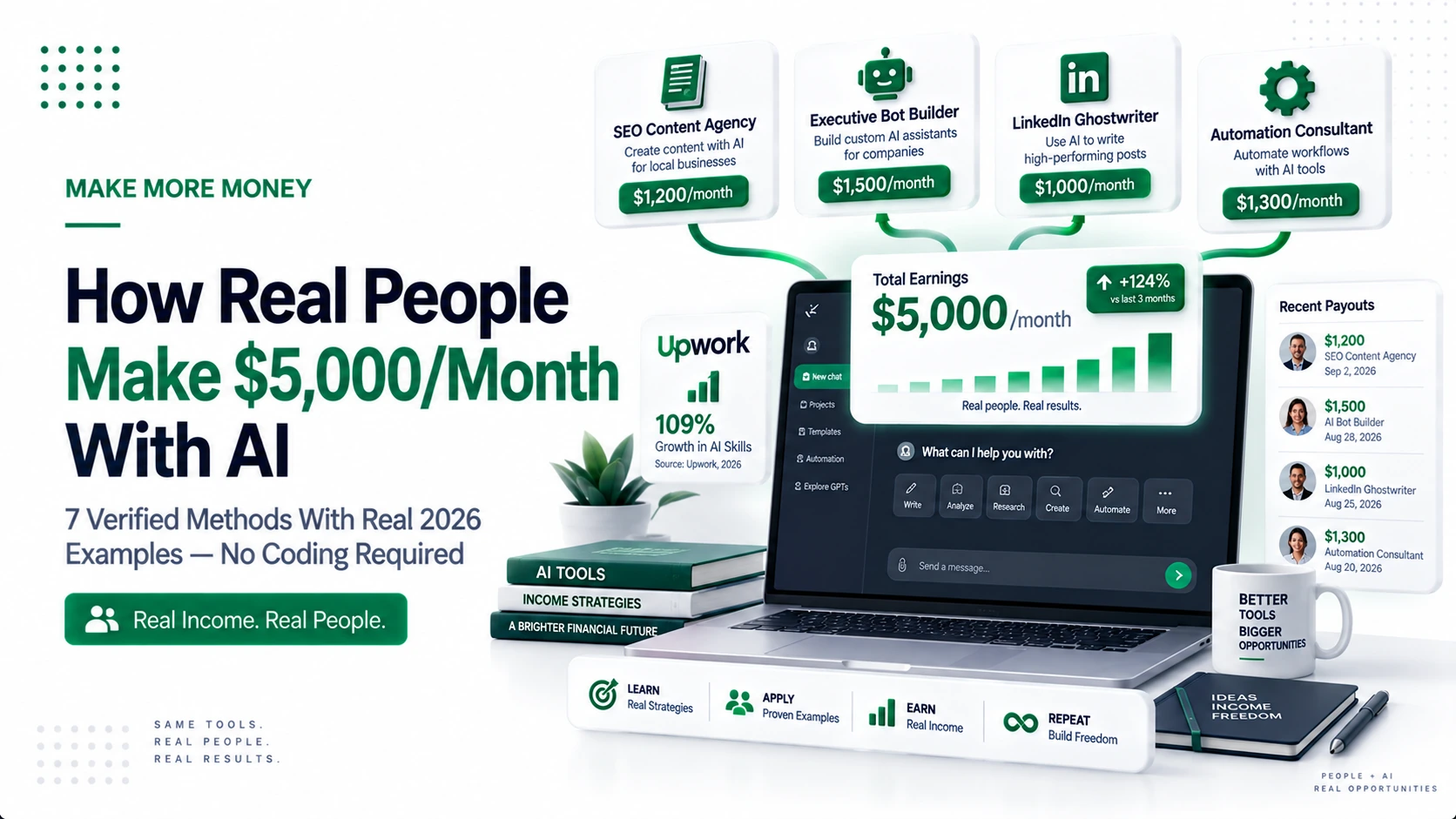
- AI-related freelance skills grew 109% on Upwork in one year — the demand for people who can use AI to deliver real business results has never been higher
- A marketing professional with zero coding experience built custom GPT bots for executives and hit her first $1,000 within months — using only no-code tools
- One creator went from £500/month in March 2024 to £4,000/month by December — not through a viral moment, but through consistent execution of one method
- The three AI income tiers in 2026: enhanced services ($10K–$25K extra per year), implementation ($40K–$150K), and development ($150K–$400K+)
- The single biggest predictor of failure: switching methods too early — most people quit at month two, right before compounding kicks in
She was a marketing professional with zero coding experience.
She started building custom GPT bots for busy executives — simple, focused tools that drafted LinkedIn posts, summarized meeting notes, and generated weekly reports. She used no-code tools. She built a separate bot for each executive. She hit her first $1,000 within months.
He was a content creator who made his first £500 from AI tools in March 2024. By December, that figure had crossed £4,000 a month. Not because he went viral. Not because he had a computer science degree. Because he identified the right opportunity and executed consistently for nine months.
These are not anomalies. According to Upwork’s 2026 In-Demand Skills Report, AI-related freelance skills grew 109% in a single year. A growing number of regular people — teachers, stay-at-home parents, ex-retail workers, and side-hustlers — are pulling in $3,000, $5,000, even $10,000 a month using AI tools that cost less than a Netflix subscription.
This is the honest guide to how they are doing it — with real examples, realistic timelines, and no course to sell you at the end.
The Honest Reality Check — What AI Income Actually Looks Like
Before the methods — the three things the viral “make money with AI” content never tells you.
AI does not replace skill — it multiplies it
The most successful AI income earners in 2026 are not people who learned to use ChatGPT. They are people who already had a skill — writing, design, marketing, analysis, customer service — and used AI to do that skill faster, at higher volume, with better output. A freelance writer using Claude to draft 20 articles a month instead of 8 can serve more clients at the same rate. A graphic designer using Midjourney can produce visual concepts 5x faster than before. The AI is leverage on existing expertise — not a substitute for it.
The first 90 days produce almost nothing
Every real income story in this article has the same shape: flat for months, then suddenly not flat. The creator who reached £4,000/month was making almost nothing for the first four months. The executive bot builder hit $1,000 “within months” — not within days. AI income is not a vending machine. It is a compounding curve. The people who built real income are the ones who did not quit at month two.
Low-skill AI tasks are already saturated
Generic blog posts, basic image generation, simple chatbots, and entry-level data annotation have seen rates compress significantly in 2026 as supply has exploded. The AI income that is growing — and that commands real rates — is specialized, outcome-based, and tied to measurable business results. “I will write your blog posts with AI” earns much less than “I will set up an AI content system that produces 20 SEO articles per month for your business.” Same tools. Different positioning.
External resource: Real AI side hustle stories and what actually works — Side Hustle School
The Three Income Tiers — Where You Fit
AI income in 2026 exists in three distinct tiers — and knowing which one you are starting from determines which methods are realistic for you right now.
| Tier | Who It Is | Annual Income Potential | Entry Barrier |
|---|---|---|---|
| Tier 1 — AI-Enhanced Services | Existing freelancers, creators, professionals adding AI to their workflow | +$10,000–$25,000/year | Low — existing skill required |
| Tier 2 — AI Implementation | People building AI systems and workflows for businesses | $40,000–$150,000/year | Medium — 3–6 months learning |
| }Tier 3 — AI Development | Engineers and developers building AI products and tools | $150,000–$400,000+/year | High — deep technical expertise |
Most beginners should start in Tier 1 — adding AI to what they already know how to do — before considering Tier 2. The people earning the most from AI in 2026 are not necessarily the most technically sophisticated. They are the ones who combined existing domain expertise with AI leverage and positioned themselves as specialists rather than generalists.
7 Methods Real People Are Using to Make $5,000+/Month
1. AI-Assisted SEO Content Agency — $6,000/Month From 4 Clients
Real example: Solo operators using Claude or ChatGPT to draft articles, plus tools like Surfer SEO and Ahrefs for keyword research, deliver 10–20 articles per month per client at $200–$500 each.
The math: 4 retainer clients × $1,500/month = $6,000/month for approximately 30 hours of work weekly. Small businesses need SEO content but cannot afford agency rates. A solo operator using AI can price below agencies while delivering comparable quality — and handle 4x the client volume of a human-only writer.
Who this works for: People with writing background or strong niche expertise (finance, legal, healthcare, tech). The AI produces volume and structure. The human provides editorial judgment, accuracy, and strategic alignment with client goals. That combination is what clients pay for — not the AI tool itself.
Time to first $1,000: 4–8 weeks with active outreach. Most clients are won through LinkedIn direct messaging and cold email, not platforms.
Tools needed: Claude or ChatGPT Plus ($20/month), Surfer SEO ($89/month), basic outreach system. Total tool cost: under $120/month.
2. Custom GPT Bots for Executives — $2,000–$5,000 Per Client
Real example: A marketing professional with zero coding experience built custom GPT bots for busy executives — drafting LinkedIn posts, summarizing meeting notes, generating weekly reports. First $1,000 within months. Monthly retainer: $2,000–$5,000 per client.
How it works: You interview the executive about their communication style, recurring tasks, and specific needs. You build and configure a custom GPT that handles their specific workflow. You train them on how to use it and provide ongoing refinement as their needs evolve. The deliverable is not the AI tool — it is the time saved for a person whose time is worth thousands of dollars per hour.
Who this works for: People with business, marketing, or communications backgrounds who understand executive workflows. Technical skills are minimal — the tools are no-code. The value is understanding what the executive needs, not how the model works.
Time to first $1,000: 2–6 weeks. One executive client paying $2,000/month changes the math immediately.
Tools needed: ChatGPT Plus ($20/month), possibly Claude API for custom integrations. Total tool cost: under $30/month.
3. Business Workflow Automation — $3,000–$4,500/Month From 2–3 Clients
Real example: Landing two or three small business clients on monthly retainers generates $3,000–$4,500/month for AI automation systems that largely run themselves once set up.
How it works: You identify what repetitive task is costing a local business owner time and money — answering the same customer questions, sending follow-up emails, sorting and summarizing data, generating weekly reports — and you build an AI-powered system to eliminate it. The business pays you a setup fee ($500–$2,000) and a monthly retainer ($500–$1,500) to maintain and improve the system.
Who this works for: People who can understand business processes and communicate clearly. The technical implementation uses tools like Zapier, Make.com, and ChatGPT API — all learnable in 4–8 weeks without prior coding experience. The hard part is finding the right problem to solve, not building the solution.
Time to first $1,000: 6–10 weeks including learning time. The first client is always the hardest to land — but every subsequent client comes faster as you build case studies.
Tools needed: Zapier ($20–$49/month), Make.com ($9/month), ChatGPT API (usage-based). Total tool cost: under $80/month.
4. Faceless YouTube Channel — $2,000–$8,000/Month at Scale
Real example: Faceless YouTube channels using AI-generated scripts, AI voiceover, and AI video tools have exploded in 2026. Tools like Pictory, HeyGen, Synthesia, and CapCut AI allow solo creators to produce polished video content without ever appearing on camera.
How it works: Pick a niche with strong advertiser demand (personal finance, health, real estate, business). Use ChatGPT to generate scripts. Use AI voice tools for narration. Use stock footage and AI editing for visuals. Upload consistently — 3–4 videos per week. Monetize through YouTube ads (requires 1,000 subscribers and 4,000 watch hours), affiliate links in descriptions, and sponsored mentions once the channel grows.
Who this works for: People willing to play a long game. The channel earns almost nothing for the first 4–6 months. At month 6–12, if you have published consistently, the compounding begins. Finance and money content pays $15–$30 per 1,000 views in ad revenue — one of the highest-paying YouTube niches. A channel with 50,000 subscribers can earn $3,000–$8,000/month from ads alone.
Time to first $1,000: 6–12 months. This is a long-game strategy with one of the highest ceilings on the list.
Tools needed: Pictory or HeyGen ($19–$29/month), ChatGPT Plus ($20/month). Total tool cost: under $50/month.
5. AI Digital Products — Passive Income After Creation
Real example: One creator built a pack of 50 ChatGPT prompts for real estate agents in an afternoon using AI to help generate and refine the prompts. It sold over 200 copies at £12 each — purely passive income after the initial creation. Another sold a 200-prompt library for a marketing agency for £2,500 as a single project.
How it works: Create a specific digital product that solves a specific problem for a specific audience. Sell it on Gumroad, Etsy, or your own site. The product is built once and sold indefinitely with zero marginal cost. The most successful AI digital products in 2026 are highly specific: prompt packs for specific professions (real estate agents, doctors, teachers, lawyers), workflow templates for specific software, Notion dashboards for specific use cases, and AI setup guides for specific industries.
Who this works for: People who can identify a specific niche audience’s specific problem. Generic prompt packs no longer sell — specificity is what commands attention and price. A “50 AI prompts for real estate agents” pack at £12 outsells “1,000 ChatGPT prompts” at £5 every time.
Realistic monthly income: $200–$5,000/month depending entirely on product quality and distribution. Building an audience through social media, a newsletter, or a blog dramatically accelerates sales.
Tools needed: ChatGPT or Claude for creation, Gumroad (free) or Etsy ($0.20/listing) to sell. Total tool cost: essentially zero.
6. AI-Assisted Copywriting — $50–$200/Hour
Real example: Marketing copy — landing pages, ad creatives, email campaigns, sales scripts — is a high-value category where AI substantially increases output speed but does not replace the strategic thinking that makes copy convert. Professional AI-assisted copywriters charge $50–$200 per hour or $500–$5,000+ per project.
How it works: You understand what makes copy convert (offer clarity, audience psychology, specific language patterns). AI handles drafts, variations, and volume. You edit for accuracy, tone, and strategic alignment. The result: you can handle 3–4x the client volume of a non-AI copywriter at comparable or higher quality. Clients in finance, e-commerce, and SaaS have the largest budgets.
Who this works for: People with marketing, sales, or writing backgrounds. This is the method with the fastest time to high income for existing marketing professionals — adding AI to your workflow can increase your effective hourly rate dramatically within weeks.
Time to first $1,000: 1–3 weeks for people with existing copywriting skills. 6–12 weeks for people learning from scratch.
Tools needed: Claude or ChatGPT Plus ($20/month). This is the lowest-cost high-income method on the list.
7. Executive LinkedIn Ghostwriting — $2,000–$5,000/Month Per Client
Real example: An AI agency launched specifically to write executives’ LinkedIn content using a combination of AI drafting and human editing. The process: AI produces a first draft from a voice note or bullet points the executive provides. Human editor refines it to match their authentic voice. Monthly retainer per executive client: $2,000–$5,000. With 3 clients, that is $6,000–$15,000/month.
How it works: Executives increasingly understand that a strong LinkedIn presence drives business development, speaking opportunities, and talent acquisition. They do not have time to write consistently. You interview them monthly, extract their ideas, and use AI to draft posts that match their authentic voice. You edit. They approve. You publish. The relationship is ongoing — great ghostwriting clients stay for years.
Who this works for: People with strong writing instincts and the ability to capture another person’s voice. Business, journalism, and communications backgrounds are particularly well-suited. This is one of the most relationship-driven methods on the list — the clients who pay the most are often found through direct professional network outreach, not platforms.
Time to first $1,000: 2–6 weeks with direct outreach to executives in your network or on LinkedIn.
Tools needed: Claude or ChatGPT Plus ($20/month), scheduling tool like Buffer ($6/month). Total tool cost: under $30/month.
How to Spot AI Income Scams — The FTC Crackdown
The FTC filed multiple enforcement actions against AI income schemes in 2025–2026, including a $25 million fraud case. Here is exactly how to tell the difference between legitimate AI income opportunities and scams.
| Scam Signal | Legitimate Signal |
|---|---|
| Income screenshots as proof | Client deliverables and measurable results as proof |
| Recruiting fees or “community access” as the primary product | Clients paying for outputs, not students paying for the course |
| Vague AI claims without specifying what is actually automated | Specific services with named deliverables and outcomes |
| Promises of passive income within days | Realistic timelines: 90 days to first $500–$1,000 |
| Urgency about a “closing window” or limited spots | Verifiable client case studies with measurable results |
The clearest test: if someone claims to own an AI prompt or system that generates money automatically, ask why they are selling it for $47 instead of using it themselves. Legitimate AI income comes from solving real problems for real clients — not from selling the secret of how to do it.
Build real income: 10 Best Side Hustles That Actually Pay in 2026 — With Real Income Data
How to Pick Your Method and Start This Week
The most common AI income mistake is not choosing the wrong method. It is spending weeks researching methods instead of starting one.
Match the method to what you already have
- You write well → AI-assisted SEO content agency or executive LinkedIn ghostwriting. Fastest path to income for existing writers.
- You have marketing or business experience → Custom GPT bots for executives or business workflow automation. Your domain knowledge is the product — AI is the tool.
- You have a niche expertise (medicine, law, real estate, finance, fitness) → AI digital products targeting that specific niche. Specificity is what sells.
- You are willing to play a long game → Faceless YouTube channel. Lowest effort after setup, highest passive ceiling over 12–24 months.
- You have existing clients or a professional network → Add AI to whatever you already sell. The fastest path to more income is serving your existing clients better, faster, and at higher volume.
The 90-day commitment rule
Every method on this list requires 90 days of consistent execution before meaningful income arrives. This is not a flaw — it is the natural shape of compounding. The skill curve, the client acquisition curve, and the platform algorithm curve all require time before they accelerate. Pick one method. Commit to it for 90 days without switching. Track your inputs (hours worked, clients pitched, content published) rather than your outputs (income earned) in the first 60 days. The outputs will follow.
Your first week action plan
Day 1: Pick your method. Day 2: Sign up for the one AI tool it requires. Day 3: Produce your first piece of work using AI — one article draft, one bot concept, one automation idea, one digital product outline. Day 4–7: Share that work with five potential clients, employers, or buyers. Feedback from the market is more valuable than any course or tutorial. The goal of week one is not income — it is your first contact with a real potential customer. Everything accelerates from there.
Invest the income you earn: 7 Best Investment Apps for Beginners in 2026 — Start With Just $100
Frequently Asked Questions
Do I need to know how to code to make money with AI in 2026?
No — and this is one of the most important facts about AI income in 2026. The majority of successful AI side hustlers are not developers. They are writers, designers, marketers, teachers, coaches, and analysts who use AI tools to amplify their existing skills. The methods that produce the highest income — executive ghostwriting, SEO content agencies, business automation consulting, digital products — require business judgment, communication skills, and domain expertise. The AI tool is accessible to anyone with a $20/month subscription. What clients pay for is the human judgment applied to the AI output.
How long does it realistically take to make $5,000/month with AI?
For most methods, 6 to 12 months of consistent work is a realistic timeline for reaching $5,000/month. The fastest paths are executive ghostwriting and custom bot building — both can reach $2,000 to $5,000/month per client within weeks for people with relevant existing skills. The slowest path is YouTube, which typically takes 6 to 18 months to reach monetization thresholds. The most consistent finding across AI income case studies in 2026: income is essentially flat for the first 60 to 90 days, then grows rapidly once client referrals, platform algorithms, or word-of-mouth begin compounding. Do not judge the method by month one or two.
What is the best AI tool to start making money with in 2026?
Claude and ChatGPT Plus ($20/month each) are the starting point for almost every method on this list. Claude is particularly strong for long-form writing, business analysis, and nuanced content. ChatGPT’s custom GPT feature is ideal for building client-facing bots. For video creation, Pictory and HeyGen are the most widely used tools by faceless YouTube creators. For workflow automation, Zapier and Make.com connect AI outputs to business systems. Start with Claude or ChatGPT Plus — it is the foundation of nearly every AI income method that actually works in 2026.
Final Thoughts
The marketing professional with zero coding experience who built executive GPT bots. The creator who went from £500 to £4,000 a month in nine months. The solo operator running a $6,000/month content agency from a laptop. These are real people, from real case studies, with real income documented in 2026.
None of them found a magic prompt. None of them bought a $997 course that unlocked the secret. They picked one method that matched their existing skills, committed to it for longer than felt comfortable, and kept going past the flat part of the curve where most people quit.
The AI tools are a $20/month subscription away. The income potential is documented and real. The only variable is whether you pick one method and execute it consistently for 90 days — or spend those 90 days researching which method to pick.
Start with what you already know how to do. Add AI as leverage. Show up consistently. The compounding will handle the rest.