
Key Takeaways
- Getting out of debt in 12 months is realistic for most people with a clear plan and consistent action
- The debt snowball and debt avalanche are the two most effective repayment strategies — choose based on your personality
- Stopping new debt is just as important as paying off existing debt
- Increasing your income accelerates debt payoff faster than cutting expenses alone
- A small emergency fund built alongside debt repayment prevents setbacks from derailing your progress
Debt has a way of feeling permanent. The minimum payments never seem to move the balance, the interest keeps piling up, and financial freedom starts to feel like something that happens to other people.
But getting out of debt in 12 months is more achievable than most people think. Not because it is easy — it requires real sacrifice and focus — but because it is a math problem with a clear solution. Give every dollar a job, attack the right debts in the right order, and protect your progress from setbacks.
This guide gives you the exact step-by-step plan to get out of debt within 12 months — no matter what you owe.
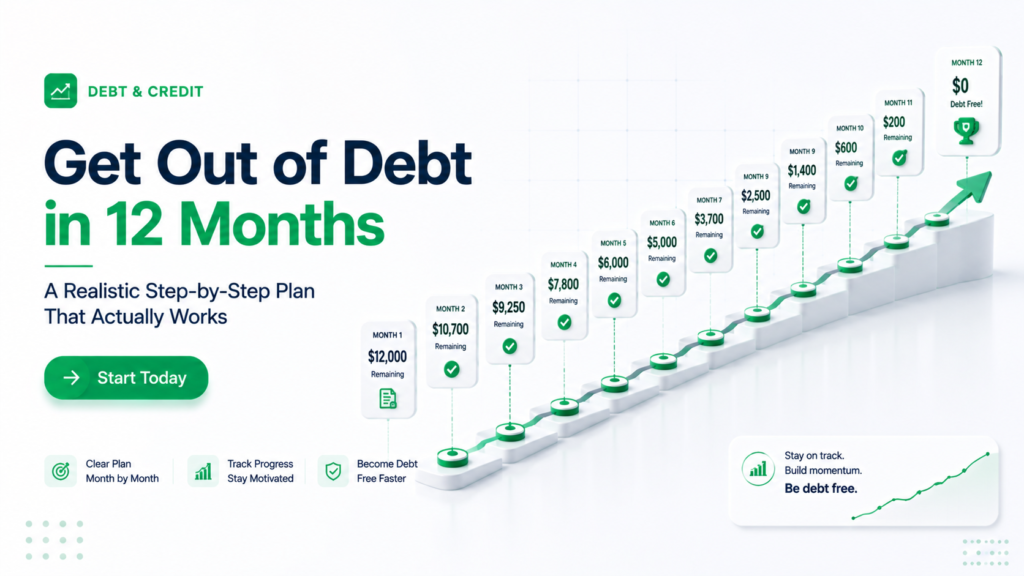
Table of Contents
- Is getting out of debt in 12 months realistic?
- Step 1 — List every debt you owe
- Step 2 — Build a small emergency fund first
- Step 3 — Stop adding new debt immediately
- Step 4 — Choose your repayment strategy
- Step 5 — Cut expenses and redirect every dollar
- Step 6 — Increase your income to accelerate payoff
- Step 7 — Track progress and stay consistent
- Frequently Asked Questions
Is Getting Out of Debt in 12 Months Realistic?
It depends on how much you owe and how aggressively you act. Someone with $5,000 in credit card debt can realistically eliminate it in 12 months by paying $420 per month. Someone with $30,000 in debt will need to make larger payments, cut more expenses, and likely increase their income to hit the same timeline.
The key is not the size of the debt alone — it is the gap between your income and your expenses. The wider that gap, the faster you get out. This guide shows you how to widen it as much as possible.
External resource: How to pay off debt — NerdWallet
Step 1 — List Every Debt You Owe
You cannot fight what you cannot see. The first step is a complete, honest inventory of everything you owe.
For each debt, write down:
- The lender or creditor name
- Total balance owed
- Interest rate (APR)
- Minimum monthly payment
- Due date
Include everything — credit cards, personal loans, car loans, student loans, buy-now-pay-later balances, money owed to family. Do not leave anything out.
Then add up your total debt. This number may feel uncomfortable to look at. That is normal. Write it down anyway. Clarity is the first step to freedom.
Step 2 — Build a Small Emergency Fund First
Before throwing everything at debt, save a small emergency buffer of $500 to $1,000. This seems counterintuitive but it is critical.
Without any emergency savings, the first unexpected expense — a car repair, a medical bill, a broken appliance — will force you straight back onto a credit card, undoing weeks of progress and adding to the debt you are trying to eliminate.
Save $500 to $1,000 first. Put it in a separate savings account and do not touch it except for genuine emergencies. Then attack your debt with everything you have.
Also read: How to Build an Emergency Fund Fast
Step 3 — Stop Adding New Debt Immediately
You cannot dig your way out of a hole while someone keeps handing you a shovel. Getting out of debt requires a complete stop to new borrowing.
Practical steps to stop new debt:
- Remove your credit card details from online stores. The harder it is to spend, the less you will spend impulsively.
- Switch to cash or debit for daily spending. Physically handing over money makes spending feel more real.
- Unsubscribe from promotional emails. Fewer sale notifications means fewer temptations.
- Implement a 48-hour rule. Before any non-essential purchase, wait 48 hours. Most impulse urges disappear.
- Leave credit cards at home. Not cancelled — just not on your person during this 12-month sprint.
Step 4 — Choose Your Repayment Strategy
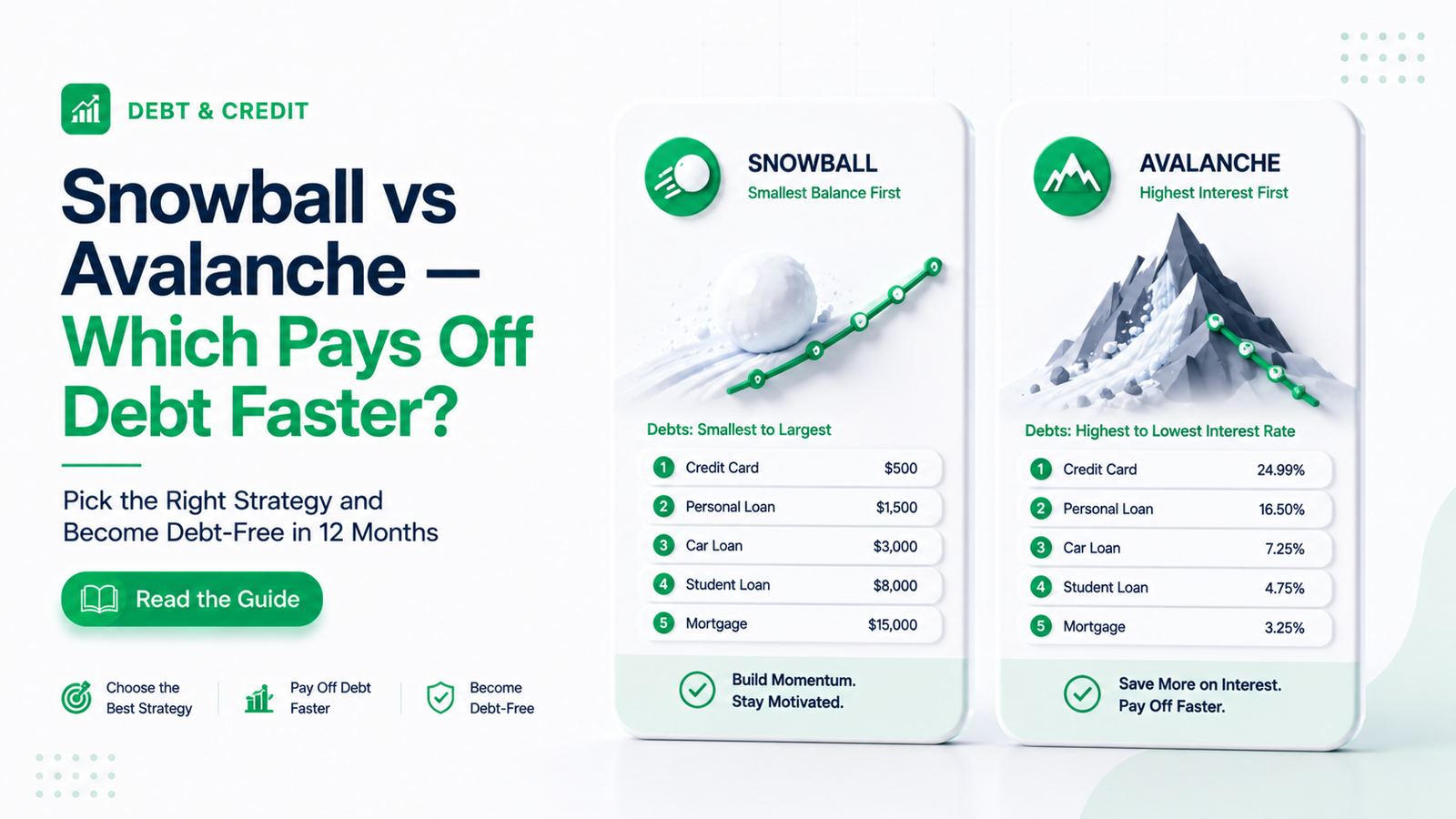
There are two proven methods for paying off multiple debts. Both work. The right one depends on your personality.
The Debt Snowball Method
Pay off your smallest balance first, regardless of interest rate. Once it is gone, roll that payment into the next smallest. Your momentum builds like a snowball rolling downhill.
- Best for: People who need quick wins and motivation to keep going
- Downside: May cost slightly more in total interest
The Debt Avalanche Method
Pay off your highest interest rate debt first, regardless of balance size. This saves the most money in total interest paid.
- Best for: People who are analytically motivated and patient
- Downside: May take longer to see the first debt eliminated
| Method | Pays Off First | Best For | Interest Saved |
|---|---|---|---|
| Snowball | Smallest balance | Motivation-driven people | Moderate |
| Avalanche | Highest interest rate | Analytically-driven people | Maximum |
External resource: How to stick to your debt payoff plan — Bankrate
Step 5 — Cut Expenses and Redirect Every Dollar
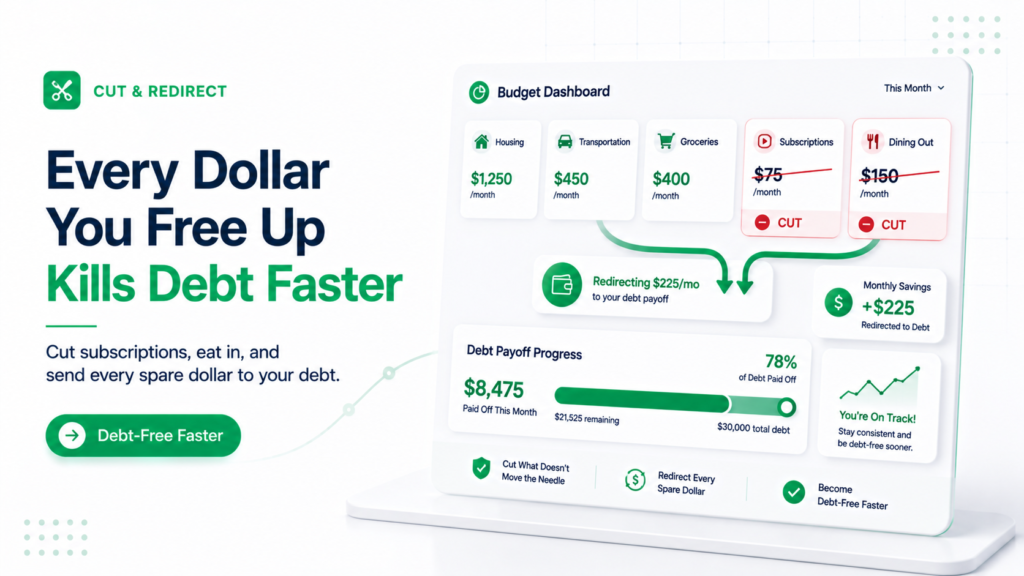
Every dollar you free up from your budget goes directly toward debt. The more aggressively you cut, the faster you get out.
Start with the biggest wins first:
- Housing and transport — Can you move to a cheaper place, get a roommate, or use public transport for 12 months? These are large numbers that make a big difference.
- Subscriptions — Cancel everything non-essential for the 12-month sprint. Netflix, gym, streaming services, magazines. Add them back when you are debt-free.
- Food — Meal prep at home instead of dining out. Even reducing restaurant spending by $200 per month saves $2,400 over the year.
- Insurance — Call your providers and ask for a better rate or compare alternatives. Many people overpay by $50 to $150 per month.
- Utilities — Switch to LED bulbs, adjust your thermostat, and reduce phone plan costs.
Take every dollar freed up and put it directly toward your target debt — not into general spending.
Step 6 — Increase Your Income to Accelerate Payoff
Cutting expenses has a limit. Earning more does not. Even an extra $300 to $500 per month from a side hustle directed entirely at debt can cut your payoff timeline dramatically.
Income boosts that work fast:
- Freelance your existing skills — Writing, design, coding, tutoring, bookkeeping. Start on Fiverr or Upwork this week.
- Deliver food or packages — DoorDash, Uber Eats, or Amazon Flex. Zero barrier to entry, first paycheck within days.
- Sell things you own — Go through every room. Sell electronics, clothes, furniture, tools, and anything unused on Facebook Marketplace or eBay.
- Ask for a raise — If you have been performing well, request a salary review. A successful negotiation could add hundreds per month permanently.
- Take on extra hours or shifts — If your employer offers overtime or weekend shifts, take them for 12 months.
Send 100% of any extra income directly to your target debt. Do not lifestyle-inflate while in debt elimination mode.
Also read: Best Side Hustles That Actually Pay in 2026
External resource: How to get out of debt — Experian
Step 7 — Track Progress and Stay Consistent
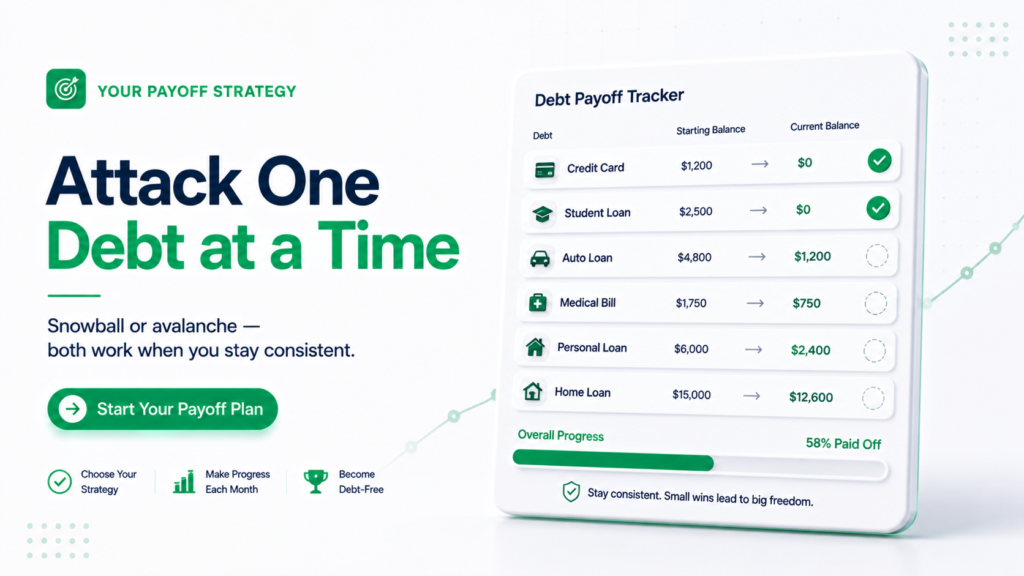
Motivation fades. Systems do not. Build a tracking system that keeps you focused through the hard months.
- Use a debt tracker spreadsheet. Update it every month after paying. Watching the numbers drop is powerful.
- Celebrate small milestones. Every debt eliminated, every $1,000 paid off, every month you hit your target — acknowledge the win without spending money to do it.
- Review your budget monthly. Life changes. So should your budget. Adjust every 30 days to make sure every dollar is working.
- Find accountability. Tell one trusted person your goal. Accountability partners significantly increase follow-through.
- Expect bad months. Something unexpected will happen. That is what the $500 to $1,000 emergency buffer is for. Use it, replenish it, keep going.
Also read: Budgeting Methods Compared — 50/30/20 vs Zero-Based
Frequently Asked Questions
What if I cannot pay more than the minimums right now?
Start by finding even $20 to $50 extra per month. That small extra payment, applied consistently, builds momentum and reduces your balance faster than minimum payments alone. The key is to start somewhere and increase the amount over time as you free up more cash through cutting and earning more.
Should I pay off debt or build savings first?
Both at the same time — but in proportion. Build a $500 to $1,000 emergency buffer first, then direct everything at debt. Once debt is eliminated, shift that same payment amount into savings and investments. Do not wait until you are debt-free to start saving.
Does paying off debt hurt your credit score?
Generally, no — paying off debt improves your credit score over time by reducing your credit utilization ratio and showing a positive payment history. Closing credit card accounts after paying them off can temporarily lower your score, so consider keeping them open with a zero balance instead.
Final Thoughts
Twelve months is not a long time. It is 365 days of consistent decisions that compound into financial freedom. The plan is simple — not easy, but simple. List your debts, build a small buffer, stop borrowing, attack with a strategy, cut hard, earn more, and track everything.
The only thing standing between you and a debt-free life is starting. Do that today.