
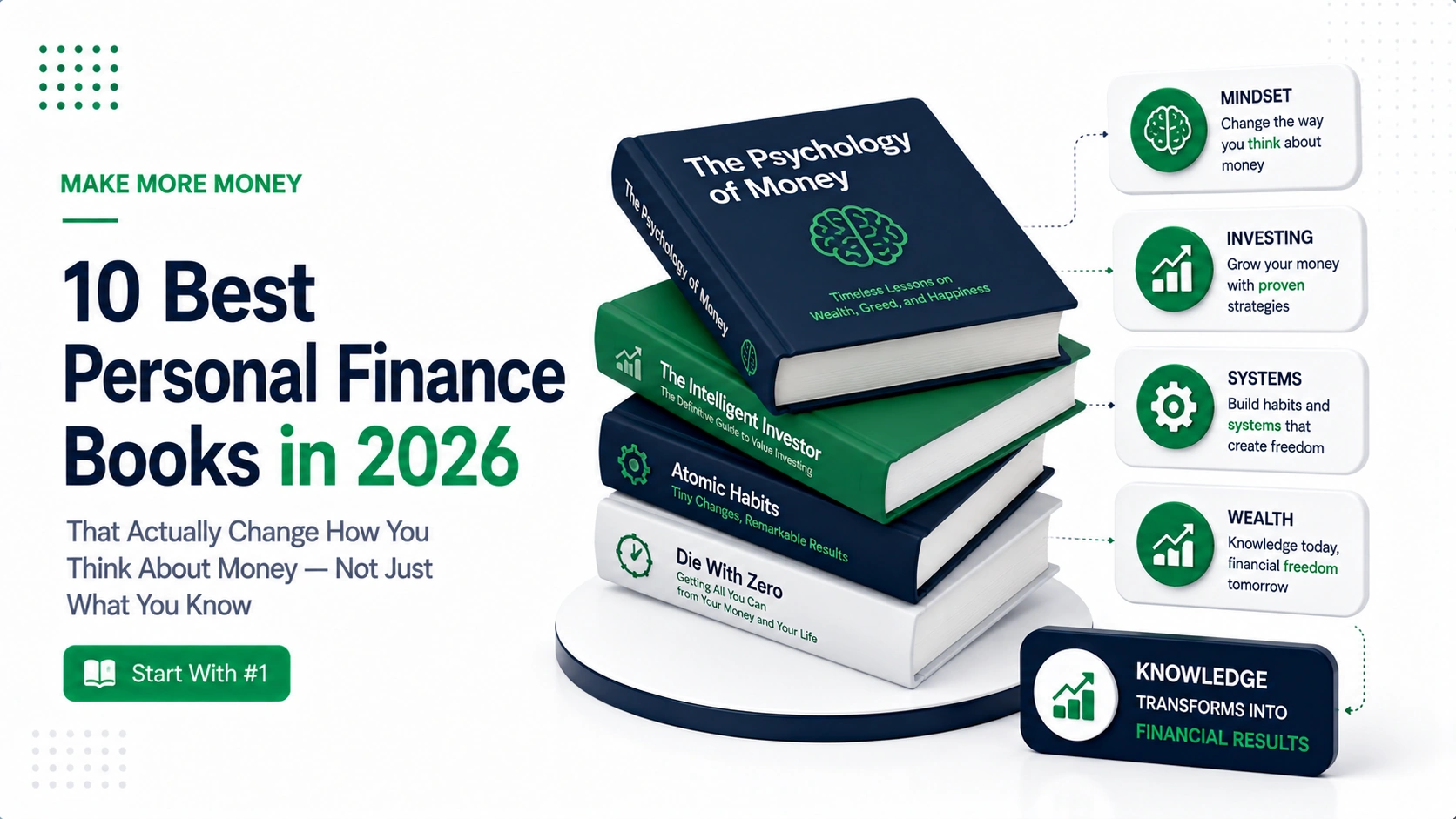
- The average American loses over $1,300 per year directly to poor financial knowledge — the right book fixes that permanently
- The Psychology of Money is the most universally recommended personal finance book of 2026 — praised by financial advisors, bestseller lists, and reader communities alike
- The best personal finance books do not just teach you facts — they change how you make decisions under pressure, stress, and social influence
- Reading order matters: mindset books first, then systems, then investing — in that sequence the lessons compound on each other
- Every book on this list is available on Amazon, Audible, and most public library apps — several cost nothing to access today
Most personal finance advice fails for a simple reason: it tells you what to do without changing how you think.
You already know you should spend less than you earn. You know you should invest early. You know you should build an emergency fund. The problem has never been knowledge — it has been behavior. The gap between knowing the right thing and actually doing it under pressure, social influence, and stress is where financial lives are made and broken.
The best personal finance books do not just add information. They rewire how you see money — permanently. The ones on this list have done exactly that for millions of readers. Some will challenge ideas you have held for years. Some will give you a system you can implement this week. All of them are worth your time.
Here are the 10 best, ranked by how much they actually change behavior — not just knowledge.
How to Use This List — The Right Reading Order
Reading personal finance books in the wrong order is one of the most common mistakes beginners make — and it is why many people finish a book feeling motivated but change nothing.
The optimal sequence is: mindset first, then systems, then investing. Here is why that order matters:
- Mindset books change how you think about money — they address the emotional and psychological roots of financial decisions. Without this foundation, systems and investing tactics feel mechanical and fail to stick.
- Systems books give you a structure for earning, spending, saving, and automating — once your mindset is right, you need a practical framework to execute.
- Investing books teach you where to put money once you have a system generating a surplus — trying to invest without the mindset and system foundations in place leads to emotional decisions and inconsistent results.
This list is organized in that reading order. Start at the top. Move through it as you implement each lesson. The books compound on each other — the insights from book one make book three twice as powerful.
The 10 Best Personal Finance Books in 2026
1. The Psychology of Money — Morgan Housel
Category: Mindset | Best for: Everyone, especially beginners | Difficulty: Easy
The most universally recommended personal finance book of 2026 — praised by financial advisors, bestseller lists, and readers across every income level. Housel’s central argument is deceptively simple: doing well with money has little to do with how smart you are and a lot to do with how you behave. Financial success is not a spreadsheet problem. It is a behavior problem.
The book’s 19 short chapters cover why wealthy people do inexplicably foolish things, why humble people build extraordinary wealth, and why the same financial facts lead to completely different decisions depending on when you were born and what you have experienced. It sold over 8 million copies for a reason: it is the rare financial book that actually changes how you make decisions, not just what you know.
The one idea that will stay with you: “Wealth is what you don’t see.” The cars, clothes, and houses that signal wealth are the opposite of wealth — they are wealth transferred away. The truly wealthy person is the one whose net worth is invisible because it is invested, compounding quietly in the background.
Read this first. Everything else on this list lands harder after Housel reframes your relationship with money.
2. I Will Teach You to Be Rich — Ramit Sethi
Category: Systems | Best for: 20s and 30s, people who want a specific action plan | Difficulty: Easy
The most actionable book on this list — and the most opinionated. Sethi does not hedge. He tells you exactly what to do: which accounts to open, in which order, how to automate your money so it flows to the right places without requiring willpower, and how to negotiate your salary, credit cards, and subscriptions with specific scripts.
The 2024 revised edition updated the content for post-pandemic financial realities — high-yield savings accounts above 4.5% APY, the rise of gig income and 1099 tax implications, and strategies for young professionals managing student debt alongside investing goals simultaneously.
The one idea that will stay with you: Conscious spending. Sethi does not ask you to cut everything you enjoy — he asks you to ruthlessly cut the things you do not care about so you can spend lavishly on the things you do. The goal is not frugality — it is intentionality.
Read this second. After Housel gives you the mindset, Sethi gives you the six-week system to implement it.
3. Rich Dad Poor Dad — Robert Kiyosaki
Category: Mindset | Best for: Anyone who grew up being told “get a good job and save” | Difficulty: Easy
The most controversial book on this list — and still one of the most important. Kiyosaki’s specific investment advice has been criticized by financial professionals for decades, and rightly so. Some of his claims do not hold up to scrutiny. But the framework he introduces — the difference between assets (things that put money in your pocket) and liabilities (things that take money out) — is genuinely transformative for people who have never thought about money that way.
The core lesson that matters: your house is not an asset if it is consuming more in mortgage, taxes, and maintenance than it produces in income. Your car is a liability. Your skills and investments are assets. That reframe alone justifies reading this book — even if you discard most of the specific tactical advice.
The one idea that will stay with you: “The rich don’t work for money — they make money work for them.” Whether or not you accept Kiyosaki’s methods, the mindset of building systems that generate income while you sleep is the foundation of every wealth-building strategy that actually works.
Read it for the framework, not the tactics. Pair it with Housel and Sethi to ground the ideas in practical reality.
4. The Total Money Makeover — Dave Ramsey
Category: Systems | Best for: People in debt who need a clear, no-exceptions framework | Difficulty: Easy
Dave Ramsey is polarizing in personal finance circles — his advice is rigid, his tone is occasionally harsh, and financial economists dispute some of his claims about debt and investing. But for one specific situation — someone drowning in consumer debt who needs a clear, motivating system with no gray areas — The Total Money Makeover is more effective than anything else on this list.
The Baby Steps framework (emergency fund → debt snowball → investing → generosity) works because it is simple enough to actually follow. The debt snowball method (pay off smallest debts first regardless of interest rate) is mathematically suboptimal — the debt avalanche is better on paper. But humans are not spreadsheets, and the psychological win of eliminating a debt entirely keeps more people in the game than the mathematically perfect approach.
The one idea that will stay with you: “Live like no one else today so you can live like no one else tomorrow.” Ramsey’s message is about delayed gratification — the willingness to sacrifice comfort now for freedom later. It is not nuanced. For people who need a blunt intervention rather than a nuanced discussion, that is exactly the point.
5. The Simple Path to Wealth — JL Collins
Category: Investing | Best for: Anyone who wants to invest but finds it overwhelming | Difficulty: Easy to medium
Originally written as a series of letters from Collins to his daughter, The Simple Path to Wealth makes the most compelling case for simple, low-cost index fund investing that exists in the personal finance literature. Collins argues that the entire investing game can be reduced to three steps: spend less than you earn, invest the surplus in low-cost total market index funds, and leave it alone.
In a world of complicated investment products, active fund managers, crypto, and algorithmic trading, Collins’ case for radical simplicity is counterintuitive and — based on decades of returns data — almost certainly correct. His specific recommendation (VTSAX, Vanguard’s total stock market index fund) is a valid starting point for most beginners even in 2026.
The one idea that will stay with you: “F-you money.” Collins argues that having enough invested to cover your expenses for an extended period changes your relationship with work, your employer, and your choices — even if you never actually use it. The option is the power, not the exercise of it.
6. Get Good with Money — Tiffany Aliche (The Budgetnista)
Category: Systems | Best for: Beginners who feel overwhelmed and want step-by-step guidance | Difficulty: Easy
Tiffany Aliche became a financial influencer by teaching one of the most practical personal finance frameworks available — the “noodle budget” method that helps readers assess spending and savings habits at every major financial life event. Her approach is warm, accessible, and specifically designed for people who find traditional personal finance advice intimidating or tone-deaf to their real circumstances.
The book covers a 10-step system to financial wholeness: budgeting, savings, debt elimination, credit improvement, and investing — in sequence and with specificity. It is the most beginner-accessible systems book on this list and particularly effective for readers who found Sethi’s style too aggressive or Ramsey’s too rigid.
The one idea that will stay with you: Financial wholeness, not financial perfection. Aliche’s framework explicitly acknowledges that real financial progress is not linear and that a good plan you actually follow beats a perfect plan you abandon under pressure.
7. Just Keep Buying — Nick Maggiulli
Category: Investing | Best for: People who overthink investing and wait for the “right time” | Difficulty: Medium
Maggiulli’s data-driven approach debunks many of the most persistent myths in personal finance with actual evidence rather than anecdote. The title captures his central argument: the single most reliable investment strategy is to buy diversified assets consistently, regardless of market conditions, without waiting for dips, corrections, or ideal entry points.
He addresses questions that most personal finance books avoid with data: Should you save more or earn more? Is dollar-cost averaging actually optimal? When does it make sense to pay off debt versus invest? Each answer is grounded in historical returns data rather than conventional wisdom — and several of his conclusions challenge what most people have been told.
The one idea that will stay with you: The cost of waiting for the perfect moment to invest is almost always higher than the cost of buying at the “wrong” time. Time in the market consistently beats timing the market — and the data to prove it is unambiguous.
8. The Millionaire Next Door — Thomas Stanley & William Danko
Category: Mindset | Best for: Anyone who thinks wealth looks like luxury | Difficulty: Easy to medium
Originally published in 1996, The Millionaire Next Door remains one of the most important personal finance books ever written because it is based on actual research into how wealthy people live — and the results are almost universally surprising. Most American millionaires are not living in mansions, driving exotic cars, or wearing expensive watches. They are living in ordinary neighborhoods, driving modest vehicles, and buying their suits off the rack.
The research reveals that the behaviors most associated with looking wealthy — luxury spending, expensive cars, premium brands — are disproportionately practiced by high-income people who are not wealthy. The people who are actually wealthy tend to live well below their means, invest consistently, and measure success by net worth rather than lifestyle display.
The one idea that will stay with you: There are two types of people in affluent neighborhoods — those with high incomes and high net worth, and those with high incomes and almost no net worth. The difference is almost entirely behavioral, not income-driven.
9. Your Money or Your Life — Vicki Robin
Category: Mindset | Best for: Anyone feeling trapped by their income or career | Difficulty: Easy to medium
Your Money or Your Life reframes money in a way that no other book on this list does: as life energy. Robin’s core argument is that every purchase you make represents hours of your life that you traded for the money to buy it. That reframe — from dollars to hours — permanently changes how you evaluate spending decisions.
The book’s central exercise is calculating your real hourly wage: not your salary divided by 40 hours per week, but your actual take-home pay divided by all the hours your job actually consumes — commuting, decompressing, buying work clothes, eating out because you are too tired to cook. For most people, the real hourly wage is dramatically lower than their nominal rate — and seeing that number changes purchasing behavior immediately.
The one idea that will stay with you: “Financial independence is not about being rich. It is about no longer having to sell your time.” The goal Robin points toward is not luxury — it is the freedom to choose how you spend your hours.
10. The Intelligent Investor — Benjamin Graham
Category: Investing | Best for: Serious investors ready to go beyond index funds | Difficulty: Hard
Warren Buffett called this “by far the best book on investing ever written.” First published in 1949, The Intelligent Investor remains the foundational text for value investing — the discipline of buying assets for less than their intrinsic value and holding them with patience. The 75th anniversary edition released in 2024 includes updated commentary by financial journalist Jason Zweig that bridges Graham’s timeless principles to 2026 market conditions.
This is the most challenging book on the list and is not suitable as a starting point for most beginners. Read it after you have a solid financial foundation, a basic investment system in place, and a genuine interest in understanding markets more deeply. For readers who reach that point, The Intelligent Investor is unlike anything else available — a rigorous, philosophically grounded framework for thinking about markets that has produced more successful investors than any other single text.
The one idea that will stay with you: “The investor’s chief problem — and even his worst enemy — is likely to be himself.” The market is not your biggest investment risk. Your own emotional reactions to market movements are.
Which Book Is Right for Your Financial Stage?
Not everyone should start with the same book. Here is the right starting point based on where you actually are financially.
| Your Situation | Start With | Then Read |
|---|---|---|
| Complete beginner, no financial system | The Psychology of Money | I Will Teach You to Be Rich |
| In debt, feeling overwhelmed | The Total Money Makeover | Get Good with Money |
| Earning well but not building wealth | The Millionaire Next Door | The Psychology of Money |
| Ready to invest, not sure where to start | The Simple Path to Wealth | Just Keep Buying |
| Feeling trapped by your job or income | Your Money or Your Life | The Simple Path to Wealth |
| Serious investor wanting deeper knowledge | The Intelligent Investor | Just Keep Buying |
Build on what you learn: How to Invest in Index Funds — Complete Beginner Guide
Frequently Asked Questions
What is the single best personal finance book for a complete beginner in 2026?
The Psychology of Money by Morgan Housel is the most universally recommended starting point in 2026 — praised by financial advisors, community forums, and bestseller lists alike. It works as a starting point for everyone regardless of income, age, or financial situation because it addresses the behavioral root of financial decisions rather than specific tactics. After reading it, every other book on this list becomes more actionable because your foundational thinking about money has already shifted.
Is Rich Dad Poor Dad still worth reading in 2026?
Yes — but read it exclusively for the mindset framework, not for specific investment tactics. Kiyosaki’s core distinction between assets (things that put money in your pocket) and liabilities (things that take money out) remains genuinely useful. His specific claims about real estate, taxes, and investment strategies have been criticized by financial professionals and should be verified independently before acting on them. Read it as a mindset book, not an investment manual.
How long does it take to read all 10 books on this list?
At the average reading pace of 30 minutes per day, most books on this list take 4 to 8 hours to complete — between one and two weeks each. Reading all 10 at that pace takes roughly 4 to 5 months. A more effective approach: read one book per month, spend the following weeks implementing its core lesson, then move to the next. Financial books read in rapid succession often produce enthusiasm without behavior change — the implementation gaps between books are where the real value is generated.
Final Thoughts
The average American loses over $1,300 per year to poor financial knowledge. A single book from this list, read and implemented, eliminates that loss permanently — and compounds forward for the rest of your financial life.
Start with The Psychology of Money if you are not sure where to begin. It is the shortest path from where you are to a fundamentally different relationship with money — and everything else on this list lands harder once you have read it.
The best time to read any of these books was years ago. The second best time is today.