
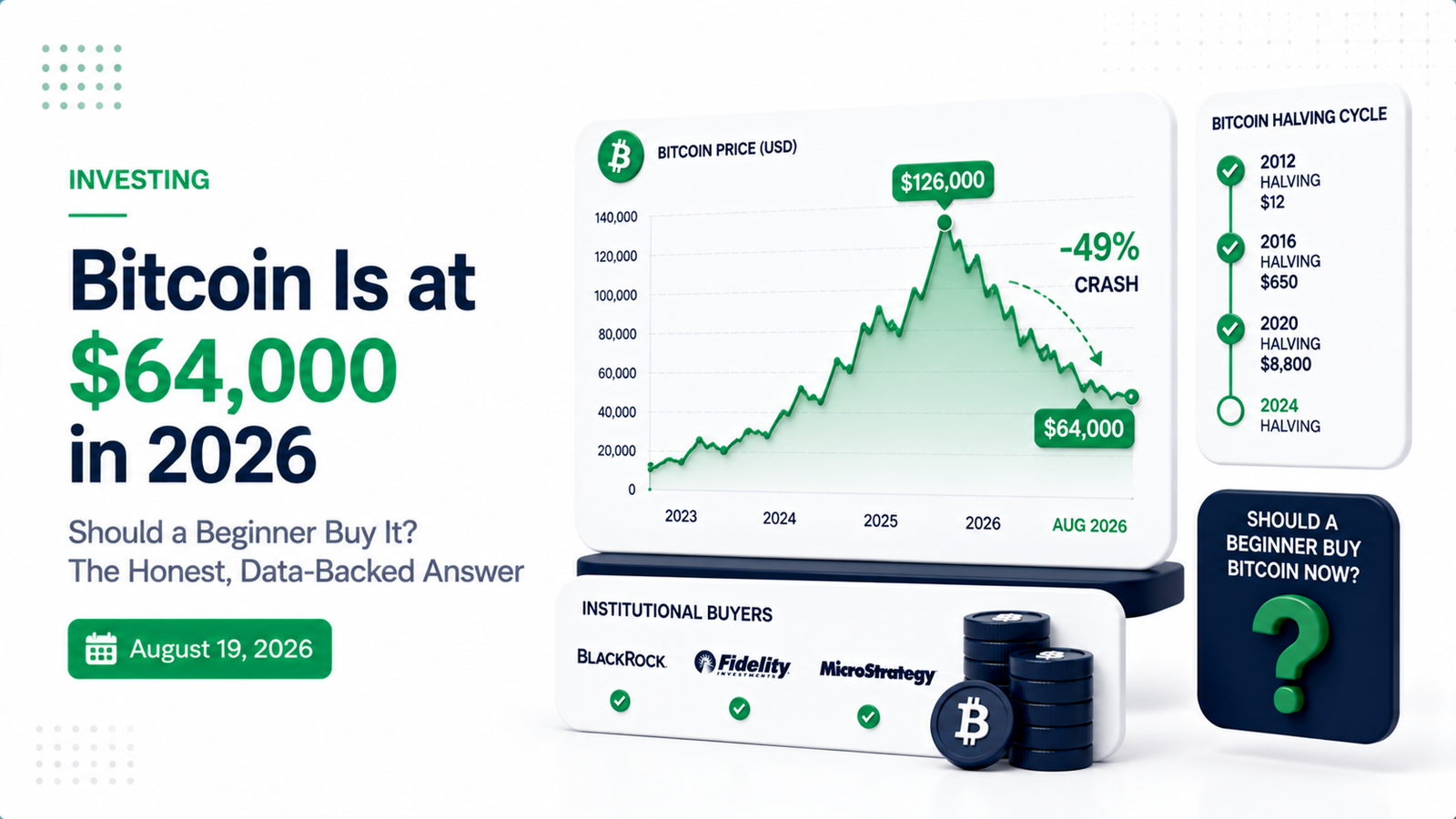
- Bitcoin opened at $64,681 on August 19, 2026 — up from a 2026 low of $60,000 hit during the Iran conflict in February
- Bitcoin hit an all-time high of $126,000 in October 2025, then fell nearly 50% — it is currently 49% below that peak
- The April 2024 halving historically triggers the biggest price moves 12 to 18 months later — that window runs through October 2026
- For beginners, the right question is not “will Bitcoin go up?” but “how much can I afford to lose without it affecting my life?”
- A Bitcoin ETF now makes it possible to invest without managing wallets, private keys, or crypto exchanges
Bitcoin hit $126,000 in October 2025. Then everything changed.
Trade tensions, the Iran conflict, leveraged position liquidations, and slowing ETF demand sent Bitcoin crashing to $60,000 by February 2026 — a 52% drop from its all-time high. More than $19 billion in crypto positions were wiped out in a single two-day crash in October.
Today, August 19, 2026, Bitcoin is trading at $64,681. It has bounced 25% from its low. Institutional buyers like Strategy — which holds over 780,000 Bitcoin on its balance sheet — kept buying through the worst of the decline.
And now millions of beginners are asking the same question: is $64,000 a buying opportunity, or is the big Bitcoin opportunity finally over?
This guide gives you the honest, data-backed answer — what Bitcoin actually is, what the 2026 price story really means, whether beginners should buy it, and exactly how to do it if you decide to.
What Bitcoin Actually Is — In Plain English
Bitcoin is a digital currency with a fixed maximum supply of 21 million coins — no government controls it, no central bank can print more of it, and no single company owns it.
It was created in 2009 by an anonymous developer known as Satoshi Nakamoto. The core idea was simple: create a form of money that could not be inflated away by government printing, could be sent anywhere in the world without a bank, and was mathematically limited in supply.
That fixed supply is the foundation of Bitcoin’s value proposition. Every other currency in history has been inflated over time — governments print more money to pay debts, fund programs, or respond to crises. Bitcoin’s supply is hardcoded. There will never be more than 21 million Bitcoin in existence. Approximately 19.7 million have already been mined.
What Bitcoin is not: it is not a company, it pays no dividends, it generates no revenue, and it has no underlying business earnings to justify its price. Its value comes entirely from what people collectively believe it is worth — which makes it fundamentally different from stocks or real estate, and far more volatile than either.
Understanding this distinction is the most important thing a beginner can do before buying a single dollar of Bitcoin.
Bitcoin’s 2026 Price Story — The Full Timeline
The 2026 Bitcoin story is a masterclass in how quickly sentiment can reverse — and why beginners who buy based on headlines consistently lose money.
| Date | Bitcoin Price | What Drove It |
|---|---|---|
| October 2025 | $126,000 — All-time high | Post-halving momentum, ETF inflows, institutional buying |
| Jan 2026 | ~$95,000–$100,000 | Profit taking, market cooling |
| Feb 2026 | $60,000 — 2026 low | Iran conflict, $19B in leveraged positions liquidated |
| Apr 2026 | ~$75,000 | Recovery, institutional accumulation continues |
| Aug 19, 2026 | $64,681 | Consolidation, macro uncertainty, halving cycle approaching end |
The pattern is important to understand: Bitcoin dropped from $75,000 in April back to $64,000 in August. It is currently testing a critical support zone at $63,830. If that support holds, analysts expect a rebound toward $65,800 to $66,000. If it breaks, the next support level is lower.
The contrarian point most beginner articles skip: everyone who bought Bitcoin at $126,000 because of the headlines is currently sitting on a 49% loss. The people making money in this cycle bought between $15,000 and $30,000 when nobody was talking about it. At $64,000, you are not early. You are not late either. You are in the middle — and the middle is the hardest place to invest from.
External resource: When will Bitcoin recover? Scenarios and price analysis — StealthEX
The Halving Cycle — Why October 2026 Matters
Bitcoin’s most reliable historical pattern is the halving cycle — and understanding it is the single most useful thing a beginner can learn about Bitcoin’s price behavior.
Approximately every four years, the reward given to Bitcoin miners for processing transactions is cut in half. This is called the halving. The most recent halving happened in April 2024 — cutting the daily new Bitcoin supply from 900 coins per day to 450.
The historical pattern after every halving is consistent: the biggest price moves come 12 to 18 months after the halving date. Here is the track record:
- 2012 halving: Bitcoin rose from $12 to $1,100 in the 12 months following
- 2016 halving: Bitcoin rose from $650 to $20,000 in the 18 months following
- 2020 halving: Bitcoin rose from $9,000 to $69,000 in the 18 months following
- 2024 halving: The 12 to 18 month window runs from April 2025 to October 2026
The October 2025 all-time high of $126,000 arrived exactly within that window. Whether the cycle has fully played out or has more upside remaining is the central question analysts are debating right now.
The bullish case: the current pullback to $64,000 is a mid-cycle correction, not the end of the cycle. Every previous halving cycle had major corrections before the final peak. Strategy holding 780,000 Bitcoin through the decline suggests institutional conviction remains strong.
The bearish case: at $64,000, Bitcoin needs to gain 95% just to reach its previous all-time high. That kind of move requires sustained demand and favorable macro conditions — neither of which is guaranteed with the Fed holding rates and geopolitical tensions unresolved.
External resource: Is 2026 a good year to buy Bitcoin? — Yahoo Finance
Should a Beginner Buy Bitcoin Right Now?
The honest answer: it depends entirely on your financial situation — and for most beginners, the financial situation is not ready for Bitcoin yet.
Here is the framework that protects beginners from the most common and costly mistakes:
Do not buy Bitcoin if:
- You do not have an emergency fund covering 3 to 6 months of expenses — Bitcoin can drop 50% in weeks, and if you need that money during a crash, you will be forced to sell at the worst possible moment
- You cannot afford to lose the entire amount you invest — this is not hypothetical. Bitcoin has dropped 80% or more three times in its history.
- You have no investments in diversified index funds yet — crypto should never be your first investment
- You are investing because of a headline, a friend’s recommendation, or social media hype — these are the conditions under which most beginners buy near peaks
- You plan to sell within 12 months — Bitcoin’s short-term price is unpredictable even to professional analysts
Consider buying Bitcoin if:
- Your emergency fund is fully funded
- You already have a core position in diversified index funds
- You can keep Bitcoin to 5% or less of your total investment portfolio
- You have a minimum 3 to 5 year time horizon and can hold through major drawdowns without panic selling
- You genuinely understand what Bitcoin is and why you are buying it — not just that it might go up
The number that matters most: ask yourself “if Bitcoin drops 50% from here — which it has done multiple times — will I be okay?” If the answer is no, the position is too large or the timing is wrong.
Build your foundation first: How to Save Your First $10,000 — Step-by-Step Plan
How to Buy Bitcoin as a Beginner in 2026
In 2026, there are two clean ways for a beginner to get Bitcoin exposure. The right choice depends on how involved you want to be.
Option 1 — Bitcoin ETF (simplest, recommended for most beginners)
Since the approval of spot Bitcoin ETFs in the US, beginners can now buy Bitcoin exposure through a standard brokerage account — the same place you would buy stocks or index funds. You buy shares of the ETF, each representing a fraction of a Bitcoin, and your investment moves with the Bitcoin price. You never need to manage a wallet, a private key, or a crypto exchange.
The main Bitcoin ETFs available in 2026: iShares Bitcoin Trust (IBIT), Fidelity Wise Origin Bitcoin Fund (FBTC), and ARK 21Shares Bitcoin ETF (ARKB). Annual fees range from 0.12% to 0.25%. This is the cleanest entry point for anyone who already has a brokerage account.
Option 2 — Direct Bitcoin purchase on a crypto exchange
Buying actual Bitcoin on a regulated exchange like Coinbase, Kraken, or Binance gives you direct ownership. You hold real Bitcoin in a wallet, which you can transfer, store, or eventually sell. This approach gives you more control and eliminates the ETF management fee — but it introduces complexity: you need to manage account security carefully, understand how wallets work, and keep your private keys safe.
For most beginners, the Bitcoin ETF removes enough friction and risk to be the better starting point. Direct ownership becomes more relevant when your Bitcoin position grows large enough to justify the additional complexity.
How much should a beginner invest?
Most financial advisors and experienced crypto investors suggest keeping Bitcoin to a maximum of 5% of your total investment portfolio. On a $10,000 portfolio, that is $500. On a $5,000 portfolio, that is $250. These amounts give you meaningful exposure to Bitcoin’s upside without making your financial security dependent on its price movements.
Dollar-cost averaging — buying a fixed amount every month regardless of price — is the most reliable way to build a Bitcoin position over time without trying to time the market. A $50 or $100 monthly purchase, held for 3 to 5 years, eliminates the question of whether $64,000 is the right entry point.
Want to start investing more broadly? Read: What Is Moneymaxxing? The Viral Trend Making People Richer in 2026
The Mistakes Most Beginners Make With Bitcoin
The same mistakes repeat in every Bitcoin cycle. Knowing them in advance is the only reliable protection against them.
Buying at the peak because of headlines
Bitcoin hit $126,000 in October 2025. The headlines were everywhere. Social media was euphoric. Millions of first-time buyers entered the market — and have watched the price fall 49% since. The media cycle around Bitcoin peaks when the price peaks, which is consistently the worst time to buy. The people who profited most from this cycle bought at $15,000 to $30,000 when the news coverage was minimal or negative.
Investing more than you can afford to lose
Bitcoin has dropped 80% or more three times in its history. Anyone who invested money they needed — an emergency fund, a down payment, money earmarked for bills — and experienced one of those crashes faced a genuinely serious financial problem. The rule is not a cliché: only invest in Bitcoin what you could lose entirely without it affecting your life.
Panic selling during crashes
Every significant Bitcoin crash has eventually been followed by a new all-time high — so far. The people who lost money permanently were the ones who panic sold at the bottom, locking in losses instead of waiting for recovery. The people who built wealth held through the crashes. This requires having bought a position small enough that you can emotionally tolerate a 50% drawdown without needing to sell.
Ignoring security
Bitcoin thefts, exchange hacks, and phishing attacks are real and ongoing. Beginners who buy on a reputable exchange should enable two-factor authentication immediately, use a strong unique password, and never share their account credentials or private keys with anyone. For larger positions, a hardware wallet provides significantly better security than leaving Bitcoin on an exchange.
Treating forecasts as certainties
Price targets of $100,000, $200,000, or $500,000 appear regularly in crypto media. Some are from credible analysts. Many are not. Even credible analysts have been wrong about Bitcoin’s price repeatedly. Treat every price forecast as one possibility among many, never as a guaranteed outcome to plan your finances around.
Frequently Asked Questions
Is $64,000 a good price to buy Bitcoin in 2026?
Nobody can answer this with certainty — including professional analysts. What the data shows: $64,000 is 49% below Bitcoin’s all-time high of $126,000, 25% above its 2026 low of $60,000, and within the historical halving cycle window that has preceded major price moves in previous cycles. Whether it goes to $100,000 or back to $50,000 first is genuinely uncertain. For a beginner with a 3 to 5 year horizon using dollar-cost averaging, the entry price matters less than the discipline to hold through volatility.
Is a Bitcoin ETF better than buying real Bitcoin?
For most beginners, yes. A Bitcoin ETF eliminates the need to manage wallets, private keys, and crypto exchange accounts — removing the biggest sources of beginner errors and security risks. The annual management fee of 0.12 to 0.25% is a small price for that simplicity. Direct Bitcoin ownership becomes more relevant for larger positions where the fee savings become meaningful, or for users who specifically want self-custody of their assets.
What percentage of my portfolio should be in Bitcoin?
Most financial advisors suggest keeping Bitcoin to 5% or less of a total investment portfolio. This gives meaningful upside exposure if Bitcoin performs well, while limiting the damage if it crashes. Someone with 5% in Bitcoin who experiences a 50% Bitcoin crash loses only 2.5% of their total portfolio — painful but manageable. Someone with 50% in Bitcoin who experiences the same crash loses 25% of everything — potentially life-changing in the wrong direction.
Final Thoughts
Bitcoin at $64,681 is not the $15,000 opportunity of 2022. The easy money from this cycle was made by people who bought when the headlines were negative and held when everyone else was panicking.
That does not mean Bitcoin has no upside from here. The halving cycle window runs through October 2026. Institutional buyers are still accumulating. The ETF makes it more accessible than ever. And the fixed supply of 21 million Bitcoin is not going to change.
But for a beginner, the most important questions are not about Bitcoin’s price. They are about your financial foundation: do you have an emergency fund? Do you have index fund investments? Can you afford to lose every dollar you put into Bitcoin without it affecting your life?
If the answers are yes — a small, disciplined Bitcoin position bought consistently over time is a reasonable calculated risk. If the answers are no — build the foundation first. Bitcoin will still be there when you are ready.